
Home › Blog › Bouquet workshop
Bouquet Making Class for Beginners: Hands-On Learning in Hanoi & HCMC
By the Vietnam Flower Workshop team · 2026-11-06
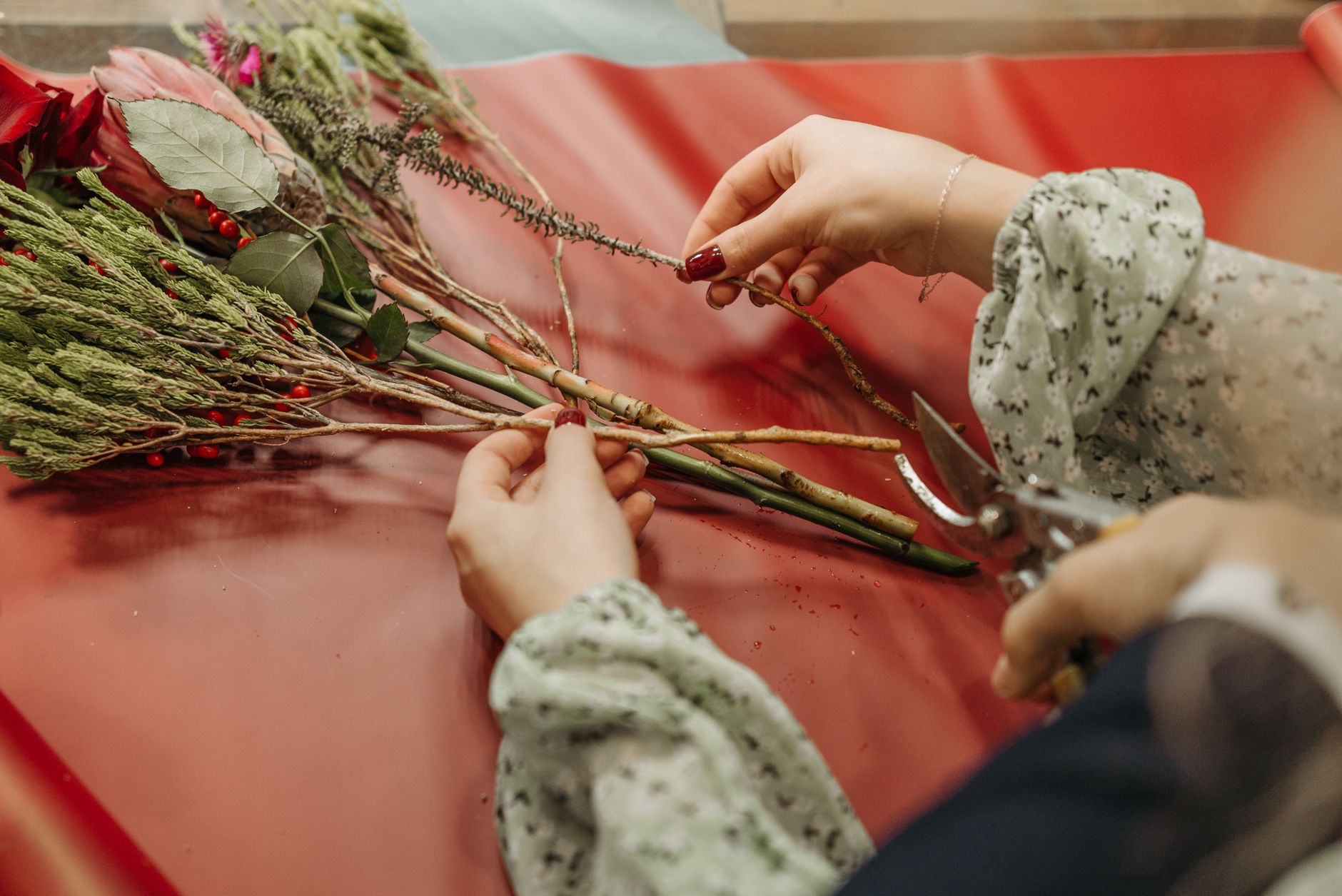
Our beginner bouquet making classes at Vietnam Flower Workshop by Hoa Lang Thang run for two hours and cover conditioning (removing lower leaves, cutting at 45°), the spiral hand-tie technique (building a dome from the center outward), and color theory basics so your arrangement doesn't clash. We supply fresh imported and local flowers; you work one-on-one or in a small group, guided step-by-step. The class suits travelers, expats, couples, teams, and anyone curious about floristry with no prior experience needed. You take your finished bouquet home immediately—it survives the Hanoi and Ho Chi Minh City heat because we teach you water-absorption tricks and how to wrap tightly to lock moisture in. Availability is confirmed on WhatsApp; ask us for a quote. Ask for workshop dates on WhatsApp
What do beginners struggle with most?
Most beginners grip the stems too tight, crushing the vascular system and blocking water uptake—the bouquet wilts within a day. They also misjudge spiral angle, creating gaps instead of a tight dome. We teach a relaxed hand position: thumb and forefinger anchor the base spiral; other fingers guide in stems at 45° without squeezing. One honest observation: people often add too many stems and create a heavy, floppy mass. We show restraint by counting—typically 15–25 stems for a hand-tied bouquet, depending on stem thickness—so the spiral stays compact and stands upright.
The heat in our cities (30–35°C in summer) is a real threat. Thin-stemmed flowers like solidago wilt fast if wrapped poorly. During the class, we demonstrate wrapping technique: spiral the kraft paper or tissue tight around the stem bundle, fold the top inward, and secure with twine or ribbon low enough that it doesn't cut off the water-absorption zone at the stem base.

Which flowers survive the Hanoi and Ho Chi Minh City heat best?
Roses, carnations, and chrysanthemums hold up longest—their woody stems and waxy petals resist dehydration. Hypericum berries and eucalyptus foliage stay crisp for days. Thin-stemmed flowers like lisianthus, sweet peas, and sunflowers wilt faster unless kept in deep water and wrapped immediately after arrangement.
In our classes, we explain water pathway: thick stems have more vascular tissue and recover faster from the shock of cutting than delicate ones. We also teach a conditioning trick: place the bouquet in a cool, shaded spot (not in direct sun or near air-conditioner vents that dehydrate rapidly) and recut the stems at 45° every two days. At home, change the water every other day and top up daily. We've observed that bouquets made with local seasonal flowers (lotus in summer, chrysanthemums in autumn) last longer than imported varieties because they're already acclimated to the local climate—something most beginner classes don't mention.
How do we adapt the class for kids or large groups?
For children under 10, we simplify the spiral: they work with shorter stems, thicker flowers (like gerberas and sunflowers), and fewer stems (8–12) so they build confidence quickly without frustration. We also let them choose colors freely—creativity matters more than rules. Teens and adult groups work the full technique but in teams or pairs, which keeps energy high and cost per person lower.
Rainy days change nothing. Our workshops run indoors with climate control, so humidity spikes don't affect the class—though we remind participants that high humidity outdoors slows water evaporation, so bouquets last slightly longer after a rain. For large groups (8+ people), we stagger start times or run back-to-back sessions so everyone gets hands-on attention and access to the flowers without crowding the workspace.
Book a kids' or group session on WhatsApp
What's the step-by-step spiral hand-tie technique?
Step 1: Prep the focal flower (1 min). Hold a large rose or focal stem at eye level, stem pointing toward you at a 45° angle. This sets the dome height.
Step 2: Add structural flowers (3 min). Layer shorter stems (hypericum, solidago, or small roses) around the focal stem, turning the bundle slightly with each addition so stems fan outward. Grip firmly but without crushing—aim for "confident, not clenched."
Step 3: Build the spiral (5 min). Continue adding stems in the same turning motion. Each new stem sits on top of the previous layer, creating a spiral that rises and rotates. Stems should cross and rest on the central bundle—not float loose.
Step 4: Check the dome (2 min). Hold the bundle at the binding point (5 cm from the stem base) and look from above. The flower heads should form a gentle dome or sphere. If gaps show, add filler or small stems into the holes.
Step 5: Tie and wrap (4 min). Secure the spiral tightly with florist twine 5 cm from the base—do not cut into the water-absorption zone. Wrap the stem bundle with kraft paper, overlapping it as you spiral down to the base. Fold the top edge inward neatly and secure with twine or ribbon.
Step 6: Hydrate (2 min). Place the bouquet immediately in deep, cool water so stems drink fully before you leave the class.
Try this at home with any flowers: the key is consistent turning and a relaxed grip. Practice with grocery-store blooms first.

How do beginner bouquets compare to advanced designs?
| Aspect | Beginner Bouquet | Advanced Design | Why the difference? |
|---|---|---|---|
| Stem count | 15–25 | 30–50+ | More density and layering depth |
| Height-to-width ratio | 1:1 (compact sphere) | Variable (tall, asymmetric, or trailing) | Beginners learn control first |
| Flower types | 2–3 varieties max | 5–7 varieties, mixed textures | Complexity builds as technique improves |
| Binding technique | Single hand-tie spiral | Multiple tie points, arching stems, filler pockets | Advanced = finer spatial awareness |
| Wrap finish | Kraft paper + simple ribbon | Floral foam, oasis, cascading ribbon, sealed leaf backings | Beginners skip structural elements |
| Wilting risk (day 3) | Low if rules followed | Medium (more surface area to hydrate) | Simpler = easier water management |
| Class length | 2 hours | 3–4 hours (deeper technique, design theory) | Foundational vs. applied skills |
Beginner classes focus on the spiral because it's portable, works with any flower type, and teaches core discipline. Advanced floral design courses introduce foam work, asymmetric structures, and color psychology for events or professional projects.
What to check before you book a beginner class
- Flower quality: Ask on WhatsApp what varieties are in stock this week. Imported roses, spray roses, and carnations are usually available; seasonal local flowers like lotus rotate monthly.
- Group size: Confirm how many people will be in your session. Smaller groups (2–4) allow more one-on-one feedback; larger groups share energy and cost per person is lower.
- Workshop location: We operate in Hanoi and Ho Chi Minh City only. Confirm the exact address on WhatsApp and allow time for traffic (30–45 min typical in rush hours).
- What you take home: Your finished bouquet goes home in your hands immediately. Bring a bag or ask us for wrapping. It will last 5–7 days if you follow our care tips.
- Allergies or accessibility: Let us know about pollen sensitivity or mobility needs when you book so we adapt the experience.
- Rainy-day planning: Classes run indoors regardless of weather. No rescheduling needed.
Learn more about our flower classes
We also offer private and couple sessions for anniversaries or proposals, team building workshops for companies, and seasonal bouquet classes for Tet, Christmas, or lotus arrangements. If you prefer a longer journey, our floral design course runs over multiple weeks and covers business fundamentals, color theory, and design history. For travelers short on time, our flower workshop for travelers condenses key techniques into a single session.
All classes include flowers, tools, and expert guidance. We reply as soon as we can on WhatsApp to confirm dates and answer questions.
️ See how a class runs | Ask for workshop dates on WhatsApp
FAQ
Do I need any experience or training before I attend?
No. Our beginner class is designed for absolute first-timers—we teach every step from stem conditioning to wrapping. You'll learn basic spiral technique and leave with a finished bouquet the same day.
What happens if I crush a stem or make a mistake during the class?
Mistakes are part of learning. We have extra flowers on hand and encourage you to try again. The class is hands-on; we guide but don't judge.
Can I attend with a friend or partner?
Yes. We run group classes and also offer private and couple sessions if you'd like a more intimate or personalized experience. Ask us for a quote on WhatsApp.
How long will my bouquet last at home after the class?
5–7 days if you change the water every other day, recut stems at 45° every two days, and keep it out of direct sun. We teach you this care routine during class. Heat and low water are the main killers in our climate.
What if the workshop is full or dates don't suit me?
We reply as soon as we can on WhatsApp to suggest alternative times or seasonal workshops tailored to your schedule. We also offer flower box and basket classes if hand-tied bouquets aren't what you're after right now.
Do you deliver bouquets made during class, or do I take them with me?
You take your arrangement home immediately in your hands or bag. We deliver same-day bouquets in Hanoi and Ho Chi Minh City for separate orders—ask us for details on WhatsApp.
Ask for dates
Tell us the city, the date and how many people. We reply on WhatsApp in English with workshop options and a quote.
FAQ
Do I need any experience or training before I attend?
No. Our beginner class is designed for absolute first-timers—we teach every step from stem conditioning to wrapping. You'll learn basic spiral technique and leave with a finished bouquet the same day.
What happens if I crush a stem or make a mistake during the class?
Mistakes are part of learning. We have extra flowers on hand and encourage you to try again. The class is hands-on; we guide but don't judge.
Can I attend with a friend or partner?
Yes. We run group classes and also offer [private and couple sessions](/private-and-couples) if you'd like a more intimate or personalized experience. Ask us for a quote on WhatsApp.
How long will my bouquet last at home after the class?
5–7 days if you change the water every other day, recut stems at 45° every two days, and keep it out of direct sun. We teach you this care routine during class. Heat and low water are the main killers in our climate.
What if the workshop is full or dates don't suit me?
We reply as soon as we can on WhatsApp to suggest alternative times or [seasonal workshops](/seasonal) tailored to your schedule. We also offer [flower box and basket classes](/flower-box-and-basket) if hand-tied bouquets aren't what you're after right now.
Do you deliver bouquets made during class, or do I take them with me?
You take your arrangement home immediately in your hands or bag. We deliver same-day bouquets in Hanoi and Ho Chi Minh City for separate orders—ask us for details on WhatsApp.
More like this
Bouquet workshop
Hand Tied Bouquet Workshop: What to Wear & Why It Matters
Flower arranging is a tactile, messy craft—your outfit shapes your comfort and confidence. We share what our students actually wear and why certain fabrics and shoes fail in tropical humidity.
Bouquet workshop
Hand-Tied Bouquet Workshop: A Rainy Day Activity in Hanoi & HCMC
Rain doesn't cancel a hands-on flower workshop—it makes it better. Our indoor hand-tied bouquet sessions turn wet afternoons into creative, keepsake moments across Hanoi and Ho Chi Minh City.
Bouquet workshop
Hand-Tied Bouquet Workshop in Ho Chi Minh City
A hand-tied bouquet workshop teaches you how to condition stems, build a spiral grip, and balance color in minutes—not hours of theory.