
Home › Blog › Vietnamese flower culture
Vietnamese Flower Culture: What to Gift, Learn & Arrange in 2026
By the Vietnam Flower Workshop team · 2026-11-06
Vietnamese flower culture centers on symbolism: chrysanthemums honor the dead, peach blossoms bring Tet luck, and yellow flowers suit funerals—never weddings. Red and gold dominate lunar new year; lotus represents purity year-round. At Vietnam Flower Workshop by Hoa Lang Thang in Hanoi and Ho Chi Minh City, we run hands-on sessions where you condition stems, learn spiral hand-ties, and take home your arrangement the same day. Beginners typically struggle with stem angle (too upright looks stiff) and water absorption in heat—we show you how to re-cut stems underwater and mist daily. Sessions range from 90-minute casual workshops for travelers to longer floral design courses. Cost varies by design type and group size; ask us for a quote on WhatsApp. Avoid gifting chrysanthemums for joy, yellow roses for apologies, or odd numbers for positive occasions—these read as mourning or bad luck in Vietnamese tradition.
What do flower colors mean in Vietnamese tradition?
Color symbolism shapes every bouquet and arrangement in Vietnam. Red and gold signal prosperity and luck—dominant at Tet and weddings. Pink and white convey respect and purity; use white for both celebrations and memorials (context matters). Yellow flowers belong at funerals and temples, never congratulations. Purple suggests admiration; orange signals enthusiasm. Green leaves symbolize renewal. A wrapped bouquet mixing red roses with gold ribbon and white chrysanthemums works for most Vietnamese celebrations; reverse it (yellow dominant) for remembrance. Our seasonal workshops teach color pairing tied to lunar calendar events—Tet arrangements differ entirely from mid-year or Christmas pieces. Always confirm intent with the gift recipient's family if unsure; flower meaning varies by region and generation.
Ask for workshop dates on WhatsApp
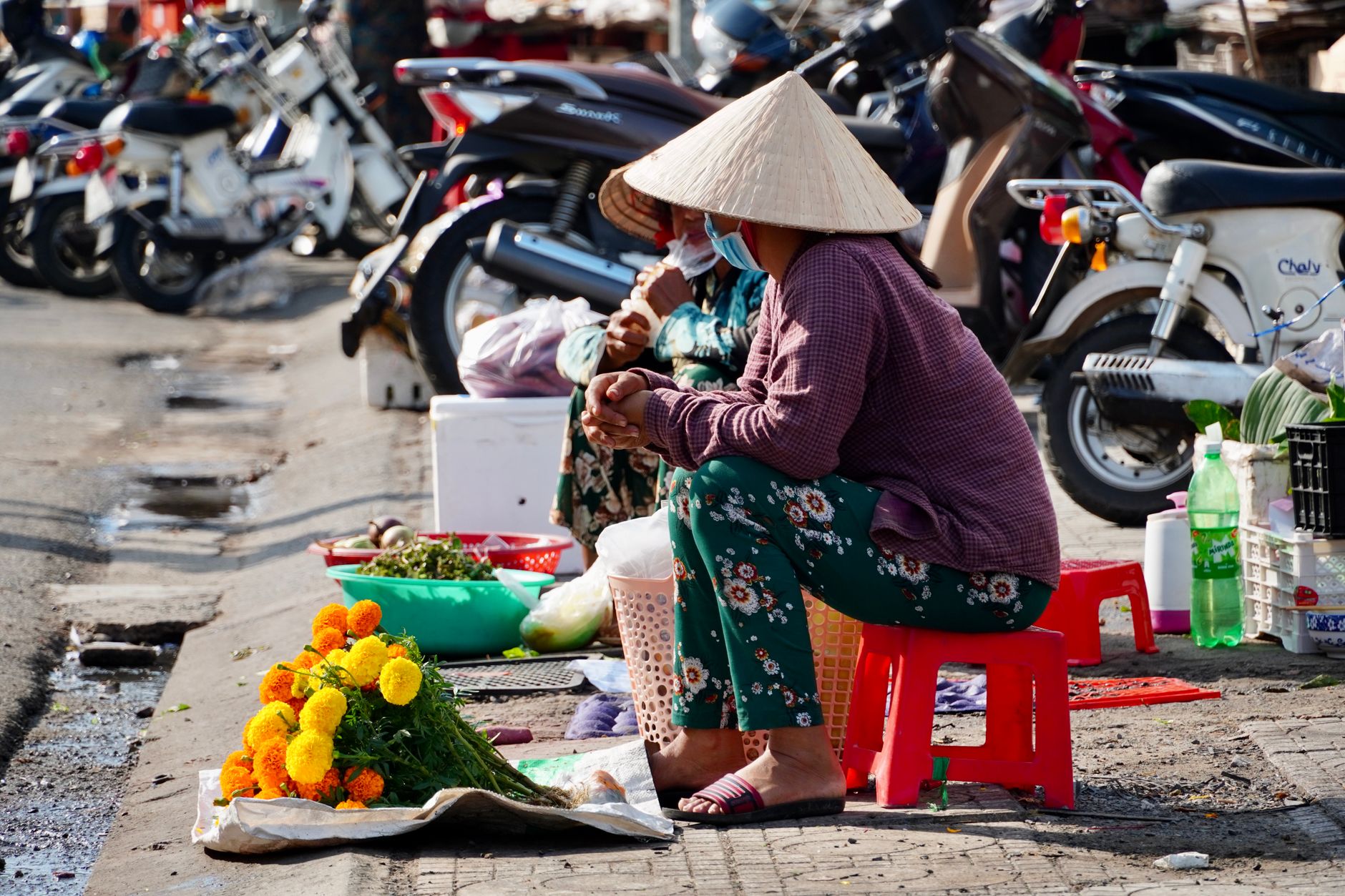
Which flowers survive the Hanoi and Ho Chi Minh City heat?
Tropical and semi-tropical blooms thrive in Vietnam's humidity and warmth; imported temperate flowers wilt fast without care. Orchids, chrysanthemums, carnations, and local roses last 5–10 days indoors with daily water-misting and stem re-cuts every two days. Imported sunflowers, peonies, and dahlias struggle after 3–4 days unless kept in air-conditioned rooms. Lotus, a sacred flower year-round, requires fresh water changes daily and survives best in shallow bowls. We condition all stems on a 45-degree angle underwater—this doubles water uptake in heat and delays wilting. Beginners often skip misting and wonder why blooms drop; the humidity outside tricks them into thinking water isn't needed indoors. In workshops, we show how to strip lower leaves (they rot and clog stems) and use flower food if you have it, though clean water alone works. For events or gifts, choose 70% local Vietnamese flowers and 30% imported hardy varieties—that mix lasts longest and costs less.
What's the difference between hand-tied bouquets and arranged boxes for gifting?
Hand-tied bouquets suit casual celebrations, apologies, and thank-yous: flowers spiral in your hand, stems visible, wrapped in kraft or silk paper, and placed straight in a vase—no filler needed. They read as personal and intimate. Arranged boxes suit formal events, corporate gifts, and occasions where presentation matters: flowers sit in foam, laid flat or tall, wrapped completely, arriving ready-to-display with no vase needed. Boxes cost 15–25% more due to packaging and delivery handling but require zero assembly. Here's when to pick each:
| Type | Best for | Setup time | Who it's for |
|---|---|---|---|
| Hand-tied | Casual, personal, thank-you | 5 min (strip, place in vase) | Friends, apologies, small groups |
| Arranged box | Weddings, corporate, formal | 0 min (display as-is) | Offices, events, multiple bouquets, premium feel |
| Seasonal wrapped | Tet, Christmas, lunar holidays | 10 min (refresh water, misting) | Family, cultural occasions, symbolic color |
Our bouquet-making workshop teaches spiral hand-tie technique—the flower spiral as you rotate it, staggering heights to create a dome shape. Most beginners' spirals look flat because they keep stems parallel instead of crossing them diagonally. Once you try it, hand-tied bouquets take 8–10 minutes per arrangement. For group events or hen parties, workshops for parties combine hand-tying with boxing or basket design in one session; everyone leaves with two arrangements and skills to repeat at home.
How do seasonal Vietnamese flowers shape what you should order?
Vietnam's flower calendar mirrors lunar traditions: Tet (Jan–Feb) spotlights peach blossoms, apricot sprigs, and chrysanthemums in red, gold, and white. Mid-Autumn (Sept–Oct) calls for lotus and local sunflowers. Christmas (imported) relies on poinsettias, evergreen, and red roses. Summer weddings lean on imported orchids and local roses. Spring funerals favor white chrysanthemums and lilies. Ordering a peach-blossom bouquet in June reads as culturally tone-deaf; a red-rose hand-tied in December works fine. We run seasonal design workshops that teach when each flower appears, how to style it, and what it signals. A five-stem lotus arrangement teaches water conditioning and minimalist design—very different from a dense Tet box with 30 stems. Availability shifts monthly; imported peonies vanish June–Aug. Local flowers cost 30–40% less but vary by season—ask us for a quote on WhatsApp with your desired date and style, and we'll confirm what's fresh and in stock.

What techniques should you learn as a beginner florist?
Three core techniques separate confident arrangers from frustrated ones: stem conditioning, spiral hand-tie, and color balance. Conditioning means cutting stems at 45° underwater (not on a board—air blocks water uptake), removing lower leaves, and using sharp pruners. Do this every two days for gifts that survive heat. Spiral hand-tie: hold one flower as anchor, rotate the bouquet counterclockwise, add stems diagonally across the center, never parallel—this creates density and a naturally balanced dome. Practice at home with six stems first; feel how the spiral tightens as you add each flower. Color balance: place your darkest or brightest color off-center (not dead middle), repeat it 2–3 times in the arrangement, and fill gaps with green or neutral tones. One-color bouquets (all red, all white) look flat; four colors with repeating hues create visual movement. In beginners' flower arranging classes, we watch every student's hand angle and height distribution; most struggle because they've never touched fresh flowers and fear waste—we work with 12–15 stems per arrangement, not 30, so mistakes become cheap lessons. After one two-hour session, you'll hand-tie a bouquet fast enough to gift it confidently.
Why join a workshop instead of just ordering arrangements?
Ordering arrangements gives you a finished product; a workshop gives you a skill that lasts years, confidence in gifting, and understanding of what you're buying. You learn why an arrangement costs what it does (labor, flower conditioning, design time, packaging), spot quality (healthy leaves, turgid stems, correct color balance), and adapt designs to your taste. Travelers often book workshops for travelers in Vietnam during a week-long stay; they gain a local cultural moment, take home a bouquet they made with their own hands, and understand Vietnamese floral symbolism before leaving. Couples book private and couple sessions as a date—relaxed, hands-on, no pressure, ending with two matching bouquets or complementary designs. Corporate teams book team building workshops to build connection while creating centerpieces for their office; everyone walks out with a design and a shared memory. Kids and families come during school holidays to learn colors, flower names, and arrangement joy in a safe, spray-bottle environment. None of this happens if you phone an order. Workshops cost more per person than a single bouquet but less than three gifts of similar size—and you leave as the florist, not the buyer.
Ask for workshop dates on WhatsApp
What should you check before booking a workshop or ordering a design?
Before committing, confirm these details with us on WhatsApp: (1) Date and preferred group size—we adapt session timing and flower selection to how many people attend. (2) Occasion and color intent—tell us if it's a thank-you (red, pink), condolence (white, yellow), celebration (red, gold), or just learning. This shapes what we stock and teach. (3) Heat and delivery reality—if you're gifting, confirm how long the recipient will keep it before water-refresh. Bouquets in air-conditioned offices last longer than outdoor event displays. (4) Budget clarity—ask us for a quote on WhatsApp; prices vary by flower type, arrangement size, and group size. We don't list prices online because seasonal availability and import costs shift monthly. (5) Allergies or flower preferences—some people dislike certain scents (strong lily, chrysanthemum pollen); tell us so we can substitute. (6) Photo consent—we may ask to photograph your finished work for our portfolio; say yes or no upfront. (7) Stem transport—wrapped bouquets stay fresh 6–8 hours in a cool bag; if you're traveling, we'll show you how to keep stems hydrated until you reach your destination. Never leave a bouquet in a hot car or direct sun.
Beyond workshops: arranging flowers at home
Here's one technique you can practice today: the beginner's grid hand-tie. Find six stems of similar height (or trim to 10 inches). Hold one upright as your center. Add the second at a 30° angle across the center, angling the base outward (not in). Add a third opposite the second. Now rotate your bouquet 45°, add a fourth stem at 30°, fifth opposite it, sixth to fill a gap. Your stems should cross below the flower heads, forming an X or grid pattern. Tighten gently, trim all stems to the same length, and place in water. This mimics spiral technique without the rotation—perfect for learning height variation and stem angle. Most florists build from this grid; it's how flower box and basket classes begin, since baskets use the same principle (a grid of stems in foam instead of your hand).
Learn more about Vietnamese flower culture and market tours if you'd like to explore where flowers come from and meet local growers.

FAQ
What flowers should never go in a Vietnamese funeral arrangement?
Red flowers, bright pink, and odd numbers are forbidden at funerals—they signal joy and luck, which disrespect the deceased. Stick to white, yellow, and purple chrysanthemums in even numbers (usually 2, 4, or 6 stems). Ask the family if unsure; traditions vary by region and family belief.
How long does a hand-tied bouquet last in Hanoi's summer heat?
5–8 days indoors with daily misting and stem re-cuts every two days. Outdoors or in direct sun, blooms wilt within 24 hours. Tropical flowers (orchids, anthuriums) outlast imported roses and peonies in the heat.
Can I learn flower arranging if I've never done it before?
Absolutely. We teach beginners in every class; no experience needed. Most people hand-tie a basic bouquet within an hour. The hardest part is trusting stem angle, not technique—we show you exactly where to hold and angle each flower.
What's the price difference between a workshop and ordering a single arrangement?
Ask us for a quote on WhatsApp—prices vary by flower type, season, and group size. Workshops cost per person and include instruction and materials; single arrangements are priced per design. A workshop often costs less per bouquet if you're arranging 2–3 pieces during the session.
Why do my bouquets wilt after two days even when I water them?
Likely causes: stems not re-cut underwater, lower leaves left on (they rot and block water), or tap water sitting too long. Cut stems at 45° under running water, strip all leaves below the waterline, change water daily, and add flower food if you have it. Mist the blooms too—Vietnamese heat dries flowers from all sides, not just the vase.
When should I order flowers instead of making them myself?
Order for events where you're also a guest (weddings, parties, corporate meetings), when presentation in a box matters more than personal touch, or when you need 10+ arrangements in one day. For learning, gifting, and occasions where your hands matter, make them in a workshop or at home once you've learned technique.
How do I know if a flower is fresh when I receive a bouquet?
Petals should feel firm and turgid (slightly waxy), not papery or bruised. Leaves should be green, not yellowed or wilted. Stems should resist a fingernail scratch (live, green inside); brown or hollow stems mean age or poor handling. Open one bloom halfway to check petal layers inside—they should be tightly packed and pale, not brown-edged.
Can I mix imported and local Vietnamese flowers in one arrangement?
Yes. Combining 70% local (cheaper, fresher, seasonal) with 30% imported (shape, color accent) creates beauty and longevity while managing cost. Local chrysanthemums, roses, and orchids pair well with imported peonies, tulips, or eucalyptus greenery. Ask us for a quote on WhatsApp if you want a specific mix.
Ask for dates
Tell us the city, the date and how many people. We reply on WhatsApp in English with workshop options and a quote.
FAQ
What flowers should never go in a Vietnamese funeral arrangement?
Red flowers, bright pink, and odd numbers are forbidden at funerals—they signal joy and luck, which disrespect the deceased. Stick to white, yellow, and purple chrysanthemums in even numbers (usually 2, 4, or 6 stems). Ask the family if unsure; traditions vary by region and family belief.
How long does a hand-tied bouquet last in Hanoi's summer heat?
5–8 days indoors with daily misting and stem re-cuts every two days. Outdoors or in direct sun, blooms wilt within 24 hours. Tropical flowers (orchids, anthuriums) outlast imported roses and peonies in the heat.
Can I learn flower arranging if I've never done it before?
Absolutely. We teach beginners in every class; no experience needed. Most people hand-tie a basic bouquet within an hour. The hardest part is trusting stem angle, not technique—we show you exactly where to hold and angle each flower.
What's the price difference between a workshop and ordering a single arrangement?
Ask us for a quote on WhatsApp—prices vary by flower type, season, and group size. Workshops cost per person and include instruction and materials; single arrangements are priced per design. A workshop often costs less per bouquet if you're arranging 2–3 pieces during the session.
Why do my bouquets wilt after two days even when I water them?
Likely causes: stems not re-cut underwater, lower leaves left on (they rot and block water), or tap water sitting too long. Cut stems at 45° under running water, strip all leaves below the waterline, change water daily, and add flower food if you have it. Mist the blooms too—Vietnamese heat dries flowers from all sides, not just the vase.
When should I order flowers instead of making them myself?
Order for events where you're also a guest (weddings, parties, corporate meetings), when presentation in a box matters more than personal touch, or when you need 10+ arrangements in one day. For learning, gifting, and occasions where your hands matter, make them in a workshop or at home once you've learned technique.
How do I know if a flower is fresh when I receive a bouquet?
Petals should feel firm and turgid (slightly waxy), not papery or bruised. Leaves should be green, not yellowed or wilted. Stems should resist a fingernail scratch (live, green inside); brown or hollow stems mean age or poor handling. Open one bloom halfway to check petal layers inside—they should be tightly packed and pale, not brown-edged.
Can I mix imported and local Vietnamese flowers in one arrangement?
Yes. Combining 70% local (cheaper, fresher, seasonal) with 30% imported (shape, color accent) creates beauty and longevity while managing cost. Local chrysanthemums, roses, and orchids pair well with imported peonies, tulips, or eucalyptus greenery. Ask us for a quote on WhatsApp if you want a specific mix.
More like this
Vietnamese flower culture
Vietnamese Flower Culture: What to Expect at a Hanoi Workshop
Vietnamese flower culture weaves ancient ritual, seasonal respect, and everyday beauty into a living practice that shapes how people celebrate, mourn, and connect. A workshop in Hanoi or Ho Chi Minh City reveals this firsthand—not as theory, but as skill you can use at home.
Vietnamese flower culture
Vietnamese Flower Culture for Beginners: What to Know
Vietnamese flower culture blends Buddhist symbolism, Lunar New Year tradition, and French colonial influence into a distinct aesthetic that beginners can learn through hands-on practice and market immersion.
Vietnamese flower culture
Vietnamese Flower Culture: Workshops & Traditions in Hanoi & HCMC
Vietnamese flower culture weaves centuries of symbolism—lotus for purity, chrysanthemums for longevity—into celebrations and daily life. We teach this living heritage through arranging workshops where travelers and expats craft authentic pieces using imported and local blooms.