
Home › Blog › Vietnamese flower culture
Vietnamese Flower Culture for Beginners: What to Know
By the Vietnam Flower Workshop team · 2026-11-06
Vietnamese flower culture draws from centuries of Buddhist temple offerings, Tet (Lunar New Year) symbolism, and French colonial floral design. Yellow chrysanthemums signal fortune; pink peonies represent prosperity and romance; orchids embody elegance and strength. At Vietnam Flower Workshop by Hoa Lang Thang in Hanoi and Ho Chi Minh City, beginners learn conditioning, spiral hand-ties, and color balance through real flowers they take home. Our workshops run as live, practical sessions where you handle imported and local blooms in climate-controlled spaces—essential in Vietnam's heat. Sessions suit travelers, expats, couples, and families; we adapt pacing and flower choices to your experience level. No prior knowledge is needed. Cost varies by workshop type; ask us for a quote on WhatsApp before booking. What to avoid: assuming dried arrangements work like fresh ones, or choosing flowers without learning their symbolism—both lead to cultural mismatches or fast wilting in humid conditions.
What symbols do Vietnamese flowers carry?
Flower choice in Vietnamese tradition is never random—each bloom carries spiritual or social weight rooted in Buddhist practices and folk beliefs. Red roses mean passionate love; white flowers honor ancestors at funerals and temples; chrysanthemums (especially golden ones) wish good fortune and joy. Orchids represent refinement and were prized in royal gardens. Peonies symbolize wealth and a happy marriage. Lotus flowers, sacred in Buddhism, appear in temple arrangements and spring workshops because they bloom during Tet season. Understanding these meanings shapes how you design gifts or home pieces. Beginners often skip this step and accidentally create arrangements that feel "off" to Vietnamese eyes—not because the technique is poor, but because the symbolism clashes. When you learn flower culture properly, your work gains cultural depth that technical skill alone cannot teach.
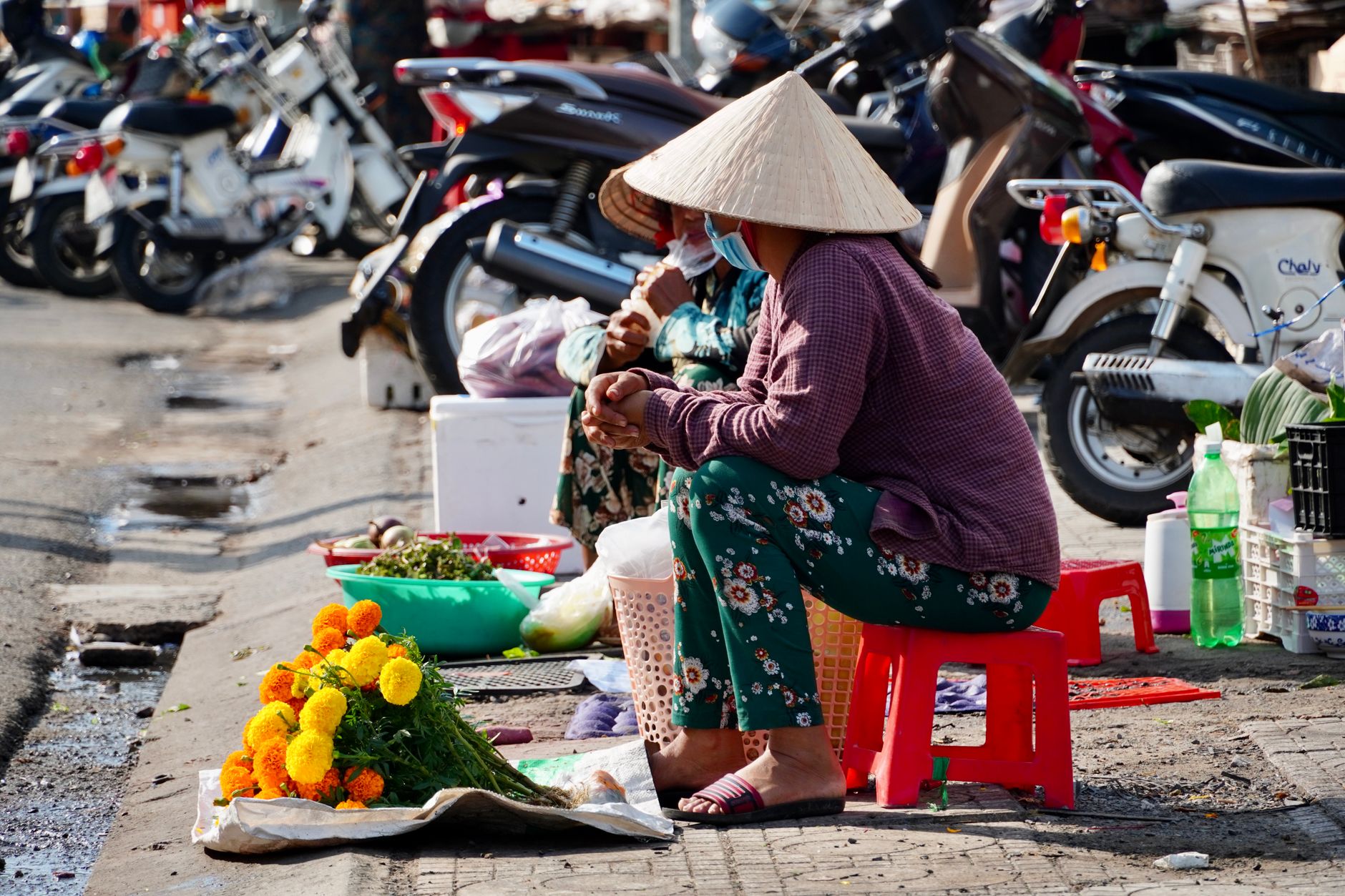
How does Vietnam's heat affect cut flowers?
Hanoi and Ho Chi Minh City both see temperatures above 30°C (86°F) for much of the year, with humidity often 70–90%. Cut flowers wilt fast in these conditions because water evaporates from stems and petals more quickly than in temperate climates. We condition every stem by cutting at a 45-degree angle, removing lower leaves (which rot in water), and using flower food to extend vase life. In our workshop spaces, air conditioning keeps blooms fresh during the session; at home, you'll need to mist daily, change water every two days, and keep arrangements away from direct sun and heat sources. Imported roses and peonies survive 5–7 days indoors with care; local chrysanthemums last 10–14 days. Many beginners don't realize the water supply matters: tap water in Hanoi and Ho Chi Minh City often contains chlorine and sediment that clogs stems. Using filtered or boiled-then-cooled water adds 2–3 extra days to vase life. The heat itself is not your enemy if you respect these rules from day one.
What's the difference between Tet and everyday arrangements?
Tet arrangements follow strict visual rules: vertical height (symbolizing growth toward heaven), use of peach or apricot branches (prosperity and renewal), and inclusion of lucky flowers like golden chrysanthemums or peonies. Everyday arrangements in Vietnamese homes tend toward softer, symmetrical shapes—often in low bowls on family altars or side tables. Tet pieces are bolder, taller, and meant to dominate a room. Commercial florists in Hanoi and Ho Chi Minh City shift their entire stock in late January to stock branches and rare blooms for the lunar holiday. Our seasonal workshops teach you to build a Tet arrangement from scratch—selecting the right branch, conditioning it (which takes longer than roses), and balancing weight so the piece doesn't topple. A beginner Tet arrangement typically takes 45–60 minutes to complete, versus 20–30 minutes for a casual bouquet. The cultural payoff is enormous: a handmade Tet piece gifted to family or friends carries meaning that a store-bought one cannot match.
Ask for workshop dates on WhatsApp
Which flowers should beginners start with?
| Flower | Why it works | Vase life | Difficulty | Best for |
|---|---|---|---|---|
| Chrysanthemum | Forgiving stems, holds shape, symbolic fortune | 10–14 days | Easy | First arrangement, Tet pieces |
| Rose | Classic, teaches spiral technique, many colors | 5–7 days | Medium | Bouquets, romantic gifts |
| Carnation | Cheap, sturdy, teaches layering | 7–10 days | Easy | Bulk arrangements, practice |
| Orchid | Local availability, long vase life, elegant | 14–21 days | Medium | Single-stem displays, luxury feel |
| Peony | Teaches heavy-stem conditioning, seasonal | 5–10 days | Hard | Tet season, special occasions |
Chrysanthemums and carnations are forgiving: their stems don't bruise easily, they don't require complex conditioning, and they hold a spiral hand-tie for hours without slipping. Beginners often fail with roses because tight thorns catch the wrap and hand fatigue sets in; we teach grip and technique in bouquet-making workshops to solve this. Peonies teach you the hardest skill—managing a heavy, woody stem that must be cut, split, and arranged at the exact angle to avoid tipping the vase. Local florists in Hanoi and Ho Chi Minh City source chrysanthemums and carnations daily; orchids appear year-round; peonies arrive in spring and peak before Tet. Starting with chrysanthemums lets you focus on color balance and wrapping; by your second or third session, you're ready for roses or orchids. Many travelers book a flower workshop for those visiting and start with chrysanthemums because the emotional payoff is instant—you leave with a beautiful, culturally grounded piece that survives the flight home.

How do professionals teach this in a group setting?
Our hands-on workshops in Hanoi and Ho Chi Minh City begin with 10–15 minutes of theory: flower symbolism, what makes a stem drink water, why colors matter. Then we move to conditioning—we demonstrate cutting technique, leaf removal, and stem splitting on three blooms while you watch. Next, each participant receives their own flowers (real imported or local blooms, not practice material) and works through the same steps with us circulating to adjust grip, angle, and pressure. A spiral hand-tie teaches spiral wrapping—the florist's core skill—by having you hold the stem at 45 degrees, add flowers in a rotating pattern, and bind tightly without crushing petals. Color balance is taught by showing how warm colors (red, orange, pink) advance visually while cool colors (blue, purple) recede; we ask you to build an arrangement and then move one flower to see the difference. Kids and families learn the same techniques but with shorter sessions (30–40 minutes) and easier flowers like carnations; we also accept groups for team building workshops where mixed-skill groups compete to build the best piece. Rainy days (common in both cities) don't slow us down—our workshop spaces are indoors and climate-controlled. What often trips up beginners: holding too tightly (crushing stems), cutting at the wrong angle (water won't travel up), and adding flowers in straight lines instead of rotating positions. We catch these live and correct them immediately, so you leave knowing how to avoid them at home.
Book a private or couple session
Can children and families really learn this?
Yes, but with real adjustments. Children under 8 struggle with fine motor control and stem scissors safety; we use child-safe tools and pair them with an adult. Kids aged 8–12 can learn conditioning and simple layering in 30–40 minutes; they often excel at color mixing because they're less self-conscious about bold choices. Families book kids and family workshops for 2–4 people and typically work on one large piece together or each create a small arrangement. We avoid thorny roses with young children; instead, we use carnations, chrysanthemums, and local dahlias. Parents often discover their kids are more patient and detail-focused than expected—flower arranging is meditative and rewarding in ways that screens are not. The heat and humidity in Hanoi and Ho Chi Minh City mean we keep workshop spaces cool and offer water frequently. Families with no flower experience whatsoever start here and leave with both a finished piece and the confidence to try again at home. The cultural benefit is also real: children learn why their grandparents prefer certain flowers for Tet, making family traditions more meaningful. Many families who join once book again for birthdays or seasonal holidays.
What should you check before joining a workshop?
Before booking, confirm these details on WhatsApp:
- Workshop type: Are you joining a general class, a private couples session, or a specialized seasonal workshop? Each has different pacing and flower selections.
- Flower allergies or preferences: Tell us if you have pollen sensitivities or dislike certain blooms; we adapt flower choices.
- Language: We teach in English for travelers and expats; confirm this matches your need.
- What you take home: Every participant leaves with their finished arrangement. Check vase inclusion (it varies by workshop type).
- Rainy day plans: Workshops run indoors year-round, but confirm the exact location with us on WhatsApp.
- Group size expectations: Confirm how many people will attend so you're not surprised by class dynamics.
- Heat concerns: If you're not acclimated to Hanoi or Ho Chi Minh City heat, let us know; we provide water and cooler indoor spaces.
We reply as soon as we can on WhatsApp. Avoid assumptions about timing—we confirm exact dates and availability on a case-by-case basis. Also, do not assume your bouquet will survive a cross-country trip unchanged; we can advise on wrapping and conditioning techniques to maximize survival, but tropical heat and long transport are challenging. Ask specific questions; generic inquiries often miss critical details.
Why learn flower culture rather than just buy?
Buying a ready-made bouquet is fast; learning to make one changes how you see flowers forever. You understand why yellow chrysanthemums appear on Tet altars, why orchids cost more, and why a wilting rose often reflects poor conditioning rather than old age. You can gift something handmade and culturally grounded instead of something generic. Travelers and expats find that flower workshops unlock conversations with locals—vendors at the market, neighbors, family hosts—because you're now asking informed questions about blooms, not just admiring them. Many people book longer floral design courses after their first workshop because the skill becomes a creative outlet. In Hanoi and Ho Chi Minh City, where flower markets are dense with color and energy, learning to read and work with blooms transforms casual walks into treasure hunts. You also discover that Vietnamese flower aesthetics differ from Western ones: vertical lines, negative space, and symbolic color matter more than volume and roundness. This cultural lens enriches how you decorate your home or give gifts long after the workshop ends.

FAQ
Do I need any prior flower experience to join a workshop?
No. Beginners start with easy flowers and basic conditioning; we teach grip, cutting angle, and spiral technique from zero. Every skill is demonstrated live and corrected as you work.
What happens if a flower breaks or my arrangement doesn't look "perfect"?
Flower arranging is a craft, not a formula. We teach you technique and principles; your personal style emerges as you practice. Broken stems are part of learning—we always have extras on hand.
How long do the arrangements you make in class actually last at home?
With daily misting, water changes every 2 days, and placement away from direct sun, arrangements last 7–14 days depending on flower type. Chrysanthemums last longer than roses. Humidity in Hanoi and Ho Chi Minh City speeds wilting, so fresh water is critical.
Can I book a workshop for a special event like a hen party or birthday?
Yes. We offer birthday and hen party workshops tailored to group dynamics and skill levels. We also teach team-building sessions. Ask us on WhatsApp for date and group size details.
Are the flowers you use imported or local?
Both. We use real imported roses, peonies, and specialty blooms alongside locally sourced chrysanthemums, orchids, and seasonal branches. We never use artificial or practice flowers in any session.
What if I'm visiting Hanoi or Ho Chi Minh City only briefly?
Our flower workshop for travelers runs flexible sessions; we reply as soon as we can on WhatsApp to find dates that fit your itinerary. You leave with a finished arrangement wrapped for travel. --- Ask for workshop dates on WhatsApp Learn more about Vietnamese flower culture and markets to deepen your practice beyond the workshop.
Ask for dates
Tell us the city, the date and how many people. We reply on WhatsApp in English with workshop options and a quote.
FAQ
Do I need any prior flower experience to join a workshop?
No. Beginners start with easy flowers and basic conditioning; we teach grip, cutting angle, and spiral technique from zero. Every skill is demonstrated live and corrected as you work.
What happens if a flower breaks or my arrangement doesn't look "perfect"?
Flower arranging is a craft, not a formula. We teach you technique and principles; your personal style emerges as you practice. Broken stems are part of learning—we always have extras on hand.
How long do the arrangements you make in class actually last at home?
With daily misting, water changes every 2 days, and placement away from direct sun, arrangements last 7–14 days depending on flower type. Chrysanthemums last longer than roses. Humidity in Hanoi and Ho Chi Minh City speeds wilting, so fresh water is critical.
Can I book a workshop for a special event like a hen party or birthday?
Yes. We offer [birthday and hen party workshops](/parties) tailored to group dynamics and skill levels. We also teach [team-building sessions](/team-building). Ask us on WhatsApp for date and group size details.
Are the flowers you use imported or local?
Both. We use real imported roses, peonies, and specialty blooms alongside locally sourced chrysanthemums, orchids, and seasonal branches. We never use artificial or practice flowers in any session.
What if I'm visiting Hanoi or Ho Chi Minh City only briefly?
Our [flower workshop for travelers](/tourist-workshop) runs flexible sessions; we reply as soon as we can on WhatsApp to find dates that fit your itinerary. You leave with a finished arrangement wrapped for travel. --- [🌸 Ask for workshop dates on WhatsApp](https://wa.me/84969293894) Learn more about [Vietnamese flower culture and markets](/vietnamese-flower-culture) to deepen your practice beyond the workshop.
More like this
Vietnamese flower culture
Cultural Workshops Saigon: Flower Classes & Team Building
Saigon's cultural workshop scene includes flower arranging, hand-tied bouquets, and team-building sessions taught in English by real florists. We run sessions for tourists, expats, families, and corporate groups year-round, adapting to the tropical heat and rainy season.
Vietnamese flower culture
Vietnamese Flower Culture Near Saigon: Learn & Celebrate Locally
Vietnamese flower culture near Saigon is alive in daily altars, Tet celebrations, and family gatherings—and you can learn it directly through workshop experiences that connect you to local growers, techniques, and meanings.
Vietnamese flower culture
Vietnamese Flower Culture Near Ho Chi Minh City: Learn & Shop
Vietnamese flower culture thrives in Ho Chi Minh City through centuries-old markets, seasonal rituals, and now accessible workshops where travelers learn to arrange lotus, chrysanthemums, and tropical blooms like locals do.