
Home › Blog › Vietnamese flower culture
Vietnamese Flower Culture: What to Expect at a Hanoi Workshop
By the Vietnam Flower Workshop team · 2026-11-06
Vietnamese flower culture is a blend of spiritual reverence, seasonal awareness, and practical artistry rooted in Confucian, Buddhist, and folk traditions. Flowers mark every major life event: Tết, weddings, funerals, altar offerings, and daily table arrangements. At Vietnam Flower Workshop by Hoa Lang Thang, you experience this not as a museum display but through hands-on arranging in real conditions—tropical heat, local and imported blooms, the way families and businesses actually use flowers. A session teaches you conditioning stems for humidity, color balance reflecting luck and harmony, wrapping techniques that protect arrangements during delivery. You'll learn why certain flowers belong on altars, which colors suit which occasions, and how to adapt designs when rain or heat threatens. Beginners typically struggle with spiral hand-ties in warm air, but practice here means you leave with an arrangement you made yourself, rooted in genuine Vietnamese practice, not borrowed Western style. ️ See how a class runs
What role do flowers play in Vietnamese daily life?
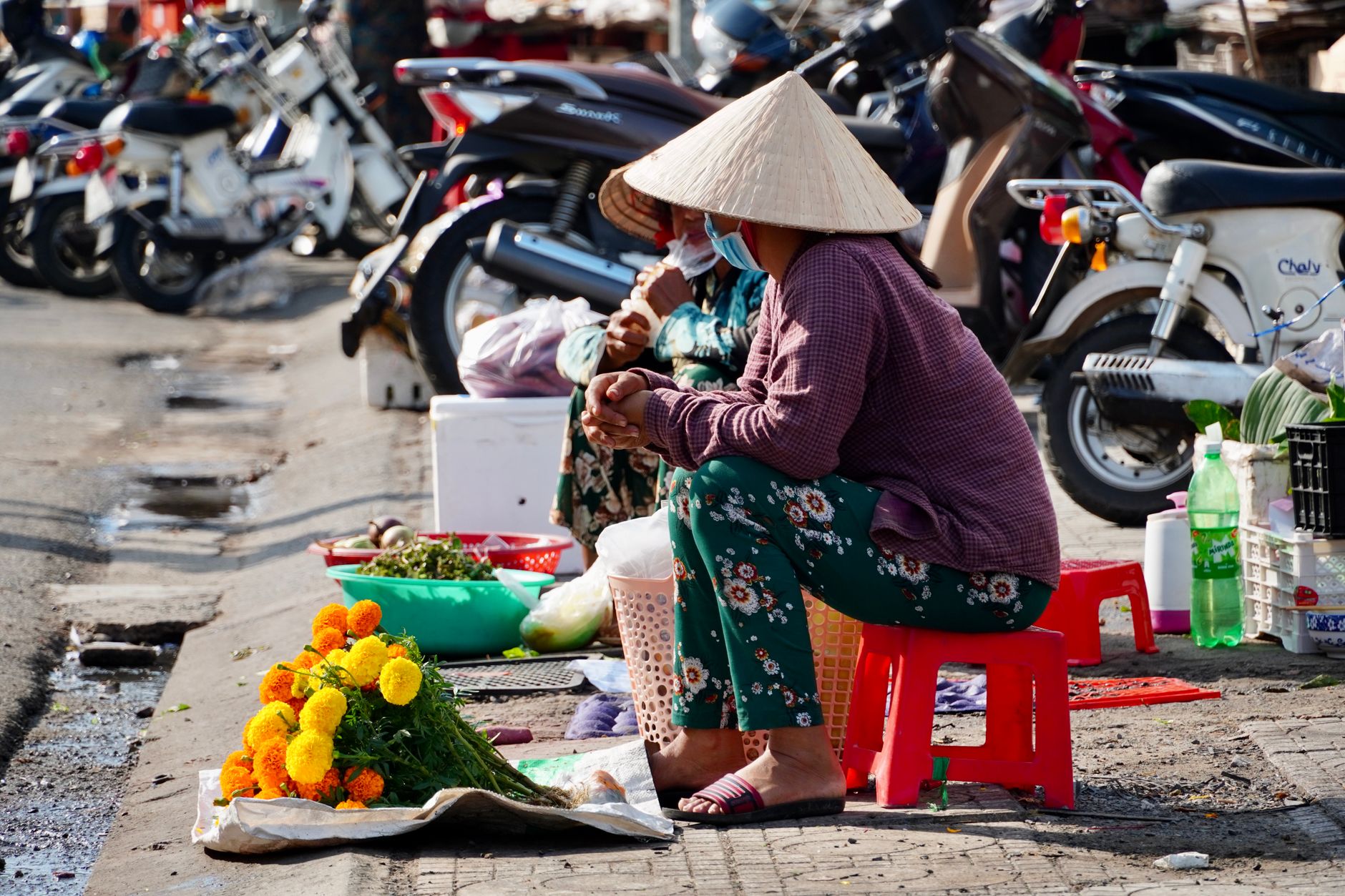
Flowers are not decoration in Vietnamese culture—they are communication. Fresh flowers on ancestral altars show respect and keep spiritual connection alive; bouquets at weddings announce joy and family unity; white and yellow chrysanthemums at funerals convey grief and honor. In offices, homes, and shops, a vase signals care and prosperity. During Tết, specific flowers like kumquat, peach blossoms, and marigolds carry wishes for wealth and luck. A single flower arrangement can tell someone you remember them, or mark a season, or ask forgiveness. This is why learning to arrange flowers here feels different: every choice—stem length, color pairing, container choice—carries cultural weight, not just aesthetic preference.
Which flowers matter most in Vietnamese tradition?
Chrysanthemums dominate Vietnamese life because they suit all occasions. White and yellow chrysanthemums appear at funerals; red and pink at celebrations. Peonies symbolize wealth and romance; roses signal deep respect or love; orchids show elegance and longevity; lotus is sacred in Buddhism, representing purity rising from mud. Sunflowers bring joy; tuberose carries strong fragrance for altar offerings. Each region and season shifts the palette slightly, and imported flowers now blend with local stems. In our bouquet-making workshop, you work with both—learning when local blooms serve better (fresher, cheaper, culturally rooted) and when imported varieties add special impact. Beginners often over-rely on roses; here we teach you why a mixed chrysanthemum bundle sometimes says more.
Ask for workshop dates on WhatsApp
How does Vietnamese weather change what you can arrange?
Heat and humidity are not obstacles in Vietnamese flower work—they are the baseline. Your arrangement must survive in a warm room without daily water access, or travel in a motorbike taxi, or sit under a shop light for hours. This is why conditioning is non-negotiable: you strip lower leaves, cut stems at 45 degrees, use floral food, and choose flowers that hold up. Chrysanthemums, celosia, and carnations last longer than peonies or gardenias in heat; tropical varieties like heliconia and anthurium thrive here. In a private or couple session, you'll practice wrapping that breathes—not plastic, which traps condensation—and learn water-retention tricks specific to tropical conditions. Rain shifts everything: wet flowers bruise easily, so timing delivery becomes crucial. We adapt by teaching you to check weather, condition stems deeper when storms loom, and choose sturdier varieties for monsoon seasons.
| Scenario | Local Flowers | Imported Flowers | Conditioning Focus | Heat Survival |
|---|---|---|---|---|
| Funeral, no AC | White chrysanthemum | White rose | Strip leaves, 2–3 hrs in water | 4–6 hours |
| Wedding table, air-con | Peony, orchid mix | Imported peach blossom | Float stems, ice pack backup | 6+ hours |
| Altar, daily refill | Local rose, celosia | Imported carnation | Morning cut, water vial daily | All day |
| Rainy delivery | Celosia, anthurium | Anthurium hybrid | Wrap tight, drip-dry paper | 2–3 hours |
| Gift bouquet, warm office | Mixed chrysanthemum | Imported garden rose | Food + glycerin stem wrap | 3–5 days if watered |
When should you book a workshop to learn this properly?
Timing matters because seasons shape what's available and what workshops run. Tết workshops (late January–early February) fill fastest: you learn symbolic arrangements, red-and-gold color theory, and altar design. Spring (March–April) brings fresh blooms and outdoor sessions. Summer (May–August) means intense heat, so we focus on conditioning and wrapping technique—fewer tourists, slower pace. Autumn (September–November) is ideal for first-timers: temperature drops, flowers hold longer, your mistakes forgive more easily. Winter (December–January) suits Christmas wreath and holiday design classes. For team building workshops, companies often book October–November or choose rainy-day indoor classes in September. We reply as soon as we can on WhatsApp to confirm what's running. A kids and family session works year-round, but spring and autumn see more English-speaking groups because weather suits longer sessions outdoors.

How do you actually learn arranging here versus watching online?
Online tutorials show technique, but they don't teach you feel. In person, an instructor shows you how a stem bends differently in humidity, why a spiral hand-tie collapses if you grip too tight, how to sense when floral foam is dry by weight. You make mistakes on real flowers while someone adjusts your hand. You learn to read a room's light and pick colors that work under fluorescent shop lights, not studio lighting. In a private and couples session, you spend unrushed time learning to match your partner's style, or designing for your specific home. In a floral design course, you revisit the same technique three or four times across weeks, building muscle memory. Group workshops teach speed and improvisation—you watch others solve problems differently. Kids pick up by doing, not explaining: a 10-year-old spirals stems faster than an adult because they don't overthink. The honest part: you'll feel clumsy first. In our hands-on sessions, that awkwardness is the learning. You leave with a real arrangement, not just knowledge.
Ask for workshop dates on WhatsApp
What should you check before booking your first session?
Venue access. We run sessions in Hanoi and Ho Chi Minh City only—in Hanoi near the Old Quarter, in Ho Chi Minh City in District 1 and surrounding areas (describe type: central workshop spaces with running water, tables, waste bins, flower coolers). Check that the address works for your location and transport time.
Flower type. Ask us on WhatsApp what's fresh that week. If you want peonies but they're expensive or wilted, we'll suggest alternatives. Some workshops use only imported flowers (looks glossy in photos, costs more). We blend local and imported—more authentic, better value, teaches you real choice-making.
Group size. Kids and family sessions run best at 4–8 people; larger groups get faster-paced demos. Hen and birthday parties scale to 10–15 easily. Solo travelers and couples suit our tourist workshop format—no rushed feel, language is English.
Rain. Tropical downpours happen. We have covered workspaces. If you're collecting flowers afterward, ask about rain-safe wrapping. Don't assume your bouquet survives an hour in a motorbike taxi without protection.
Time investment. A basic session is hands-on; a floral design course requires 4–6 week commitment. Seasonal workshops (Christmas wreaths, Tết altar design) are intensive single days. Be honest about your schedule.
️ See how a class runs
One technique you can try at home right now: the 45-degree cut.
Before you arrange, prepare your stems. Using sharp pruning shears (not scissors—they crush vascular tissues), cut the bottom of each stem at a 45-degree angle, not straight across. Why? The angle exposes more surface area to water, and the slant prevents the cut from sitting flat against a vase bottom, which blocks water uptake. In Vietnamese heat, this single step extends a bouquet's life by 24–48 hours. Strip any leaves below the waterline—they rot and cloud water. If your local florist delivers bouquets with straight cuts still wet, re-cut them at home. This is the non-negotiable first move in every professional arrangement. Practice it once and the difference is obvious.
What to expect when you arrive for a workshop.
You'll meet in a cool, wet room (cooler than the street). Flowers are already in buckets with water and floral food mixed in. An instructor greets you, assesses your confidence level with a casual question or two, and shows the day's design—maybe a hand-tied bouquet, a low arrangement, a box design. You spend 5–10 minutes on conditioning: learning the cut, the angle, the strip, the water vial fill. Then 30–40 minutes of hands-on arranging with instruction. You make mistakes, ask, adjust, finish. If it's not perfect, that's normal—commercial florists remake arrangements too. You wrap your piece or box it, and you leave with it the same day. For flower box and basket classes, you learn how to build foam structure and pack flowers tight for delivery stability. For seasonal workshops, the entire session builds one type: a Christmas wreath, a Tết arrangement, a lotus altar piece. No assembly-line rush; it's your design, your pace, your result.
Ask for workshop dates on WhatsApp

FAQ
Do I need experience to join a workshop?
No. Beginners are the norm. We teach from the ground up—conditioning, holding technique, color theory, spiral wraps. In one session, you'll arrange a real bouquet and take it home. Your first attempt won't be flawless, but it will be yours.
Which flowers are best for someone who's never arranged before?
Chrysanthemums, celosia, carnations, and local roses. They're forgiving—they hold their shape, survive heat, and teach you spiral and balance technique without wilting mid-session. Peonies and gardenias are beautiful but bruise if you grip too hard.
Can I learn Vietnamese floral design if I don't speak Vietnamese?
Yes. Our workshops run in English for travelers and expats. The instructor demonstrates by hand; you mirror the movement. Color, spiral, wrap—these are visual. We translate specific cultural meanings (why white flowers suit funerals, why red brings luck) as we work.
How long does a bouquet last after I take it home?
In air-conditioned rooms, 5–7 days with daily water change and 45-degree re-cuts. In a warm room without AC, 3–4 days. Tropical heat and low humidity are the main limits. We teach you conditioning tricks that buy an extra day or two.
What's the difference between a tourist workshop and a floral design course?
A tourist workshop is a single hands-on session (usually 2 hours), great for travelers with tight schedules. A floral design course runs weekly over 4–6 weeks, building skill layer by layer—spiral, color theory, seasonal design, commercial pressure. Choose the course if you want to arrange regularly at home or consider a side skill.
Can I book a private session just for myself or my partner?
Yes. Private and couples sessions let you set the date, design type, and pace. Perfect if you're shy in groups, want to design something specific (wedding, funeral, anniversary), or need language support. Ask us on WhatsApp for availability.
What happens if it rains the day of my workshop?
Sessions run indoors with covered spaces. Rain doesn't cancel. If you're collecting flowers afterward, we wrap them in breathable paper (not plastic) and teach you to keep them out of direct rain. Motorbike taxi? Ask the driver to stash them in a helmet or bag.
Do you offer workshops for kids and families?
Yes. Kids from age 5 can join family sessions. They learn basic spiraling, color matching, and take home a smaller version of the day's design. It's less about perfection and more about enjoying the process together. Groups of 4–8 work best for focus.
Ask for dates
Tell us the city, the date and how many people. We reply on WhatsApp in English with workshop options and a quote.
FAQ
Do I need experience to join a workshop?
No. Beginners are the norm. We teach from the ground up—conditioning, holding technique, color theory, spiral wraps. In one session, you'll arrange a real bouquet and take it home. Your first attempt won't be flawless, but it will be yours.
Which flowers are best for someone who's never arranged before?
Chrysanthemums, celosia, carnations, and local roses. They're forgiving—they hold their shape, survive heat, and teach you spiral and balance technique without wilting mid-session. Peonies and gardenias are beautiful but bruise if you grip too hard.
Can I learn Vietnamese floral design if I don't speak Vietnamese?
Yes. Our workshops run in English for travelers and expats. The instructor demonstrates by hand; you mirror the movement. Color, spiral, wrap—these are visual. We translate specific cultural meanings (why white flowers suit funerals, why red brings luck) as we work.
How long does a bouquet last after I take it home?
In air-conditioned rooms, 5–7 days with daily water change and 45-degree re-cuts. In a warm room without AC, 3–4 days. Tropical heat and low humidity are the main limits. We teach you conditioning tricks that buy an extra day or two.
What's the difference between a tourist workshop and a floral design course?
A tourist workshop is a single hands-on session (usually 2 hours), great for travelers with tight schedules. A floral design course runs weekly over 4–6 weeks, building skill layer by layer—spiral, color theory, seasonal design, commercial pressure. Choose the course if you want to arrange regularly at home or consider a side skill.
Can I book a private session just for myself or my partner?
Yes. Private and couples sessions let you set the date, design type, and pace. Perfect if you're shy in groups, want to design something specific (wedding, funeral, anniversary), or need language support. Ask us on WhatsApp for availability.
What happens if it rains the day of my workshop?
Sessions run indoors with covered spaces. Rain doesn't cancel. If you're collecting flowers afterward, we wrap them in breathable paper (not plastic) and teach you to keep them out of direct rain. Motorbike taxi? Ask the driver to stash them in a helmet or bag.
Do you offer workshops for kids and families?
Yes. Kids from age 5 can join family sessions. They learn basic spiraling, color matching, and take home a smaller version of the day's design. It's less about perfection and more about enjoying the process together. Groups of 4–8 work best for focus.
More like this
Vietnamese flower culture
Vietnamese Flower Culture for Beginners: What to Know
Vietnamese flower culture blends Buddhist symbolism, Lunar New Year tradition, and French colonial influence into a distinct aesthetic that beginners can learn through hands-on practice and market immersion.
Vietnamese flower culture
Vietnamese Flower Culture: Workshops & Traditions in Hanoi & HCMC
Vietnamese flower culture weaves centuries of symbolism—lotus for purity, chrysanthemums for longevity—into celebrations and daily life. We teach this living heritage through arranging workshops where travelers and expats craft authentic pieces using imported and local blooms.
Vietnamese flower culture
Vietnamese Flower Culture: What to Gift, Learn & Arrange in 2026
Vietnamese flower culture blends spiritual symbolism, seasonal abundance, and everyday beauty into gifts and celebrations. This guide shows what each design means, who to arrange for, and how to start learning floral art in Vietnam.