
Home › Blog › Vietnamese flower culture
Vietnamese Flower Culture Near Tay Ho: Live Workshops & Market Tours
By the Vietnam Flower Workshop team · 2026-11-06
Vietnamese flower culture near Tay Ho blends spiritual reverence for blooms with practical everyday arranging, rooted in Tet traditions and temple offerings. Our Vietnam Flower Workshop by Hoa Lang Thang offers hands-on sessions in English for travelers and expats: 2–3 hour classes where you condition real imported and local stems, learn spiral hand-ties, and carry home a finished piece. Classes run in Hanoi and Ho Chi Minh City near flower wholesale markets; we cover color balance, seasonal symbolism (lotus for purity, chrysanthemum for longevity), and why Vietnamese florists strip lower leaves before arranging. No experience needed. Beginners struggle most with stem angle in a hand-tie spiral and how tightly to wrap; we show you muscle memory drills and demonstrate on blooms you'll reuse. Heat survival and humidity management are built into every session. Ask us for a quote on WhatsApp for private, group, or couple sessions tailored to your schedule and interests. Ask for workshop dates on WhatsApp
What makes Vietnamese flower arranging different from Western styles?
Vietnamese arranging prioritizes asymmetry, negative space, and symbolic color over the dense, symmetrical "dome" style common in Western floristry. Red blooms symbolize luck and prosperity; white means respect but also mourning in some contexts; yellow conveys happiness and friendship. We teach you to read these meanings so arrangements feel authentic, not just pretty. Traditional Vietnamese design uses odd numbers (3, 5, 7 stems), follows the "heaven-earth-human" principle of height variation, and often features branches (pussy willow, peach) that Western florists rarely touch. When you join our flower arranging class, you'll practice these principles on real stems sourced from Hanoi's markets—the same suppliers local florists use. By the end of a session, you'll understand why a single lotus bud can carry more impact than a dozen roses. This approach teaches restraint and intention, not volume.
️ See how a class runs

Where do Tay Ho florists source their blooms, and can you visit?
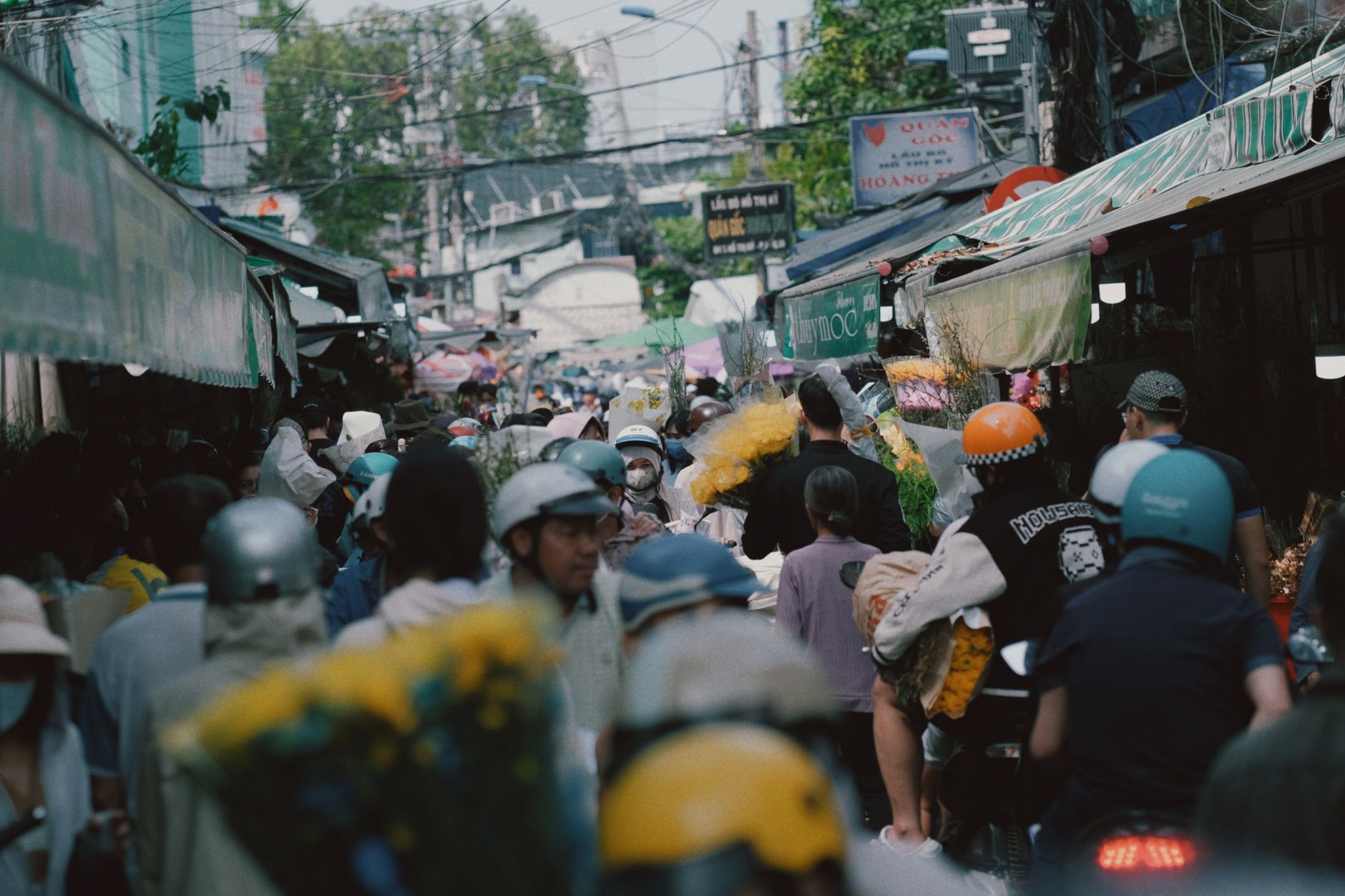
Tay Ho and the surrounding Old Quarter sit near several active flower wholesale markets where Hanoi's florists buy daily. We guide Vietnamese flower culture & market tours that start before dawn when growers unload trucks of imported roses, locally grown orchids, and seasonal dahlias. You'll see stems sorted by quality (Grade A for events, B for everyday), learn how florists judge freshness by checking petal firmness and stem color, and talk to vendors about preservation techniques—misting, cold storage, floral preservative ratios. Most markets operate 3–6 a.m.; we arrange transport and translation so you can ask growers directly why they choose certain varieties for Tet or Christmas. The tour includes a 1–2 hour arranging session afterward, so you apply what you've learned on blooms you've just watched being sorted. This full immersion shows you why a stem's water uptake matters and why Vietnamese florists condition flowers so aggressively before work.
What's the best workshop style if you're visiting Hanoi for only a few days?
Tourist workshops are designed for 2–4 hour slots on your actual schedule, with no prior experience required. You'll learn one signature technique (spiral hand-tie, box arrangement, or seasonal wreath) and leave with a finished, wrapped piece that survives the flight home. Most travelers choose a hand-tied bouquet session because it's portable, teaches the core skill, and gives you a keepsake in 3 hours. We run classes in both Hanoi and Ho Chi Minh City, typically morning or late afternoon to dodge the midday heat. Classes are in English, and we supply all stems, tools, and materials—you bring only curiosity. If you're here longer or planning to come back, a floral design course spans multiple days and dives into color theory, seasonal design, and business basics for anyone considering floristry as a serious hobby or career. Ask us for a quote on WhatsApp to match your exact dates and interests.
How do you keep flowers fresh in Hanoi's heat and humidity?
Hanoi's tropical climate—high humidity, 30°C+ temperatures April–September—stresses cut blooms because water evaporates fast and bacteria thrive. Our first lesson is always stem conditioning: we cut each stem at a 45-degree angle under running water, remove all leaves below the waterline, and split woody stems (hydrangea, roses) to expose more surface area for water uptake. We use floral preservative in every arrangement's water—it's a mix of sugar (food), citric acid (bacterial inhibitor), and biocide supplied in every workshop. Never let blooms sit in a hot car or direct sun; store them in cool water in a dim corner instead. Tropical flowers (anthuriums, birds of paradise) tolerate heat far better than European roses, so we teach you to choose heat-hardy varieties for daytime events or outdoor settings. Misting stems every few hours with a spray bottle extends life by 2–3 days. When you arrange flowers here, you're working against the clock—heat management isn't optional. Our private and couple sessions include detailed home-care instructions tailored to your climate and chosen flowers.

How do we adapt workshops for children, groups, and rainy days?
Children (ages 6–12): Our kids and family workshop simplifies techniques—hand-tying with fewer, sturdier stems; focus on color and texture rather than spiral precision. Sessions are 1.5–2 hours with frequent water breaks. Kids arrange posies for parents, which builds confidence without the pressure of a polished bouquet.
Large groups (8–20 people): Team building workshops and hen & birthday parties work best when we prep stems in advance, assign one technique per group, and rotate stations to prevent crowding. A 3-hour session lets everyone finish a piece and share it. We manage pace with demo-practice-finish cycles so no one feels rushed.
Rainy days: Vietnamese humidity soars during monsoon season (May–September). We stay inside; indoor lighting is neutral, and air conditioning helps blooms last longer during the session. We focus on hand-tied bouquets and flower box & basket arrangements because wrapped boxes travel home safely in rain. Stems don't need outdoor light to teach you technique—only your hands and our guidance matter. We've taught hundreds of classes in rain; it rarely changes the outcome if you're indoors and the flowers are conditioned well. Booking during dry seasons (October–April, December–February) is ideal if you prefer a relaxed outdoor photo session afterward.
Comparison: Choose Your Workshop by Goal
| Workshop Type | Who It's For | Duration | Takes Home | Why It Works |
|---|---|---|---|---|
| Flower arranging class | Curious travelers, beginners | 2–3 hours | Finished arrangement | Core skills, no fluff |
| Bouquet workshop | Gift-givers, romantic occasions | 2–3 hours | Hand-tied bouquet | Portable, photogenic, personal |
| Seasonal workshops | Tet, Christmas, holiday planners | 2–3 hours | Themed arrangement | Culturally grounded, symbolic |
| Private & couple sessions | Anniversaries, proposals, intimacy | 1.5–4 hours | Bespoke piece | One-on-one attention, custom design |
| Team building | Corporate groups, staff events | 2–4 hours | Individual + group display | Bonding, stress relief, tangible output |
| Hen & birthday parties | Friends, milestone celebrations | 2–3 hours | Personal arrangement + photos | Fun, alcohol-friendly, memorable |
| Floral design course | Serious learners, career-curious | Multi-day | Portfolio + certificate | Depth, theory, business fundamentals |
What to Check Before Booking Your Workshop
Location & transport: We run sessions in Hanoi and Ho Chi Minh City. Confirm which city suits you and whether we provide transport from central areas (ask on WhatsApp—logistics vary by season and group size).
Flower availability: Imported blooms (roses, peonies, tulips) cost more and may be unavailable outside their season. Local and tropical flowers are always in stock. Ask which stems are included before committing, especially if you have a specific color or type in mind.
Heat & humidity: If you're visiting April–September, expect indoor air-conditioned workshops and shorter stem lifespans at home. Bring blooms back to a cool, dark space within 2 hours of leaving.
Language & pace: All our classes are in English for travelers and expats. Tell us if English isn't your first language; we slow down, show more, and repeat technique steps.
Take-home logistics: Arrangements are wrapped and boxed; we show you how to carry them safely. If you're flying, ask about packing tips for your specific airline (most allow wrapped floral arrangements in carry-on or checked baggage; we advise checking 24 hours before departure).
Physical accessibility: Our workshops involve standing at a table for 2–3 hours with hands in water and floral foam. If you have mobility concerns, tell us in advance; we can discuss seated adaptations or modified sessions.
One Technique You Can Try at Home: The Spiral Hand-Tie
This is the signature move in Vietnamese and modern floristry. Here's how:
- Gather 5–7 stems (odd number) of varying heights—a focal flower (rose), secondary (hypericum berry), and filler (eucalyptus, ruscus).
- Hold the focal stem upright in your left hand (right if left-handed), thumb and forefinger pinching the stem about 3 inches below the bloom.
- Add the second stem at a 45-degree angle to the right, between thumb and forefinger, so it crosses the first stem's midpoint.
- Rotate the bundle (the whole thing in your hand, not your hand) counterclockwise a quarter-turn. Add the third stem at 45 degrees again, let it cross.
- Keep rotating and adding until all stems are in; you'll see a natural spiral where each stem crosses the previous one.
- Tighten gently: where all stems meet (the binding point), this should be a neat, compact junction about 2–3 inches long.
- Trim all stems to the same length from the binding point downward—usually 6–8 inches.
- Wrap the binding point with floral tape or twine, then wrap the whole lower stem in kraft paper or cellophane.
The most common mistake: rotating too fast or too slow, so stems slip. Go slow. The second mistake: binding too loose, so stems fan apart when you set the bouquet down. Squeeze gently as you wrap. Practice on eucalyptus or ruscus (cheap, forgiving) before using expensive roses.
We teach this in every flower arranging class, bouquet workshop, and private and couple sessions. You'll feel the muscle memory click around your fifth bouquet; by ten, your hands will spiral without thinking.
Ask for workshop dates on WhatsApp
️ See how a class runs
FAQ
Are workshops available year-round, or only during Tet and Christmas?
We run workshops year-round in Hanoi and Ho Chi Minh City. Tet (late January–early February) and Christmas (December) are busiest; we recommend booking 2–3 weeks ahead. Off-season (May–August) has fewer travelers, so availability is relaxed. Ask us for a quote on WhatsApp with your preferred dates.
Can I bring my own flowers, or do you supply everything?
We supply all stems, tools, floral foam, preservative, and wrapping materials. You choose your workshop type and color theme; we source the blooms. If you want to use flowers from a specific local market or garden, ask in advance—we can sometimes work with your stems if they're properly conditioned first.
How do I keep my arrangement alive after I get home?
Change the water every 2 days, re-trim stems at 45 degrees, and keep the arrangement out of direct sun and away from ripening fruit (ethylene gas kills blooms). Store in a cool spot—ideally 15–20°C. Tropical flowers last 7–10 days; imported roses and hydrangeas last 10–14 days if treated well. We give you a care card with every arrangement listing the specific flowers and their lifespan.
What's the difference between a hand-tied bouquet and a box arrangement?
A hand-tied bouquet is spiraled stems wrapped in paper—portable, romantic, looks good in a vase at home. A box arrangement is blooms in floral foam inside a keepsake box—lasts slightly longer, no vase needed, more dramatic for gifting. Bouquets are faster to learn (2 hours); boxes teach more precision with foam and spacing (2.5–3 hours). See bouquet workshop or flower box & basket class to compare.
Is there a minimum group size for team building or hen parties?
No minimum, but ask us for a quote on WhatsApp—we price differently for 2 people vs. 10. Smaller groups get one-on-one demo and pacing; larger groups rotate stations. Team building and hen & birthday parties pages outline typical structures. We've run sessions for 2 close friends and for 20-person corporate events.
Do you offer floral design training if I want to start a small business?
Yes. Our floral design course spans multiple days and covers color theory, seasonal design, business pricing, and client communication. It's not a diploma course, but it gives hobby florists the tools to sell arrangements informally or launch a small side business. Ask on WhatsApp about course structure, dates, and cost.
What if I'm nervous about working with flowers or my hands aren't steady?
Nervousness is normal; we've taught hundreds of first-timers. Florists aren't born with steady hands—they practice. Our flower arranging class paces technique with demo-then-you-do cycles so you see it work before trying. Stems are forgiving; a slightly asymmetrical spiral still looks beautiful. We'll adjust your pace and demo more if needed. Tell us about your concern when you book; we'll meet you there.
Can I take a private class with a friend, just the two of us?
Absolutely. Private and couple sessions are designed for 2–4 people. We tailor the content to your interests—proposal bouquet, anniversary arrangement, casual skill-share. This is also perfect if you want to learn at your own pace or celebrate something specific together. Ask for a quote on WhatsApp. --- ️ Book your Tay Ho workshop now
Ask for dates
Tell us the city, the date and how many people. We reply on WhatsApp in English with workshop options and a quote.
FAQ
Are workshops available year-round, or only during Tet and Christmas?
We run workshops year-round in Hanoi and Ho Chi Minh City. Tet (late January–early February) and Christmas (December) are busiest; we recommend booking 2–3 weeks ahead. Off-season (May–August) has fewer travelers, so availability is relaxed. Ask us for a quote on WhatsApp with your preferred dates.
Can I bring my own flowers, or do you supply everything?
We supply all stems, tools, floral foam, preservative, and wrapping materials. You choose your workshop type and color theme; we source the blooms. If you want to use flowers from a specific local market or garden, ask in advance—we can sometimes work with your stems if they're properly conditioned first.
How do I keep my arrangement alive after I get home?
Change the water every 2 days, re-trim stems at 45 degrees, and keep the arrangement out of direct sun and away from ripening fruit (ethylene gas kills blooms). Store in a cool spot—ideally 15–20°C. Tropical flowers last 7–10 days; imported roses and hydrangeas last 10–14 days if treated well. We give you a care card with every arrangement listing the specific flowers and their lifespan.
What's the difference between a hand-tied bouquet and a box arrangement?
A hand-tied bouquet is spiraled stems wrapped in paper—portable, romantic, looks good in a vase at home. A box arrangement is blooms in floral foam inside a keepsake box—lasts slightly longer, no vase needed, more dramatic for gifting. Bouquets are faster to learn (2 hours); boxes teach more precision with foam and spacing (2.5–3 hours). See bouquet workshop or flower box & basket class to compare.
Is there a minimum group size for team building or hen parties?
No minimum, but ask us for a quote on WhatsApp—we price differently for 2 people vs. 10. Smaller groups get one-on-one demo and pacing; larger groups rotate stations. Team building and hen & birthday parties pages outline typical structures. We've run sessions for 2 close friends and for 20-person corporate events.
Do you offer floral design training if I want to start a small business?
Yes. Our floral design course spans multiple days and covers color theory, seasonal design, business pricing, and client communication. It's not a diploma course, but it gives hobby florists the tools to sell arrangements informally or launch a small side business. Ask on WhatsApp about course structure, dates, and cost.
What if I'm nervous about working with flowers or my hands aren't steady?
Nervousness is normal; we've taught hundreds of first-timers. Florists aren't born with steady hands—they practice. Our flower arranging class paces technique with demo-then-you-do cycles so you see it work before trying. Stems are forgiving; a slightly asymmetrical spiral still looks beautiful. We'll adjust your pace and demo more if needed. Tell us about your concern when you book; we'll meet you there.
Can I take a private class with a friend, just the two of us?
Absolutely. Private and couple sessions are designed for 2–4 people. We tailor the content to your interests—proposal bouquet, anniversary arrangement, casual skill-share. This is also perfect if you want to learn at your own pace or celebrate something specific together. Ask for a quote on WhatsApp. --- [✂️ Book your Tay Ho workshop now](https://wa.me/84969293894)
More like this
Vietnamese flower culture
Cultural Workshops Saigon: Flower Classes & Team Building
Saigon's cultural workshop scene includes flower arranging, hand-tied bouquets, and team-building sessions taught in English by real florists. We run sessions for tourists, expats, families, and corporate groups year-round, adapting to the tropical heat and rainy season.
Vietnamese flower culture
Vietnamese Flower Culture Near Saigon: Learn & Celebrate Locally
Vietnamese flower culture near Saigon is alive in daily altars, Tet celebrations, and family gatherings—and you can learn it directly through workshop experiences that connect you to local growers, techniques, and meanings.
Vietnamese flower culture
Vietnamese Flower Culture Near Ho Chi Minh City: Learn & Shop
Vietnamese flower culture thrives in Ho Chi Minh City through centuries-old markets, seasonal rituals, and now accessible workshops where travelers learn to arrange lotus, chrysanthemums, and tropical blooms like locals do.