
Home › Blog › Vietnamese flower culture
Vietnamese Flower Culture Near Hanoi: Where to Learn & Arrange
By the Vietnam Flower Workshop team · 2026-11-06
Vietnamese flower culture celebrates blooms as spiritual and social anchors: lotus for purity, chrysanthemums for longevity, and peach blossoms welcoming Lunar New Year. Near Hanoi, the best way to experience it is through hands-on workshops at Vietnam Flower Workshop by Hoa Lang Thang, where florists teach the techniques, color symbolism, and seasonal rhythms that shape arrangements for homes, temples, and celebrations. A typical session runs two to three hours, includes real imported and local flowers you take home, and covers conditioning, spiral hand-ties, and the Vietnamese preference for asymmetrical balance. Whether you're a traveler seeking cultural immersion, a couple marking an occasion, or someone curious about Tet or Christmas styling, there are sessions for every group size and skill. We adapt for heat (flowers wilt fast here), rain, and kids—and no prior experience is needed. Ask us for a quote on WhatsApp to compare class types and dates. Ask for workshop dates on WhatsApp
What Makes Vietnamese Flower Tradition Unique?
Vietnamese flower arranging balances symbolism, seasonality, and restraint in ways that differ sharply from Western or Japanese styles. Blooms aren't massed densely; instead, each stem is a voice in a quiet conversation. Lotus represents enlightenment and is reserved for temples and Tet altars. Chrysanthemums signal respect and long life—common at funerals and family gatherings. Peach and plum blossoms announce spring and new beginnings. Colors follow strict etiquette: red and gold for luck, white for mourning (though this is evolving in urban contexts), and pastels for intimate gifting.
Our workshops teach this grammar so you understand why a florist in Hanoi arranges differently than one in New York. We show how Vietnamese homes traditionally display a single stem or a loose trio in a narrow vase, creating space for air and silence—qualities prized in Buddhist-influenced aesthetics. Beginners struggle most with resisting the urge to fill every gap; we coach restraint as strength.
The practice ties directly to Vietnam's agricultural calendar and market life. Learn the essentials at our seasonal workshops, where we cover Tet arrangements, Christmas wreaths, and lotus styling timed to local blooms.
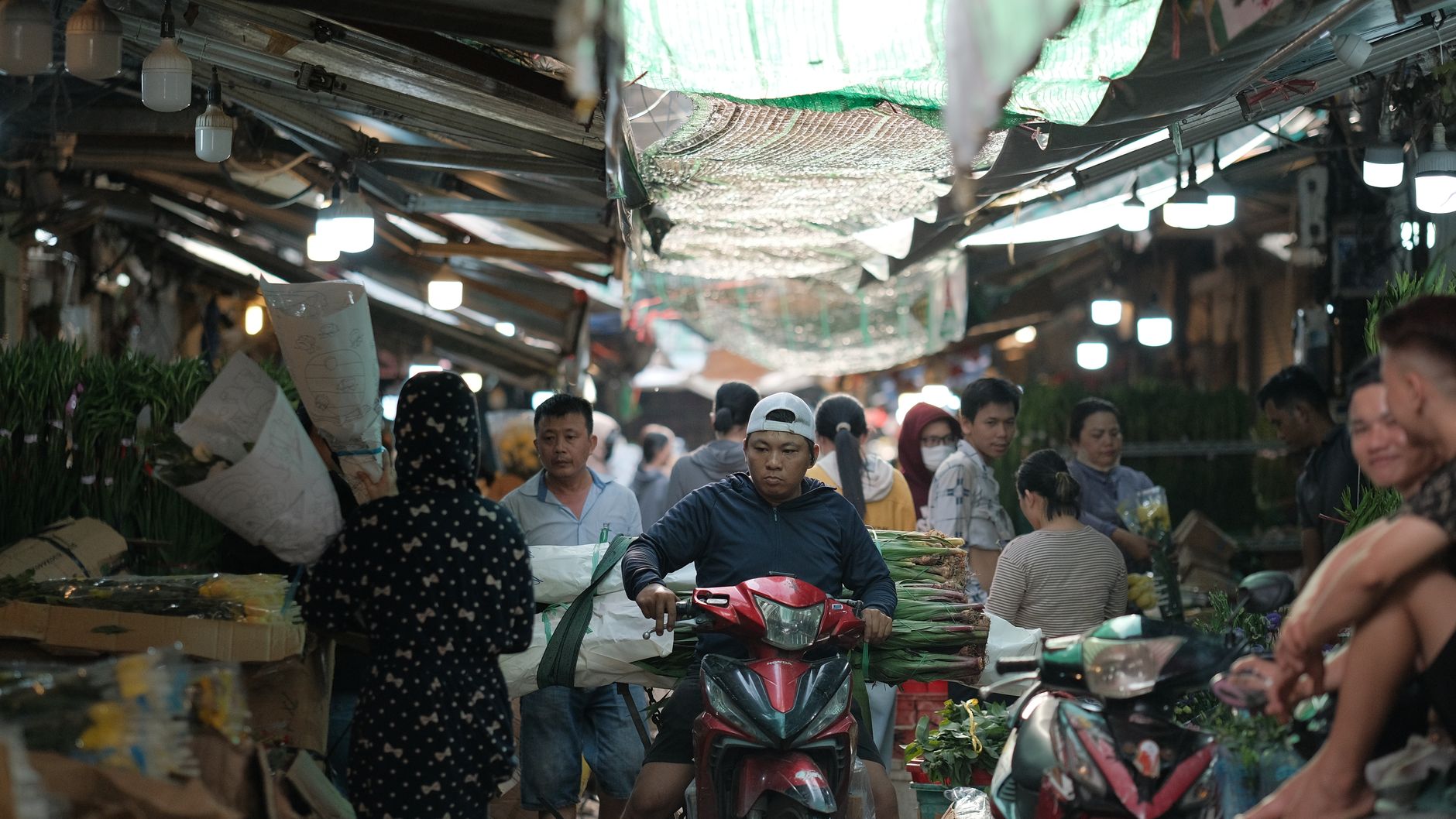
Where Can You Practice Vietnamese Arranging Near Hanoi?
Vietnam Flower Workshop by Hoa Lang Thang operates in Hanoi and Ho Chi Minh City with dedicated studio spaces designed for group and private learning. We use real imported flowers (roses, hydrangea, spray blooms) alongside local seasonal stock to teach core techniques in a heat-managed, rain-proof environment. Sessions run daily; ask us for a quote on WhatsApp to check availability for your dates.
Near Hanoi itself, traditional flower markets open early (5–7 a.m.) in central districts, where vendors sell temple offerings, wedding stock, and daily blooms. Visiting these markets before a workshop deepens your sense of how Vietnamese florists source and price their work—though we recommend starting with a guided class first, because market haggling and plant knowledge go hand-in-hand and can feel overwhelming solo.
Our flower arranging class format is best for tourists and expats wanting a structured introduction. Private and couple sessions suit anniversaries, honeymoons, or deep-dive learning. Team-building workshops work for companies wanting a shared cultural experience. Kids and family workshops scale difficulty and session length for younger hands.
️ See how a class runs
What Techniques Define Vietnamese Flower Work?
The Spiral Hand-Tie
This is the signature move. Stems spiral counterclockwise (or clockwise, depending on your hand) at a 45-degree angle, creating depth and movement while keeping the bouquet compact and hand-holdable. Beginners typically hold stems too parallel; we teach rotation and angle awareness in the first 20 minutes. A proper spiral takes three to five minutes once you've done it twice. The result is elegant, not fussy.
Conditioning for Heat & Humidity
Hanoi summers top 35°C (95°F) with high humidity. Wilting happens fast. We condition stems by removing lower leaves, cutting at a 45-degree angle under running water, and placing blooms in room-temperature water immediately. Tropical flowers (orchids, anthuriums) and fleshy stems (hydrangea) need extra care: we strip more foliage and recut every two days at home. This single step—taught hands-on in our classes—stops flowers dying by day three.
Color Balance & Symbolism
Vietnamese arranging avoids color clashing. We teach a three-tone approach: a dominant hue (often blush, green, or cream), a secondary accent (deep burgundy, soft gold), and a neutral filler (white limonium, eucalyptus). This mirrors traditional aesthetics and suits gifting to older relatives or temples. Our bouquet-making workshops spend 30 minutes on this alone, with real swatches and demo pieces.
Wrapping & Presentation
Hand-tied bouquets are wrapped in kraft paper, tissue, or cellophane—each choice carries meaning. Kraft signals casual friendliness; white tissue conveys respect; cellophane shows off the spiral. We teach grip, angle, and proportion so your wrap sits flush and looks professional. Beginners under-wrap; we show you how tight is too tight (stems bruise) and loose enough to breathe.
You can practice at home: buy three stems of local flowers, condition them, and rotate in your hand while holding at the spiral point. Watch your local florist's grip next time you buy a bouquet—you'll see these principles everywhere.
How Do Workshop Types Compare?
| Workshop Type | Who It's For | Duration | Group Size | Special Notes |
|---|---|---|---|---|
| Tourist / Traveler | First-time visitors, English speakers, 1–2 days in city | 2–3 hours | 2–8 people | Intro to techniques + local market stories; flowers to take home; no experience needed. |
| Private & Couples | Anniversaries, honeymoons, solo deep-dive | 1.5–3 hours | 1–2 people | Customizable; can focus on gifting styles, advanced wrapping, or specific blooms; more personal teaching. |
| Bouquet Making | Gift-preppers, event planners, hobbyists | 2–2.5 hours | 2–6 people | Emphasis on hand-ties, wrapping, and color theory; you make 2–3 bouquets to take home. |
| Team Building | Corporate groups, offices, friend circles | 2–3 hours | 6–20 people | Less technical; focus on creativity, fun, collaboration; flowers are group gifts to local charities or offices. |
| Kids & Family | Ages 6+, families, school groups | 1–1.5 hours | 2–10 children + adults | Shorter, play-based; simple mechanics (color, texture); low-pressure; flowers suited to small hands. |
| Seasonal (Tet, Christmas, Lotus) | Holiday gifters, temple decorators, thematic learners | 2–3 hours | 2–8 people | Specific blooms (peach, chrysanthemum, lotus); cultural context; styles only seasonal florists use. |
| Floral Design Course | Aspiring florists, career-changers, serious hobbyists | 4–12 weeks | 2–6 people (cohort) | Deeper theory, market sourcing, business basics, longer projects; portfolio-building. |
| Flower Box & Basket | Gifters, event stylists, home decorators | 2 hours | 2–6 people | Box and basket mechanics; floral foam prep; stacked and tiered designs; less hand-tying. |
Ask for workshop dates on WhatsApp

What Should You Check Before Booking a Session?
Dates & Availability Sessions fill quickly, especially during Tet (late January/early February) and Christmas. Ask us for a quote on WhatsApp with your preferred dates and group size; we'll confirm within 24 hours.
Language & Comfort All classes are taught in English for travelers and expats. If you're booking a larger group, let us know; we can arrange interpretation or bilingual co-teaching if needed.
Physical Considerations Classes involve standing, bending, and fine hand work for 2–3 hours. Those with arthritis or limited grip strength should mention it; we adapt scissors, stem lengths, and seating.
Heat & Humidity Impact Flowers wilt faster in our tropical climate than you might expect. We condition and cool blooms; you should refrigerate your finished arrangement at home (if you have space) and recut stems daily. We'll give you a care sheet when you leave.
Rain & Rescheduling Workshops run rain or shine in our covered studio. If a visitor cancels last-minute due to weather, we'll reschedule free of charge (as long as you give us notice).
Kids' Ages & Attention Kids workshops work best for ages 6+. Younger siblings can attend with a caregiver, but we can't guarantee they'll complete an arrangement. Tell us in advance so we can prepare simpler tasks.
Bringing Guests vs. Surprises If you're gifting a class as a surprise, email us the recipient's name, preferred date range, and phone number. We'll send a warm welcome message—but never confirm until they choose their date.
How Does Vietnamese Flower Culture Connect to Daily Life Here?
Vietnamese homes and businesses treat flowers as living air, not just decoration. A single lotus bloom in a slim ceramic vase sits on an altar or entryway for days, its petals opening and closing with light and temperature. Offices display arranged greenery to invite calm and focus. Restaurants and hotels source daily blooms from local markets, replacing them every few days because blooms age visibly and that's seen as disrespectful.
Temples during Tet see the most elaborate flower work: massive arrangements flanking altar tables, with peonies, chrysanthemums, and miniature kumquat trees (potted) creating height and narrative. These aren't random; each bloom, color, and height follows Buddhist and folk-tradition protocols. Our seasonal workshops walk you through this—you'll make a scaled version for a home altar or entryway.
Gift-giving also hinges on flowers. A bouquet to an elder signals reverence; blooms to a new business opening promise prosperity; white flowers to a funeral home express sorrow (though practices are shifting in urban, younger circles). Understanding these unspoken rules helps visitors and expats avoid missteps—and our workshops thread this cultural layer throughout, so you're never just making a "nice bouquet"; you're learning when and why it matters.
What Do Beginners Struggle With, and How Do We Help?
Over-Filling Space Western floral trends pack flowers densely; Vietnamese aesthetics prize air and asymmetry. Beginners cram stems in. We coach: "Imagine a window between the stems—light should pass through." Pointing out this gap repeatedly (and praising restraint) rewires instinct in one session.
Uneven Stem Lengths A hand-tie bouquet works only if stems spiral from a single grip point. Uneven lengths break the spiral and cause the top to look flat or lopsided. We teach the "rule of thirds"—focal blooms tall, secondary mid-level, filler shorter—and measure as a group before tying. By the second attempt, it clicks.
Weak Wrapping Tissue and kraft tear easily if wrapped too tight or at the wrong angle. Our hands-on demo shows the grip: thumb and index on the bouquet base, other three fingers on the wrap, rotating slowly while pulling gently. Practice on the demo bouquet first; then do yours. Wrapping is the last skill to stick—usually clear by day two of a course.
Choosing Flowers That Won't Last Certain blooms (ranunculus, sweet pea) are lovely but wilt in 3–4 days in tropical heat. We always advise: anthuriums, orchids, chrysanthemums, and spray roses last 7–10 days if conditioned daily. We show you how to check flower age at the market (tight petals = fresh; opened fully = older) and avoid the temptation to buy the biggest, most open bloom.
Not Removing Lower Leaves Foliage in water rots and clogs the stem, killing the flower within days. We strip 3–4 inches of leaves from every stem in the first minutes of a class—seems wasteful, but it's non-negotiable. Once you see the difference (a bouquet lasting 10 days instead of 4), you'll never skip this step.

FAQ
Can I visit a local flower market near Hanoi without a tour?
Yes—markets open 5–7 a.m. in central Hanoi. Haggling is normal; prices drop if you buy multiple stems. Bring cash in Vietnamese dong. However, if you're new to the city or unsure of local varieties, a workshop that includes a market visit is safer and more educational.
What's the difference between Vietnamese and Chinese flower arranging?
Vietnamese work emphasizes spiritual balance and restraint (Buddhist influence); Chinese style often features symmetry and symbolic numerology more rigidly. Vietnamese florists mix imported and local blooms freely; Chinese tradition favors specific flowers by season. Both are beautiful—our workshops highlight the Vietnamese approach, which suits Hanoi's cultural context and climate.
Do I need to speak Vietnamese to enjoy a workshop?
No. All our classes are taught in English for travelers and expats. We use visual demos and hands-on practice, so language barriers are minimal. If your group has mixed language levels, tell us; we can arrange bilingual support.
What happens if flowers wilt during my workshop?
Heat and humidity can stress blooms, especially imported ones. We keep water cool, shade flowers between projects, and recut stems regularly. If a stem wilts visibly, we swap it out—you're learning technique with fresh material, not fighting dying flowers.
Can I bring a bouquet I made at a workshop on a plane home?
Yes, if wrapped tightly in tissue and placed upright in a hard-sided box or vase. Remove excess water before packing. International flights are usually 12–24 hours; blooms may open fully but shouldn't wilt if conditioned well and kept cool. Domestic flights (1–3 hours) are risk-free. We'll give you a care sheet with shipping tips.
Is there a minimum age for kids' workshops?
Ages 6+. Younger siblings can attend with a caregiver, but we can't guarantee a completed arrangement. See our kids workshop details or ask us for a quote on WhatsApp to discuss your group.
Do you offer workshops in Vietnamese or other languages?
All classes are taught in English. For groups requesting another language, ask us on WhatsApp; we'll explore options based on group size and timing.
What's the best season to visit Hanoi for a flower workshop?
October–November (cool, dry, blooms abundant) and Tet season (January–February, peach and chrysanthemum peak). Summer (May–September) is hot and humidity high, but we manage it—air-conditioned studio, frequent water changes, hardy tropical blooms. Winter (December–February) is ideal. Ask us for a quote to align dates with flower availability. --- Ask for workshop dates on WhatsApp Learn more about Vietnamese flower culture and market tours, or explore all workshop guides to find your perfect session.
Ask for dates
Tell us the city, the date and how many people. We reply on WhatsApp in English with workshop options and a quote.
FAQ
Can I visit a local flower market near Hanoi without a tour?
Yes—markets open 5–7 a.m. in central Hanoi. Haggling is normal; prices drop if you buy multiple stems. Bring cash in Vietnamese dong. However, if you're new to the city or unsure of local varieties, a [workshop that includes a market visit](/vietnamese-flower-culture) is safer and more educational.
What's the difference between Vietnamese and Chinese flower arranging?
Vietnamese work emphasizes spiritual balance and restraint (Buddhist influence); Chinese style often features symmetry and symbolic numerology more rigidly. Vietnamese florists mix imported and local blooms freely; Chinese tradition favors specific flowers by season. Both are beautiful—our workshops highlight the Vietnamese approach, which suits Hanoi's cultural context and climate.
Do I need to speak Vietnamese to enjoy a workshop?
No. All our classes are taught in English for travelers and expats. We use visual demos and hands-on practice, so language barriers are minimal. If your group has mixed language levels, tell us; we can arrange bilingual support.
What happens if flowers wilt during my workshop?
Heat and humidity can stress blooms, especially imported ones. We keep water cool, shade flowers between projects, and recut stems regularly. If a stem wilts visibly, we swap it out—you're learning technique with fresh material, not fighting dying flowers.
Can I bring a bouquet I made at a workshop on a plane home?
Yes, if wrapped tightly in tissue and placed upright in a hard-sided box or vase. Remove excess water before packing. International flights are usually 12–24 hours; blooms may open fully but shouldn't wilt if conditioned well and kept cool. Domestic flights (1–3 hours) are risk-free. We'll give you a care sheet with shipping tips.
Is there a minimum age for kids' workshops?
Ages 6+. Younger siblings can attend with a caregiver, but we can't guarantee a completed arrangement. See our kids workshop details or ask us for a quote on WhatsApp to discuss your group.
Do you offer workshops in Vietnamese or other languages?
All classes are taught in English. For groups requesting another language, ask us on WhatsApp; we'll explore options based on group size and timing.
What's the best season to visit Hanoi for a flower workshop?
October–November (cool, dry, blooms abundant) and Tet season (January–February, peach and chrysanthemum peak). Summer (May–September) is hot and humidity high, but we manage it—air-conditioned studio, frequent water changes, hardy tropical blooms. Winter (December–February) is ideal. Ask us for a quote to align dates with flower availability. --- [🌸 Ask for workshop dates on WhatsApp](https://wa.me/84969293894) Learn more about Vietnamese flower culture and market tours, or explore [all workshop guides](/blog) to find your perfect session.
More like this
Vietnamese flower culture
Vietnamese Flower Culture: What to Expect at a Hanoi Workshop
Vietnamese flower culture weaves ancient ritual, seasonal respect, and everyday beauty into a living practice that shapes how people celebrate, mourn, and connect. A workshop in Hanoi or Ho Chi Minh City reveals this firsthand—not as theory, but as skill you can use at home.
Vietnamese flower culture
Vietnamese Flower Culture for Beginners: What to Know
Vietnamese flower culture blends Buddhist symbolism, Lunar New Year tradition, and French colonial influence into a distinct aesthetic that beginners can learn through hands-on practice and market immersion.
Vietnamese flower culture
Vietnamese Flower Culture: Workshops & Traditions in Hanoi & HCMC
Vietnamese flower culture weaves centuries of symbolism—lotus for purity, chrysanthemums for longevity—into celebrations and daily life. We teach this living heritage through arranging workshops where travelers and expats craft authentic pieces using imported and local blooms.