
Home › Blog › Vietnamese flower culture
Vietnamese Flower Culture Near Hanoi Old Quarter: Learn & Buy
By the Vietnam Flower Workshop team · 2026-11-06
Vietnamese flower culture in Hanoi's Old Quarter centers on seasonal arrangements, temple offerings, and Tet traditions—practices rooted in symbolic meaning and family ritual. The Old Quarter hosts morning flower markets, Buddhist temples, and family-run vendors selling fresh imports and local varieties. Vietnam Flower Workshop by Hoa Lang Thang offers hands-on sessions where you learn conditioning, spiral hand-ties, and color balance while working with real imported and local flowers—most last 90 minutes to three hours and include taking your finished piece home. Beginners learn why Vietnamese arrangements favor asymmetry, odd-numbered stems, and vertical lines that mirror natural growth. Expect to condition stems, strip leaves, and arrange in spirals or linear styles. Ask us for a quote on WhatsApp for group rates, private sessions, or longer floral design courses tailored to cultural context. Ask for workshop dates on WhatsApp
What makes Vietnamese flower arrangements different from Western styles?
Vietnamese arrangements emphasize negative space, vertical flow, and asymmetrical balance—reflecting Buddhist and Confucian aesthetics of natural harmony. Where Western floristry often builds dense, rounded structures, Vietnamese design celebrates the stem's line and air between blooms. This comes from temple traditions and ink-brush painting philosophy: less is more, and emptiness holds meaning. We teach this principle in our flower arranging classes by having beginners place three or five stems first, then add secondary material sparingly. Most students struggle at first—they want to fill every gap—but once they see the final piece, the restraint clicks. Temple offerings, Tet arrangements, and family altars all follow this rule. Understanding this shift changes how you see every bouquet you make.
Which flowers are essential to Hanoi's market culture?
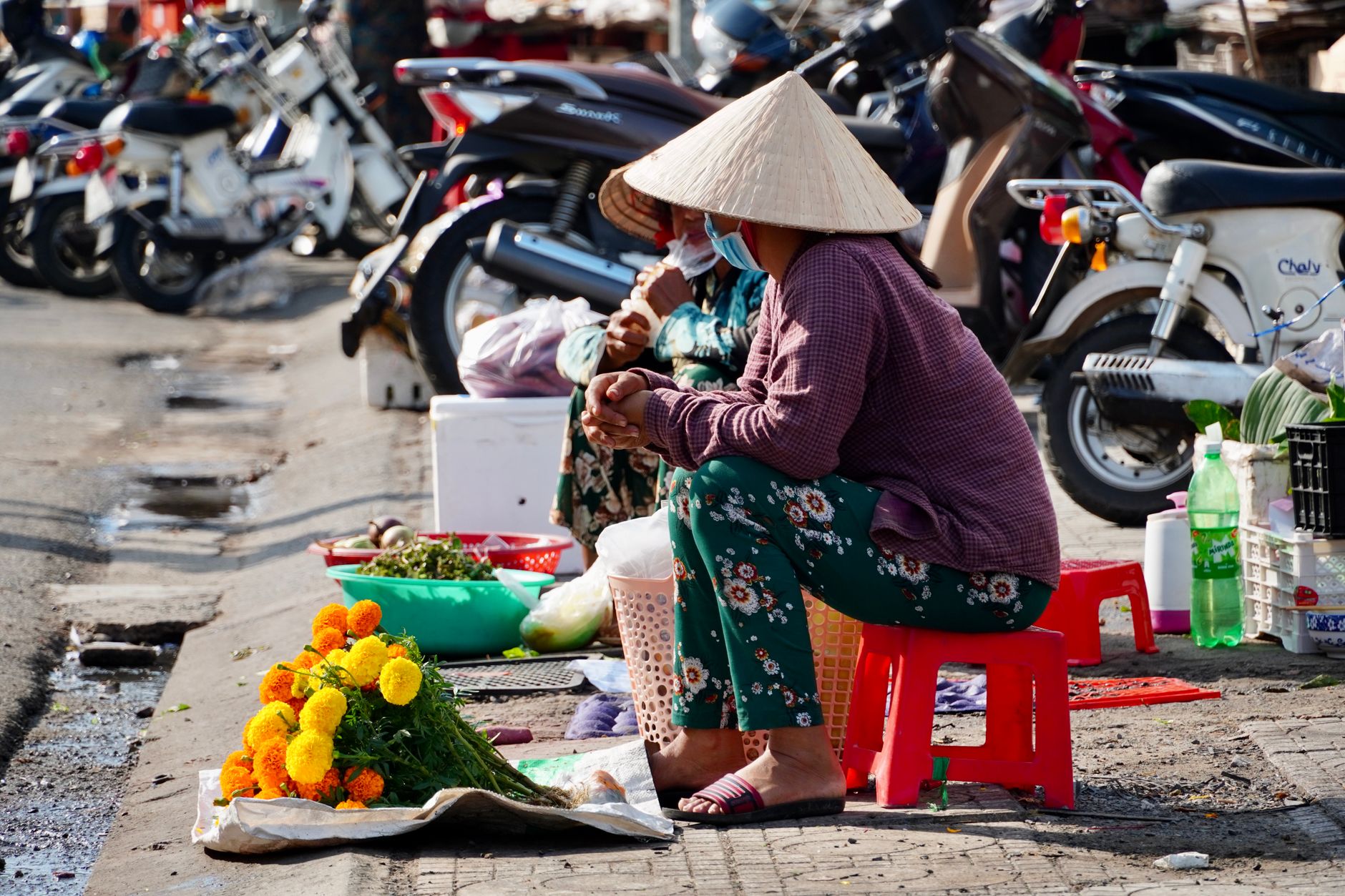
Hanoi's Old Quarter flower markets—operating daily before dawn—feature chrysanthemums (symbolizing truth and longevity), orchids (refinement), lotus (purity in Buddhist context), gladiolus (strength), and seasonal imports like roses and carnations. Chrysanthemums dominate Tet season; lotus appears in summer and holds sacred weight. Rose varieties—especially the imported deep reds—are recent arrivals but now common for anniversaries and proposals. Local vendors, many family-run for decades, can tell you the bloom's origin, water life (typically 7–14 days for chrysanthemums in Hanoi's heat), and symbolic use. In our seasonal workshops, we show how holiday demand shapes what the market stocks and how to choose specimens that survive the tropical humidity. Most travelers don't realize that Hanoi heat wilts blooms faster than cooler climates—a trick we teach: mist arrangements in the early morning and evening, strip lower leaves to reduce water loss, and refresh the water every two days.
️ See how a class runs
How do workshops adapt to Hanoi's heat and humidity?
Hanoi's tropical climate (average 25–32°C April–September) demands aggressive conditioning: we condition stems in cool water for two hours before class, strip all lower leaves to prevent bacterial rot, and cut stems at 45-degree angles under running water to maximize water intake. We fill vases with room-temperature water (not cold—shock wilts blooms faster) and add flower food if the flowers are imported. During class, we work in air-conditioned studios with humidity control; students complete arrangements within 90 minutes to avoid heat stress on freshly cut stems. For group workshops held outdoors or in less controlled venues, we shorten duration to 60 minutes and use tougher varieties (chrysanthemums, hypericum berries, eucalyptus) that tolerate temperature swings. We advise students taking arrangements home: keep them away from direct sun, air-conditioning vents, and ripening fruit (ethylene gas wilts blooms). These conditions add five to seven days to vase life compared to rooms with no air flow.
What do children and families learn differently in our sessions?
Kids and family workshops skip the strict asymmetrical rules and focus on color, texture, and the sensory joy of working with fresh flowers. Children aged 6–12 often create linear or radial designs (simpler grip mechanics) and learn flower names, water absorption, and why thorns need respect. We use shorter stems, sturdier varieties, and child-safe tools (blunt floral scissors, no knives). Parents and kids work as pairs—adults condition and prep; kids arrange and decide placement. Sessions run 75 minutes because focus spans and attention to detail differ sharply from adult learners. We adapt the "what will go wrong" lecture: instead of bacterial rot and wilting, we teach "why we change the water" and "how stems drink from the bottom, not the top"—hands-on understanding beats theory. Family groups report that kids remember flower names and care routines far better after touch-based learning than after videos.

How do you compare workshop types for different visitor goals?
| Workshop Type | Best For | Duration | Group Size | What You Take Home | Key Skill |
|---|---|---|---|---|---|
| Tourist workshop | First-time visitors, busy schedules | 90 min | 1–8 | 1 hand-tied bouquet | Spiral technique |
| Bouquet making | Gift-givers, special occasions | 2 hours | 1–6 | 2–3 finished bouquets | Wrapping, color balance |
| Private & couples sessions | Anniversaries, proposals, date days | 2–3 hours | 2–4 | Custom arrangement + certificate | Design consultation |
| Team building | Corporate groups, employee bonding | 3 hours | 5–20 | 1 arrangement per person | Collaboration, listening |
| Hen & birthday parties | Celebrations, milestone events | 2–3 hours | 4–12 | 1 centerpiece + corsages | Social creativity |
| Seasonal specialty | Holiday traditions, cultural immersion | 2–4 hours | 1–6 | Tet wreath, Christmas centerpiece | Cultural symbolism |
| Floral design course | Career changers, deep skill-building | 4–6 weeks (multiple sessions) | 1–4 | Portfolio of 20+ pieces | Industry techniques |
Ask for workshop dates on WhatsApp
Why does the Old Quarter matter for learning flower culture?
Hanoi's Old Quarter (36 Streets) sits metres from wholesale and retail flower markets that have operated since the French colonial era. Walking the streets before a workshop, you see vendors sorting chrysanthemums by stem length, mixing flowers for Tet altars, and arranging temple offerings in traditional patterns. This context makes our Vietnamese flower culture market tour so powerful: you meet vendors, handle varieties you'll later arrange, and understand pricing and seasonal rhythms firsthand. The Old Quarter's narrow streets, family workshops, and 100-year-old shopfronts show how flower culture isn't trendy—it's embedded in daily ritual. Students who visit markets before arranging class grasp symbolism and quality standards faster. After class, many return to vendors they met and buy for home. This cycle of learning, buying, and reconnecting to local growers is what "flower culture near Hanoi Old Quarter" actually means—not just Instagram aesthetics, but active participation in a living tradition.
What to check before you book
- Timing: Morning workshops (6:00–9:00 AM) use cooler conditions and fresher blooms direct from night markets. Afternoon sessions (2:00–5:00 PM) may see wilting if air-conditioning fails. Ask which time suits your schedule.
- Flower freshness: Blooms should arrive the morning of your class. Ask when flowers are conditioned (before you arrive or on-site?). Stems should smell fresh—musty water = bacterial rot.
- Group size and noise: Small groups (1–4) allow detailed feedback. Large groups (10+) mean less 1-on-1 correction; you may miss technique nuances. Confirm group size when booking.
- What's included: Some workshops provide vase/wrapping; others ask you to bring containers. Clarify upfront. Ask if flower food and scissors are provided or if you supply them.
- Temperature and humidity control: Studios should be air-conditioned, especially April–September. Ask if outdoor venues have shade or misting fans.
- Transport home: Arrangements are fragile. Ask if the venue provides boxes or how to carry a wet spiral bouquet safely. Plan taxi or transport before class ends.
Next steps: from learning to living the culture
After your session, keeping your arrangement alive extends the memory and deepens your connection to the craft. Change water every two days, mist in early morning, remove any yellowing leaves, and keep blooms away from direct sun and heating vents. Most hand-tied bouquets last 10–14 days in Hanoi's heat if cared for properly. For ongoing engagement, we offer longer floral design courses for visitors staying 2+ weeks, and we welcome repeat learners to join different seasonal workshops (Tet, Christmas, lunar celebrations) each year. Many past students report they now visit Old Quarter flower markets monthly and arrange blooms at home—a habit born from one class. This is how flower culture spreads: not from buying pre-made pieces, but from learning to make them yourself.
️ See how a class runs | Ask for workshop dates on WhatsApp

FAQ
What is the best season to visit Hanoi for flower workshops?
October–March (cool, dry season) offers ideal working conditions and widest flower variety. April–September is humid and hot, but blooms are abundant and prices lower. Ask us for a quote on WhatsApp to match your dates to flower availability and workshop themes.
Can I do a flower workshop if I have no arranging experience?
Yes. All our flower arranging classes assume zero prior skill. We teach conditioning, spiral hand-ties, and design principles step-by-step. Beginners often struggle with spacing and stem-stripping speed, but we slow down and correct in real time. Most finish a beautiful piece in one session.
How long do hand-tied bouquets last in Hanoi's climate?
With daily water changes and morning misting, 10–14 days. Vase life drops to 5–7 days if kept in direct sun or near air-conditioning vents. Conditioning matters: fresh stems cut at 45 degrees and stripped of lower leaves stay alive longer than tight bunches with full foliage.
Are workshops suitable for children or first-time visitors?
Yes. Kids and family workshops run shorter sessions (75 minutes) with simpler designs and sturdier flowers. Tourist workshops are 90 minutes and require no experience. Both include taking your finished piece home—ideal for travelers with limited time.
Can I book a private session for a special occasion like an anniversary?
Absolutely. Private and couples sessions run 2–3 hours and are fully customized: you can learn to make an anniversary bouquet, get design advice, and receive a certificate. Ask us for a quote on WhatsApp and mention your date so we can book flower availability and arrange any special touches.
What flowers are most important in Vietnamese culture?
Chrysanthemums (truth, longevity), orchids (refinement), and lotus (purity, spirituality) are core. Roses are modern for romance; gladiolus symbolize strength. Seasonal blooms for Tet and festivals vary. Our seasonal workshops teach cultural meaning and symbolic use for each holiday.
Ask for dates
Tell us the city, the date and how many people. We reply on WhatsApp in English with workshop options and a quote.
FAQ
What is the best season to visit Hanoi for flower workshops?
October–March (cool, dry season) offers ideal working conditions and widest flower variety. April–September is humid and hot, but blooms are abundant and prices lower. Ask us for a quote on WhatsApp to match your dates to flower availability and workshop themes.
Can I do a flower workshop if I have no arranging experience?
Yes. All our [flower arranging classes](/flower-arranging-class) assume zero prior skill. We teach conditioning, spiral hand-ties, and design principles step-by-step. Beginners often struggle with spacing and stem-stripping speed, but we slow down and correct in real time. Most finish a beautiful piece in one session.
How long do hand-tied bouquets last in Hanoi's climate?
With daily water changes and morning misting, 10–14 days. Vase life drops to 5–7 days if kept in direct sun or near air-conditioning vents. Conditioning matters: fresh stems cut at 45 degrees and stripped of lower leaves stay alive longer than tight bunches with full foliage.
Are workshops suitable for children or first-time visitors?
Yes. [Kids and family workshops](/kids-and-family) run shorter sessions (75 minutes) with simpler designs and sturdier flowers. [Tourist workshops](/tourist-workshop) are 90 minutes and require no experience. Both include taking your finished piece home—ideal for travelers with limited time.
Can I book a private session for a special occasion like an anniversary?
Absolutely. [Private and couples sessions](/private-and-couples) run 2–3 hours and are fully customized: you can learn to make an anniversary bouquet, get design advice, and receive a certificate. Ask us for a quote on WhatsApp and mention your date so we can book flower availability and arrange any special touches.
What flowers are most important in Vietnamese culture?
Chrysanthemums (truth, longevity), orchids (refinement), and lotus (purity, spirituality) are core. Roses are modern for romance; gladiolus symbolize strength. Seasonal blooms for Tet and festivals vary. Our [seasonal workshops](/seasonal) teach cultural meaning and symbolic use for each holiday.
More like this
Vietnamese flower culture
Cultural Workshops Saigon: Flower Classes & Team Building
Saigon's cultural workshop scene includes flower arranging, hand-tied bouquets, and team-building sessions taught in English by real florists. We run sessions for tourists, expats, families, and corporate groups year-round, adapting to the tropical heat and rainy season.
Vietnamese flower culture
Vietnamese Flower Culture Near Saigon: Learn & Celebrate Locally
Vietnamese flower culture near Saigon is alive in daily altars, Tet celebrations, and family gatherings—and you can learn it directly through workshop experiences that connect you to local growers, techniques, and meanings.
Vietnamese flower culture
Vietnamese Flower Culture Near Ho Chi Minh City: Learn & Shop
Vietnamese flower culture thrives in Ho Chi Minh City through centuries-old markets, seasonal rituals, and now accessible workshops where travelers learn to arrange lotus, chrysanthemums, and tropical blooms like locals do.