
Home › Blog › Vietnamese flower culture
Quang Ba Flower Market Tour Near Hanoi Old Quarter: Insider Guide 2026
By the Vietnam Flower Workshop team · 2026-11-06
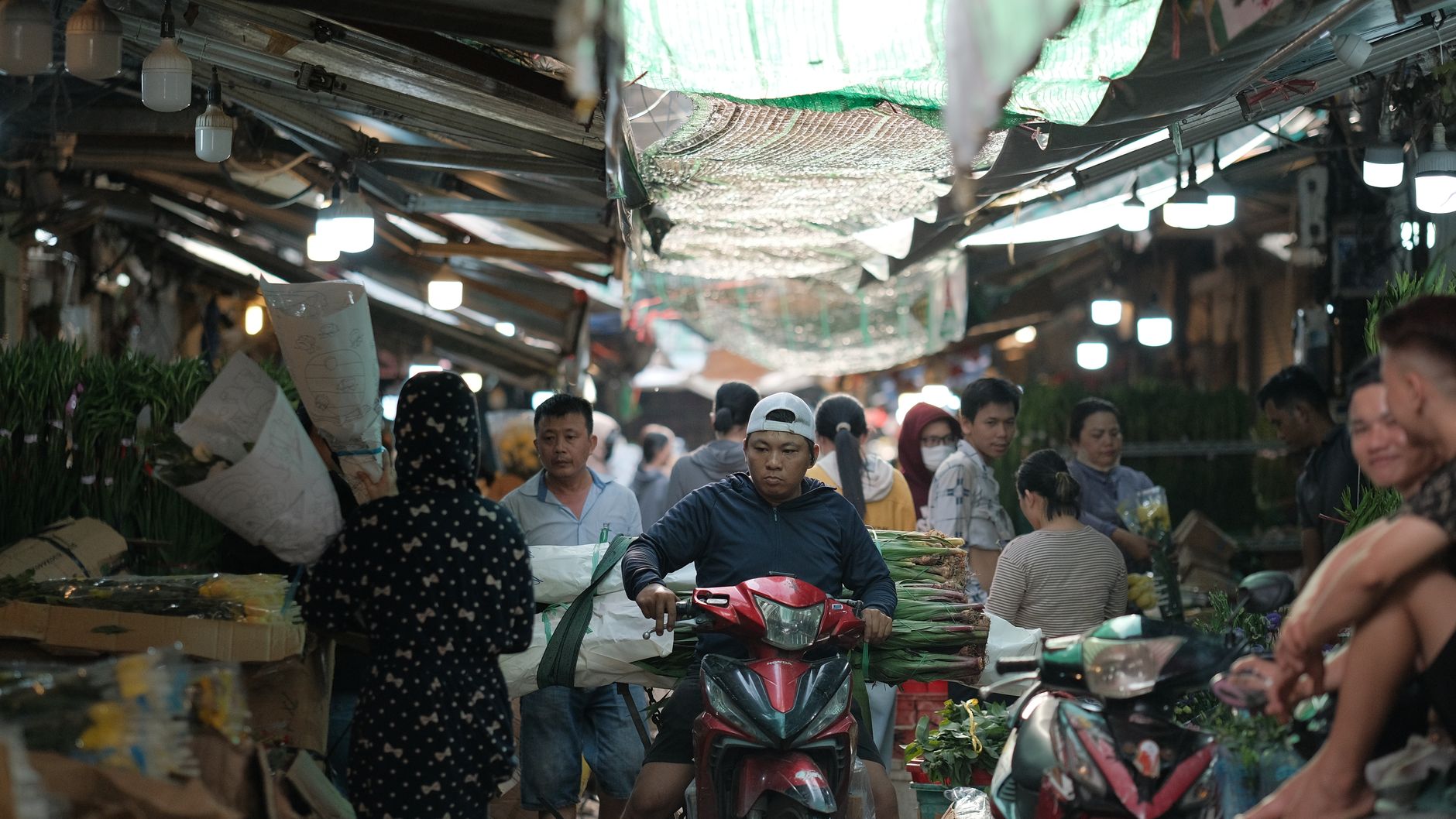
Quang Ba Flower Market sits on the Red River's north bank, 3 km west of Hanoi's Old Quarter, and opens at 4 a.m.–noon daily. The market sprawls across a riverside plaza where wholesalers and growers sell 200+ varieties—roses, chrysanthemums, orchids, lilies, tropical species—at 40–60% less than retail florists. Visitors browse stalls, negotiate prices, and carry away armfuls of fresh stems. Vietnam Flower Workshop by Hoa Lang Thang combines a guided morning market walk (you learn wholesale grades, seasonal stock, vendor-haggling tactics) with a hands-on arranging class afterwards, so your market purchases become a finished bouquet or arrangement you take home. Tour length is 2–3 hours including the workshop. Cost varies by group size and whether you want just the market tour or the full workshop add-on; ask us for a quote on WhatsApp. Best time: October–April, when flowers are abundant and heat stress is low. Avoid mid-summer (June–August) when stems wilt fast and prices spike. Ask for workshop dates on WhatsApp
What flowers should I look for at Quang Ba as a beginner?
Beginners often grab the first cheap bunch they see, ignoring freshness signals. Look for: firm, crisp petals (no brown edges); tight buds (will open over 5–7 days, not split open); supple stems (bend without snapping); no slime or smell near the cut end. Roses, dahlias, and chrysanthemums are beginner-proof—they last 10–14 days indoors. Orchids and proteas cost more but last 3+ weeks. Ask vendors for "today's delivery" or "this morning's fresh"—they'll point you to the newest stalls. We teach this firsthand at the market; you learn to pinch a stem, check the hydration, and spot wilted stock before money changes hands.

How do market prices compare to retail florist bouquets?
A wholesale rose bunch (25 stems) costs 40,000–our current quote (roughly our current quote–our current quote equivalent); a retail florist bouquet of 12 roses runs 400,000–our current quote (our current quote–our current quote equivalent). Market tulips cost 30% of florist markup. The trade-off: market vendors pack tight for transport; stems need re-cutting and conditioning. Hybrid orchids sell for 15,000–our current quote per stem at wholesale versus 100,000+ VND at retail. First-timers are shocked by the savings, but they also discover why: no delivery fee, no designer labor, no markup for rent. Our flower-arranging workshop teaches conditioning, so your market stems outlast a pre-made florist arrangement.
️ See how a class runs
When is Quang Ba least crowded for first-timers?
The market peaks 4–6 a.m. when wholesalers and florists buy for the day. After 8 a.m., foot traffic drops 70%, but stock thins and prices don't fall—vendors hold inventory for midday retail buyers. Weekdays (Monday–Friday) are calmer than Saturday–Sunday when tourists and locals flood in. For a relaxed first visit, arrive 6–7 a.m. on a Tuesday or Wednesday. Our market tours schedule this window so you can walk slowly, ask vendors questions, and photograph without shoulder-bumping. Combined with our flower workshop for travelers, you get the experience without the rush.
How do I negotiate prices as a foreign visitor?
Vendors expect haggling and show respect when buyers speak Vietnamese or attempt basic numbers ("mười, hai mươi"—10, 20). Offer 80–85% of the asking price; vendors rarely budge below 70%. Bulk purchases (5+ bunches) unlock better rates. Smile, be patient, and show genuine interest in quality—transactional coldness gets no discount. Foreigners often overpay by 30% because they don't haggle; learning the rhythm takes one visit with a local guide. Our guides speak Vietnamese and walk between stalls with you, teaching timing and vendor trust. Private and couple sessions can include a market tour as a pair or small group.
Ask for workshop dates on WhatsApp
Can I take market flowers on a flight home?
Most airlines allow fresh flowers in carry-on luggage if wrapped tightly and kept moist. Stems must be in a water-filled bag or holder. Checked luggage risks crushing. International flights require flowers purchased within 24 hours of departure and a signed receipt proving sale date. Orchids, roses, and chrysanthemums travel best; soft dahlias bruise easily. We recommend enjoying your market purchase at a private arranging session the same morning, then displaying at your accommodation. If you're staying weeks, a seasonal workshop teaches long-term care and vase-life extension for Hanoi's humid climate.
Quick comparison: Market vs. florist vs. workshop bundle
| Option | Best for | Time investment | Final cost | Quality control | Learning |
|---|---|---|---|---|---|
| Quang Ba market solo | Budget conscious, confident pickers | 45–90 min | Lowest (stems only) | Depends on eye; risky wilting | None |
| Retail florist | Gift-giving, convenience | 10 min | Highest | Professional; pre-arranged | None |
| Market tour + workshop | Travelers, couples, skill-building | 3–4 hours | Moderate (market + class fee) | Vendor + instructor guidance | Conditioning, spiral ties, color theory |
What should I check before booking a market tour workshop?
Before you commit:
- Confirm your arrival time – the market opens at 4 a.m.; tours depart 5–6 a.m. to catch peak freshness and light.
- Ask if the workshop is included or add-on – some tours are market-only (budget option); most include a 2-hour arranging class after, where you create a hand-tied bouquet or box with your purchases.
- Verify transportation – does the operator provide a vehicle from your accommodation, or do you meet at the market? Quang Ba is a taxi ride from the Old Quarter; a guide saves time and language stress.
- Check group size – small groups (≤6 people) allow vendor interaction; large tours (10+) risk bottlenecks at stalls.
- Understand what you're taking home – live, conditioning flowers in paper wrapping. Plan for a vase at your hotel or to arrange same-day.
- Rain contingency – Hanoi's monsoon (May–September) brings street flooding near the river. Ask if the tour reschedules or relocates indoors on downpour days.
We operate team-building workshops and kids and family sessions that include optional market components; format varies by season and group, so contact us for a custom quote.
Conditioning fresh market stems at home
The one technique you can try today:
- Cut 1–2 cm off the base at 45° angle – increases water-absorption surface.
- Remove lower leaves – submerged foliage rots fast in humid climates; strip 5 cm up the stem.
- Fill a clean vase with room-temperature water – tap water is fine; change daily (twice daily in heat above 30°C).
- Stand stems in the vase immediately – every hour out of water costs 1–2 days of vase life.
- Place away from direct sun and AC vents – Hanoi heat and air conditioning create stress; a cool corner with indirect light extends bloom to 12–16 days.
This is what we teach in the post-market workshop section. Most travelers underestimate water change; we make it routine so stems survive the humid apartment and weekend visits outside Hanoi.
Our flower-arranging class and floral design course both draw on Quang Ba stock during peak seasons. Curious about Vietnamese flower culture and why the market exists? That pillar explains the tradition. For a guided experience tailored to your schedule, contact us on WhatsApp or browse our blog for market seasonal guides and care tips.
Ask for workshop dates on WhatsApp

FAQ
Is it safe for solo travelers to visit Quang Ba at 5 a.m.?
The market is busy, well-lit, and actively policed—thousands of flower traders and early shoppers are present. Stick to main aisles, keep bags close, and go with a tour guide on your first visit. We arrange pickups from central accommodations, so you're never alone.
What's the difference between Quang Ba and other Hanoi flower markets?
Quang Ba is the largest and most wholesale-focused, selling direct to florists and retailers. Other smaller markets (like stalls near Hoan Kiem Lake) sell pre-arranged retail bouquets at higher markup. Quang Ba offers bulk stems, variety, and haggling—worth the early wake-up.
Can I buy market flowers and arrange them in the workshop the same day?
Yes. That's the core of our market-tour-plus-workshop offering. You spend 90 minutes at Quang Ba, then 2 hours with us learning to condition, tie spirals, balance color, and finish your bouquet or box—all using stems you selected yourself.
Do I need to speak Vietnamese to succeed at Quang Ba?
No, but basic numbers help ("mười, hai mươi"—10, 20) and a smile go a long way. Our guides translate, negotiate, and teach you vendor etiquette so you feel confident. Solo visitors without guides often overpay 20–40%.
What's the best season for Quang Ba freshness and price?
October–April: abundant imported roses, chrysanthemums, and local varieties; prices stable and stems are hardy. June–August (monsoon): stock is scarce, prices spike, heat causes wilting within 24 hours. Visit in cooler months if possible, or book a workshop in summer to learn heat-survival care.
Can I book a private group market tour for a hen party or team building?
Yes. We run hen and birthday parties and team-building workshops that include optional market walks. Groups up to 12–15 work well; larger groups may split into shifts. Email or WhatsApp for custom quotes and dates.
Ask for dates
Tell us the city, the date and how many people. We reply on WhatsApp in English with workshop options and a quote.
FAQ
Is it safe for solo travelers to visit Quang Ba at 5 a.m.?
The market is busy, well-lit, and actively policed—thousands of flower traders and early shoppers are present. Stick to main aisles, keep bags close, and go with a tour guide on your first visit. We arrange pickups from central accommodations, so you're never alone.
What's the difference between Quang Ba and other Hanoi flower markets?
Quang Ba is the largest and most wholesale-focused, selling direct to florists and retailers. Other smaller markets (like stalls near Hoan Kiem Lake) sell pre-arranged retail bouquets at higher markup. Quang Ba offers bulk stems, variety, and haggling—worth the early wake-up.
Can I buy market flowers and arrange them in the workshop the same day?
Yes. That's the core of our market-tour-plus-workshop offering. You spend 90 minutes at Quang Ba, then 2 hours with us learning to condition, tie spirals, balance color, and finish your bouquet or box—all using stems you selected yourself.
Do I need to speak Vietnamese to succeed at Quang Ba?
No, but basic numbers help ("mười, hai mươi"—10, 20) and a smile go a long way. Our guides translate, negotiate, and teach you vendor etiquette so you feel confident. Solo visitors without guides often overpay 20–40%.
What's the best season for Quang Ba freshness and price?
October–April: abundant imported roses, chrysanthemums, and local varieties; prices stable and stems are hardy. June–August (monsoon): stock is scarce, prices spike, heat causes wilting within 24 hours. Visit in cooler months if possible, or book a workshop in summer to learn heat-survival care.
Can I book a private group market tour for a hen party or team building?
Yes. We run [hen and birthday parties](/parties) and [team-building workshops](/team-building) that include optional market walks. Groups up to 12–15 work well; larger groups may split into shifts. Email or WhatsApp for custom quotes and dates.
More like this
Vietnamese flower culture
Vietnamese Flower Culture: What to Expect at a Hanoi Workshop
Vietnamese flower culture weaves ancient ritual, seasonal respect, and everyday beauty into a living practice that shapes how people celebrate, mourn, and connect. A workshop in Hanoi or Ho Chi Minh City reveals this firsthand—not as theory, but as skill you can use at home.
Vietnamese flower culture
Vietnamese Flower Culture for Beginners: What to Know
Vietnamese flower culture blends Buddhist symbolism, Lunar New Year tradition, and French colonial influence into a distinct aesthetic that beginners can learn through hands-on practice and market immersion.
Vietnamese flower culture
Vietnamese Flower Culture: Workshops & Traditions in Hanoi & HCMC
Vietnamese flower culture weaves centuries of symbolism—lotus for purity, chrysanthemums for longevity—into celebrations and daily life. We teach this living heritage through arranging workshops where travelers and expats craft authentic pieces using imported and local blooms.