
Home › Blog › Vietnamese flower culture
Quang Ba Flower Market Tour in English: What to Buy & How
By the Vietnam Flower Workshop team · 2026-11-06
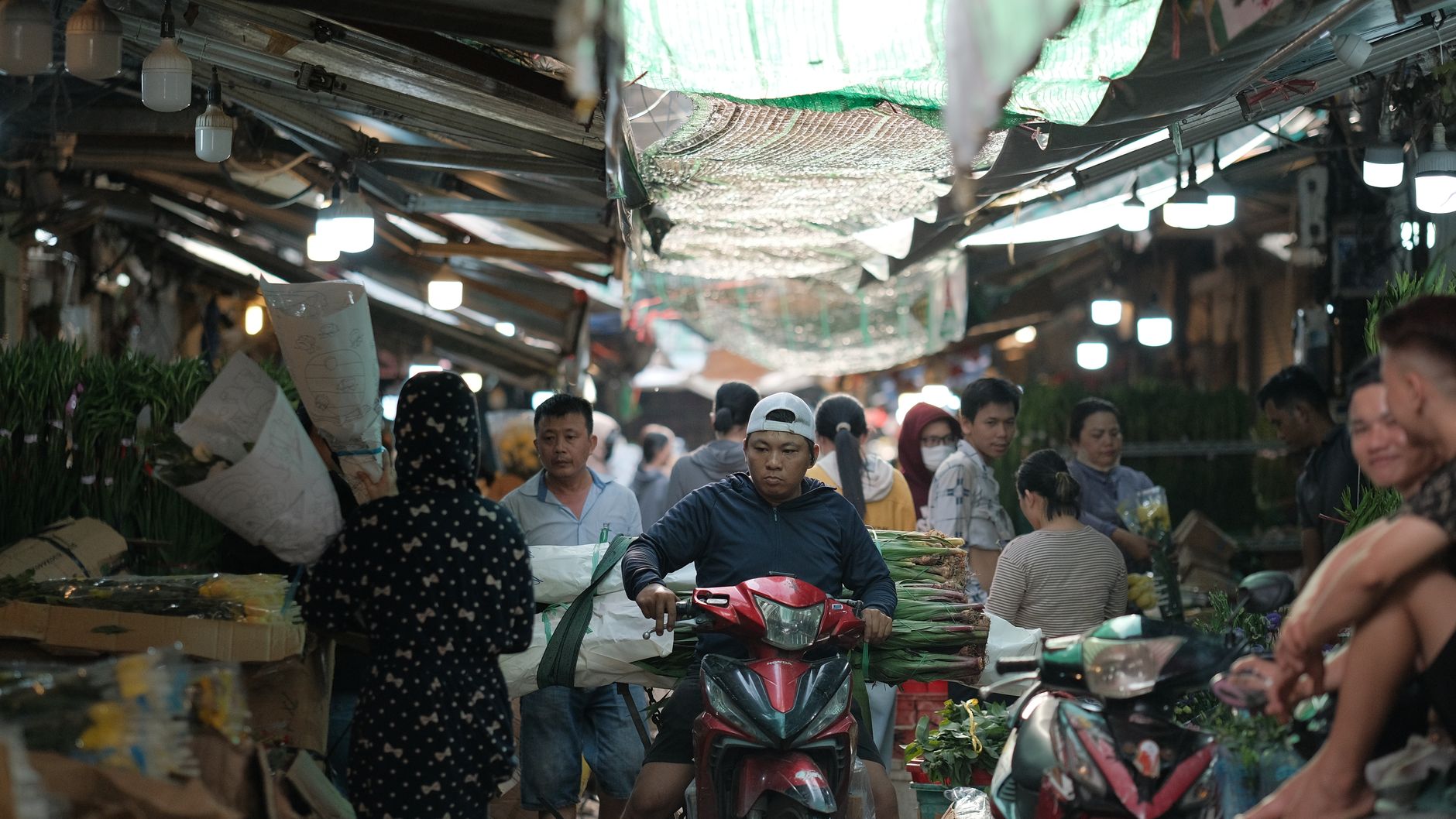
Quang Ba Flower Market (Chợ Hoa Quảng Bá) in Tây Hồ opens before 6 a.m. and closes by midday; most tourists visit 6–8 a.m. when energy peaks. Vietnam Flower Workshop by Hoa Lang Thang offers English-led market tours that decode wholesale prices, seasonal crops, and the unofficial haggle rules local florists use. You'll see orchids, roses, chrysanthemums, and tropical imports fresh off the truck, often 40–60% cheaper than retail shops. Tours run 2–3 hours and include stops at 5–7 stalls chosen by your guide based on what's in season and your flower interests. Many guests combine a market tour with our same-day bouquet-making workshop to arrange what they've learned to buy. No formal "cost per person" is published; ask us for a quote on WhatsApp. Wear sturdy shoes (wet concrete), bring a small bag, and don't touch flowers without permission—it's a working market, not a gallery. Ask for workshop dates on WhatsApp | ️ See how a class runs
What flowers are actually in season at Quang Ba right now?
Quang Ba's inventory shifts by Vietnamese lunar calendar, imports, and regional harvest timing. January–March brings chrysanthemums (mums), gladiolus, and imported roses; April–May features wild orchids and tropical heliconia; June–August is tight (heat kills many imports), so you see more local sunflowers and celosia; September–November explodes with chrysanthemums again and dahlias for Tết prep. December stocks imported lilies and poinsettias. Our tours show you the actual stall boards (handwritten, in Vietnamese) that list the day's arrival time and origin—so you know if roses came yesterday from Sa Đéc (domestic, cheaper, shorter vase life) or flown in from Ecuador (pricier, lasts 10+ days). We teach you to ask the seller: "Hôm nay về mấy giờ?" (What time today?) and "Bao lâu kém?" (How many days left?). Beginners often skip this step and buy flowers already two days old—they wilt within 48 hours at home.
Book a market tour + workshop

How do wholesale prices actually work—and can you haggle?
Wholesale prices are posted by the bunch (10, 20, or 50 stems), not per stem. A bunch of domestic roses costs 30,000–our current quote; imported roses 80,000–our current quote. Chrysanthemums are the cheapest (15,000–25,000 per bunch). Orchids vary wildly (80,000–300,000+ per stem, depending on size and color rarity). You can negotiate—but only if you're buying multiple bunches or returning regularly. A one-time tourist asking "lower price?" for a single bunch will hear "no." Sellers know tourists come once; they don't discount for volume. However, if you buy 3–5 bunches, they'll trim 5–10%. Our guides know which stalls respect repeat customers and which are strict. The real secret: go late (7–8 a.m., after the restaurant and hotel buyers leave) when stalls have overstock and are willing to move it. A bunch sitting for 2 hours loses value fast in summer heat. We time tours accordingly and teach you to spot tired flowers (drooping heads, browning leaf edges, soft stems).
| Flower type | Wholesale per bunch (VND) | Retail markup (typical) | Best time to find deals |
|---|---|---|---|
| Domestic roses | 30,000–50,000 | 2–3× | 7–8 a.m. or rainy days |
| Imported roses | 80,000–150,000 | 1.5–2× | 7:30+ a.m. |
| Chrysanthemums | 15,000–25,000 | 2.5–3× | Any time (high volume) |
| Orchids (premium) | 80,000–300,000+ | 2–4× | Early morning (fresh stock) |
| Seasonal (dahlias, gladiolus) | 40,000–80,000 | 2–2.5× | 1–2 weeks before holidays |
Our guides show you how to reverse-calculate what you're really paying. If a retail bouquet shop charges our current quote for a mixed design, they bought 60–70% of that in wholesale flowers. Knowing this helps you decide: is it cheaper to buy wholesale and arrange at home, or pay for a florist's labor and design skill? Most tourists realize that one market visit teaches them more about pricing than a year of Instagram shopping.
Which stalls sell retail to tourists, and which are wholesale-only?
Most stalls at Quang Ba are strictly wholesale—they don't sell single stems or small quantities and don't speak English. Our guides navigate this by establishing rapport with the handful of vendors who welcome tourists. These stalls (positions vary seasonally) will split bunches, explain flower conditioning, and sometimes offer "tourist mixes" in small bags: 3–5 stems of 4–5 varieties for 100,000–our current quote, already cut and wrapped. They're not cheaper than retail shops, but you get fresher stock and educational banter. Many guides have standing relationships; sellers will set aside rare orchids or unusual dahlias if you pre-order via WhatsApp. We teach you the key phrases: "Có bao giờ bán lẻ không?" (Do you ever sell single stems?), "Đó là hoa gì?" (What flower is that?), "Giá bao nhiêu?" (What's the price?). If a seller says no to singles, don't push—it disrupts their wholesale rhythm and makes you a hassle for the next tour group. Respect the market culture, and they'll be friendlier next time.
️ Combine your tour with a bouquet class
How do you keep flowers fresh from market to home in Hanoi heat?
The market opens in cool morning air (15–22°C); by 9 a.m., it's warming fast, and by noon it's 28–32°C. Flowers lose water rapidly—roses wilt 30% faster in summer heat than spring. We provide or recommend: (1) a small insulated bag or a damp cloth to wrap stems; (2) water bottles or a damp newspaper to keep bunches hydrated during the tour; (3) instructions to plunge stems in room-temperature water (not ice—it shocks them) the moment you reach home; (4) re-cut stems at 45° under running water before arranging (removes air blocks and opens vascular tissue). Many beginners skip the re-cut and wonder why flowers droop by evening. Our flower-arranging class covers stem conditioning in detail: how to strip lower leaves (they rot and breed bacteria), prune to 2–3 inches of clean stem, and use flower food (usually a packet in our supplies). In our Hanoi workshops (humid, 60–90% humidity), we keep buckets in a cool corner away from direct sun and change water daily. Guests learn that a rose bought at 7 a.m. can last 7–10 days if conditioned and arranged well, but the same flower neglected for 2 hours at the market then left in a vase without food dies by day 3.
Ask for workshop dates on WhatsApp

Should you visit Quang Ba alone or with a tour guide?
Solo visits work if you speak conversational Vietnamese, know which stalls are tourist-friendly, and have a camera or notes app to translate labels. Most solo tourists spend 60–90 minutes getting lost, asking questions in English (few sellers speak it), and overpaying because they don't know market prices. With an English-speaking guide, you compress 90 minutes into 120–150 minutes of learning—you see more stalls, understand grading systems, ask questions without shame, and leave with a mental map of seasonal flowers. Guides also handle safety (the market is busy and wet; a guide steers you clear of forklifts and puddles) and introduce you to vetted vendors. Many of our guests are travelers on tight itineraries or groups (hens, birthdays, team builds) who value time efficiency. We pair market tours with same-day workshop for travelers so you see production, buy flowers, and immediately practice arranging. Repeat visitors (expats living in Hanoi, locals) often skip tours and go directly to stalls they've built relationships with. A first-time visitor always benefits from a guide.
What to check before you book a tour
- Timing: Tours depart 6–6:30 a.m. to catch stalls at peak freshness. Arriving after 8 a.m. means slower energy and picked-over stock.
- Season: December–January are busiest (Tết prep); June–August have the smallest selection. Confirm flower types you want to see are in season.
- Group size: Intimate groups (1–4 people) get more vendor attention. Large groups (15+) move faster but see fewer deep conversations. Private tours are available; ask us for a quote on WhatsApp.
- Language: Our guides speak English fluently and teach key Vietnamese phrases. If you speak some Vietnamese, tell your guide—they'll let you practice with sellers.
- Follow-up arrangement: Decide if you want to arrange your purchases on the same day (book a same-day workshop) or take flowers home uncut. Raw stems in water last 3–4 hours at room temperature.
- Footwear & luggage: Wear closed-toe shoes with grip (concrete is wet and slippery). Bring a small bag; large luggage is awkward in crowded aisles.
- Dietary / accessibility: Tours involve standing and walking for 2–3 hours. We can slow the pace for mobility issues; mention this when booking.
Real examples: what guests typically buy and make
Scenario 1: A couple on their last day in Hanoi. They visit Quang Ba at 6:30 a.m., buy 2 bunches of imported roses (our current quote), 1 bunch of chrysanthemums (20,000), and some greenery. By 8:30 a.m., they're in our workshop learning spiral hand-tie technique. By 10:30 a.m., they've each made a bouquet (roses dominate, mums fill, eucalyptus greenery spirals). Cost of flowers: ~our current quote. Value of that bouquet at a retail shop: 400,000–our current quote. The experience—learning to haggle, seeing the market's energy, making it themselves—is priceless. They take photos, pack it in a box (we provide), and carry it home or to the airport (wrapped in damp paper, lasts 48 hours in checked luggage if kept cool).
Scenario 2: A hen party (8 bridesmaids). They book a private market tour + hen party workshop combo. Each person buys 1–2 bunches of mixed flowers (total ~1.2 million VND for the group). Back at the workshop, they make hand-tied bouquets together, laugh at technique mistakes, and use leftover flowers for a "bouquet tower" (stacked vessels with short stems). Photos are endless. Cost per person (split): ~our current quote flowers + workshop fee (ask us). Value if they'd ordered from a florist: 3–4× the cost.
Scenario 3: A local expat and their child (8 years old). They visit Quang Ba early, pick flowers with the guide (who explains colors and names), then do a kids and family workshop where the child learns to strip stems and arrange a small mixed posy. The child takes home a 30-stem design (mostly mums, some filler) and feels ownership. The parent realizes flowers don't have to be expensive or high-pressure—just fun, accessible, and fresh.
FAQ
Do I need to speak Vietnamese to visit Quang Ba?
Not if you book our English-led tour. Our guide speaks Vietnamese fluently and translates questions, prices, and vendor advice. If you go solo, basic phrases (flower names, "how much," "which is fresher") help—but most tourists manage with pointing and photos.
What's the cheapest flower at the market right now?
Chrysanthemums are consistently the cheapest (15,000–a quoted price per bunch of 20–30 stems). Dahlias and gladiolus are mid-range (40,000–80,000). Orchids and imported specialty flowers are priciest (80,000–300,000+). Prices shift weekly based on supply.
Can I bring flowers on an airplane after a market tour?
Yes. Keep stems in water until 2 hours before departure. Wrap in damp newspaper, place in a plastic bag, and pack in checked luggage where it's cool. Domestic flights (1–3 hours) work best. International flights are riskier—flowers may dehydrate or bruise. Many guests hand-carry a small bouquet in a small vase in their carry-on instead.
Is Quang Ba market safe for tourists?
Yes. It's a busy, working market—no crime, but lots of foot traffic, forklifts, wet surfaces, and early-morning energy. Wear sturdy shoes, keep bags secure, and stay aware. Our guides navigate crowded aisles and keep groups safe. Solo visitors should go during peak hours (6–8 a.m.) when light is good and vendors are focused.
How much should I plan to spend on flowers at Quang Ba?
Budget 200,000–a quoted price (~$8–20 USD) for a decent mixed bunch to take home, or 500,000–1 million VND (~$20–40) if you're buying enough to fill a large arrangement or for multiple people. High-end orchids or imported roses push prices higher. Most first-time tourists spend 300,000–a quoted price and are delighted by the freshness and value. --- ️ See how a class runs | Ask for workshop dates on WhatsApp | Explore our seasonal workshops
Ask for dates
Tell us the city, the date and how many people. We reply on WhatsApp in English with workshop options and a quote.
FAQ
Do I need to speak Vietnamese to visit Quang Ba?
Not if you book our English-led tour. Our guide speaks Vietnamese fluently and translates questions, prices, and vendor advice. If you go solo, basic phrases (flower names, "how much," "which is fresher") help—but most tourists manage with pointing and photos.
What's the cheapest flower at the market right now?
Chrysanthemums are consistently the cheapest (15,000–25,000 VND per bunch of 20–30 stems). Dahlias and gladiolus are mid-range (40,000–80,000). Orchids and imported specialty flowers are priciest (80,000–300,000+). Prices shift weekly based on supply.
Can I bring flowers on an airplane after a market tour?
Yes. Keep stems in water until 2 hours before departure. Wrap in damp newspaper, place in a plastic bag, and pack in checked luggage where it's cool. Domestic flights (1–3 hours) work best. International flights are riskier—flowers may dehydrate or bruise. Many guests hand-carry a small bouquet in a small vase in their carry-on instead.
Is Quang Ba market safe for tourists?
Yes. It's a busy, working market—no crime, but lots of foot traffic, forklifts, wet surfaces, and early-morning energy. Wear sturdy shoes, keep bags secure, and stay aware. Our guides navigate crowded aisles and keep groups safe. Solo visitors should go during peak hours (6–8 a.m.) when light is good and vendors are focused.
How much should I plan to spend on flowers at Quang Ba?
Budget 200,000–500,000 VND (~$8–20 USD) for a decent mixed bunch to take home, or 500,000–1 million VND (~$20–40) if you're buying enough to fill a large arrangement or for multiple people. High-end orchids or imported roses push prices higher. Most first-time tourists spend 300,000–600,000 VND and are delighted by the freshness and value. --- ✂️ See how a class runs | [🌸 Ask for workshop dates on WhatsApp](https://wa.me/84969293894) | [🎁 Explore our seasonal workshops](/seasonal)
More like this
Vietnamese flower culture
Vietnamese Flower Culture: What to Expect at a Hanoi Workshop
Vietnamese flower culture weaves ancient ritual, seasonal respect, and everyday beauty into a living practice that shapes how people celebrate, mourn, and connect. A workshop in Hanoi or Ho Chi Minh City reveals this firsthand—not as theory, but as skill you can use at home.
Vietnamese flower culture
Vietnamese Flower Culture for Beginners: What to Know
Vietnamese flower culture blends Buddhist symbolism, Lunar New Year tradition, and French colonial influence into a distinct aesthetic that beginners can learn through hands-on practice and market immersion.
Vietnamese flower culture
Vietnamese Flower Culture: Workshops & Traditions in Hanoi & HCMC
Vietnamese flower culture weaves centuries of symbolism—lotus for purity, chrysanthemums for longevity—into celebrations and daily life. We teach this living heritage through arranging workshops where travelers and expats craft authentic pieces using imported and local blooms.