
Home › Blog › Workshop guides
Hoan Kiem Creative Workshops for Tourists: Flower Design in Hanoi
By the Vietnam Flower Workshop team · 2026-11-06
Vietnam Flower Workshop by Hoa Lang Thang offers hands-on creative sessions in Hanoi near Hoan Kiem Lake, where tourists and expats learn real floral design techniques with imported and local flowers. A typical workshop runs 90–120 minutes: we teach conditioning (removing lower leaves, splitting woody stems), spiral hand-tie structure (the classic method that holds flowers at angles in a domed shape), and color balance so your arrangement doesn't look lopsided. You take your finished piece home the same day. Sessions are taught in English, small groups or private, and cost is confirmed on WhatsApp based on flower choice and group size. We adapt for rainy weather, kids, couples, and team-building parties. Beginners often grip stems too tight or add too many flowers too fast—we show you how to slow down and let the spiral build naturally. Heat and humidity are real challenges in Hanoi; we condition heavily and use techniques that keep arrangements fresh indoors for 5–7 days. Ask for workshop dates on WhatsApp
What exactly happens in a Hoan Kiem workshop session?
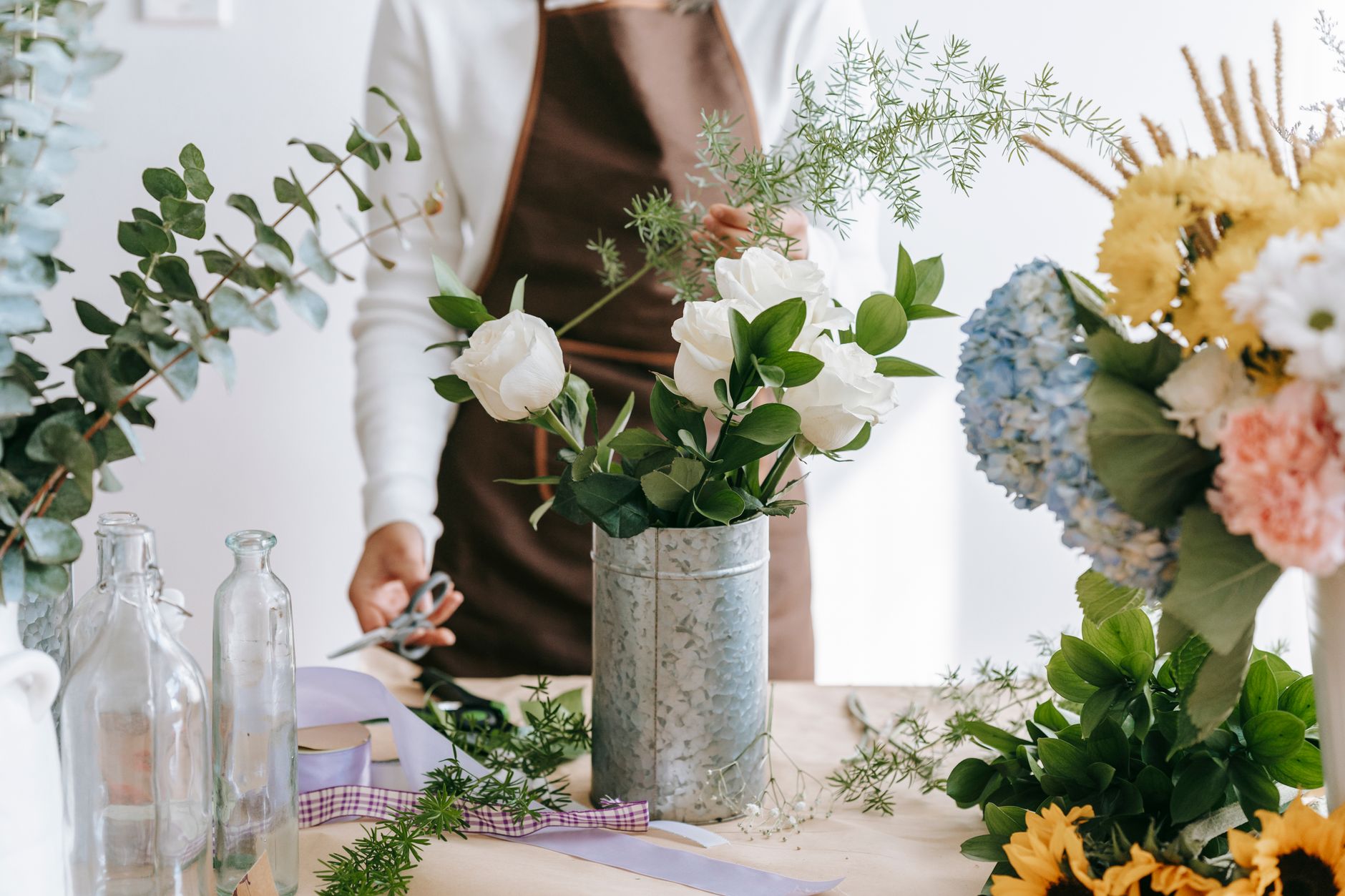
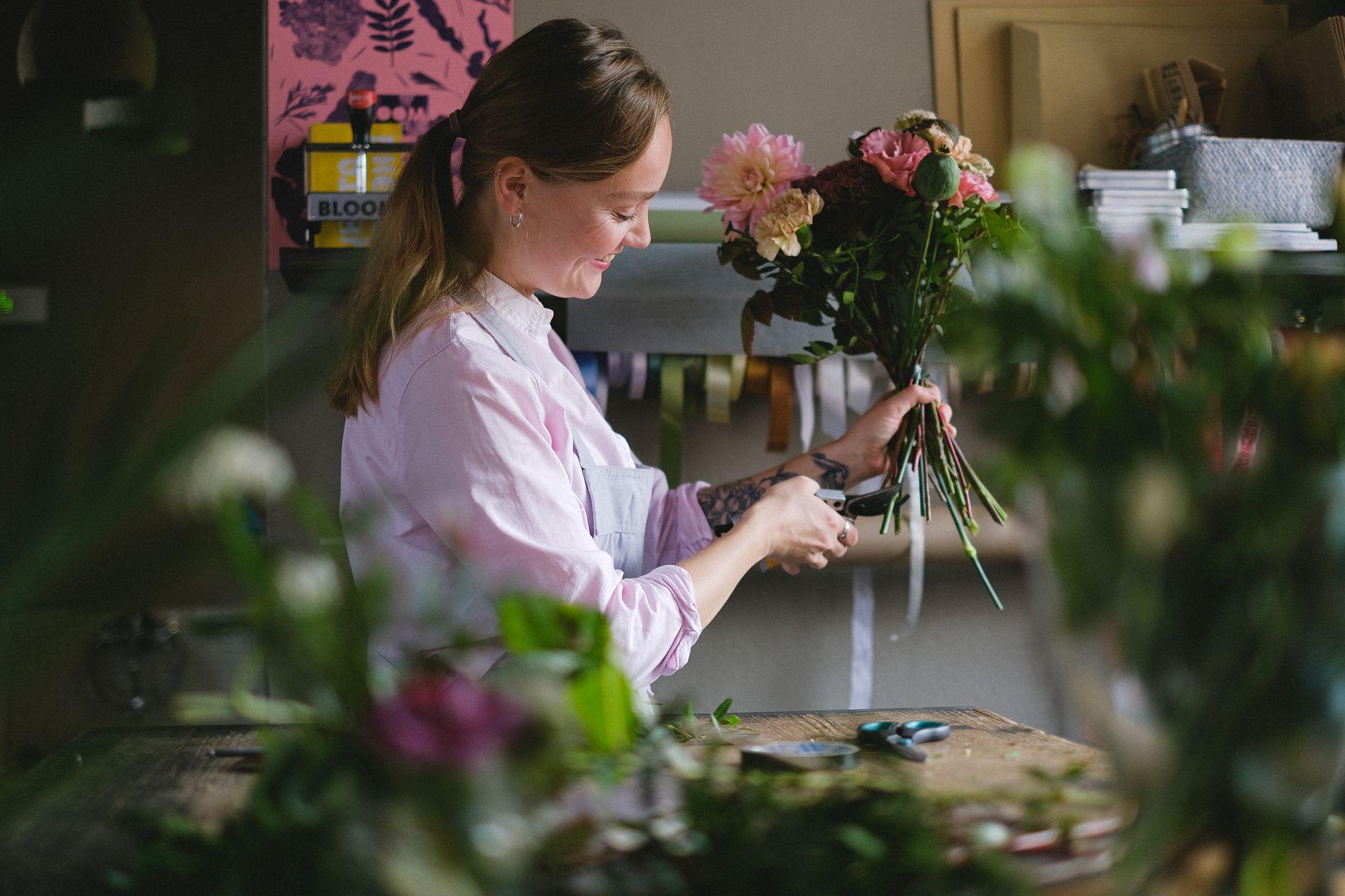
We start with a 10-minute introduction to your flowers: where they're from, how to read freshness (firm petals, green stems), and why conditioning matters in tropical heat. Next, 15–20 minutes conditioning: you'll strip lower leaves with your fingers, recut stems at 45 degrees under running water, and split woody bases with a knife. Then the core 40–60 minutes: spiral hand-tie technique, where you hold the focal flower (often a rose or chrysanthemum) and rotate the bunch as you add secondary flowers at angles—each layer creates a domed, professional shape. We stop every few minutes so you can check for gaps and balance. Last 15 minutes: we wrap the stems with tape, tie with twine, and trim the stems level. You photograph it, we bag it with care notes, and you leave with your arrangement. The whole arc teaches you to slow down, trust the spiral, and see how structure beats random stuffing.
Why do tourists choose workshops over buying finished bouquets?
Finished bouquets are fast, but workshops give you the skill and memory—you'll recognize good technique in flowers for months afterward. Many travelers tell us a class is their favorite Hanoi activity because it's calm, creative, and you have a keepsake that photos alone can't capture. You also learn why certain flowers die fast (heavy-petaled varieties in 30°C heat) and which ones last longer (chrysanthemums, carnations, hypericum berries), so you can order better arrangements at home. The personal touch—knowing you wired that stem yourself—changes how you see flowers forever. Beyond that, workshops are more intimate than crowds at tourist landmarks; you're in a working flower studio with real gardeners and florists, not a performance venue.
Learn more about flower arranging to see what other tourists discover.
What should a first-timer bring or know before arriving?
Wear clothes you don't mind getting wet; flower foam, stems, and tape leave marks. Bring your phone to photograph the final piece and capture the techniques we show you—you'll want to replay the spiral motion later. Tell us in advance if you have a favorite color (we stock coral, blush, white, deep red, purple, yellow, and green) or allergies (some people react to chrysanthemum pollen). Arrive 5–10 minutes early so we can settle in without rushing. If you're traveling with kids, let us know their age; we adapt the knife work and hand-tie to their reach and strength. Come with curiosity, not perfection—your first spiral won't be magazine-perfect, and ours weren't either. Our private sessions also let you book a specific time if group workshops don't fit your schedule.
Book a private session for you and travel companions
How do flowers survive Hanoi's heat and humidity after the workshop?
The tropical climate is our biggest challenge and our best teacher. During the workshop, we condition aggressively—longer stem splits, cold water dips, and removal of every leaf that would sit in water—because flowers here die 3–4 days faster than in temperate cities. We use floral foam (soaked 30 minutes before class) to keep stems constantly hydrated, unlike a dry hand-tie bouquet. After you leave, we give you a care card: change water every 2 days, recut 1 cm off the stem each time, keep the arrangement away from direct sun and AC vents (both speed wilting), and remove any leaves that fall into the water. Indoors with these steps, most mixed arrangements last 5–7 days; roses and hypericum last longer (7–10), while peonies and tulips fade faster (3–5). If you're traveling further, ask us about seasonal workshops that use hardy, long-lasting varieties—lotus in summer, chrysanthemums in autumn—built for transit and heat.
How do we adapt workshops for kids, groups, rainy weather, and celebrations?
Kids (age 4–12): We use shorter stems, lighter flowers (sunflowers, daisies, button chrysanthemums), and simpler structures—a loose posy instead of a tight spiral. A 60-minute session works best; they focus, create something they're proud of, and leave with energy still left. We handle all knife work; kids do the spiral and wrapping. Explore our kids and family workshops for age-by-age guidance and booking.
Groups (8–20 people): We run team-building sessions where each person makes one arrangement, or collaborative challenges where small teams design one piece together. Rainy days don't stop us—our studio is covered, water is already running, and wet floor mats keep everyone safe. We actually love rain because flowers stay fresher in high humidity.
Hen parties & birthdays: We do themed sessions—bride and bridesmaids each make a bouquet in coordinating colors, or guests compete in a "color-balance challenge" and vote on the best design. These run 2–3 hours with breaks for photos and chat. See our parties page for options and group pricing.
Corporate team building: We've run sessions for 6–15 people where each team member brings their own skill—some are natural with color, others with structure—and they learn to rely on each other. Check our team-building workshop details for how we frame it.
Comparison: Workshop Types at Hoan Kiem
| Workshop Type | Who It's For | Session Length | What You Make | Best If |
|---|---|---|---|---|
| Drop-in mixed arrangement | Solo travelers, curious first-timers | 90–120 min | One hand-tied bouquet | You want no booking stress |
| Private couples session | Honeymooners, anniversaries, partners | 90–150 min | 1–2 bouquets, your choice | You want privacy and a date memory |
| Kids & family | Families, age 4+, multi-skill levels | 60–90 min | One loose posy per child | Kids focus for 1 hour without boredom |
| Team-building | Corporate groups, 6–20 people | 120–180 min | One per person + collaborative piece | You want icebreaker and photo op |
| Hen & birthday parties | Groups celebrating, mixed skill | 2–3 hours | One per guest, themed | You want themes, competition, and fun |
| Seasonal (lotus, wreaths) | Travelers in Tet, Christmas, summer | 60–90 min | Seasonal specialty | You want authentic Vietnamese techniques |
| Floral design course | Serious learners, 4+ weeks | 3–4 hours × 4–8 weeks | Multiple styles, portfolio | You're considering floristry as a career |
How a beginner learns the spiral hand-tie: a step-by-step framework
Why spirals matter: A spiral creates a domed, professional shape that looks larger and more balanced than a gathered bunch. It's the foundation of all hand-tied bouquets worldwide.
Step 1: Hold the focal flower at chest height, stem pointing away. This is your anchor. Don't grip hard—thumb and forefinger only.
Step 2: Add your first secondary flower at a 45° angle, rotate the bunch slightly toward you. The new stem crosses the old one. You're building a crossing spiral, not stacking straight up. This angle is everything.
Step 3: Add a third flower on the opposite side, still at 45°, rotate again. Now you have three flowers in a triangle. The pattern becomes clear fast.
Step 4: Keep adding one flower at a time, always rotating and angling, until the handle fills. Stop when you have 5–7 stems in hand. Don't rush. Too many flowers too fast collapses the spiral.
Step 5: Check from above—the spiral should look like a dome, gaps are okay. Step back and adjust by removing one flower if it's too dense, or adding a delicate filler if you see holes.
Step 6: Tie the handle with floral tape, wrap with twine, trim stems level. Tape first (sticky, holds everything), then twine (aesthetic and protection).
What beginners get wrong: Gripping too tight, adding flowers too fast, not rotating enough, and angling everything straight up instead of out. The fix is to breathe, go slow, and trust that each flower will find its place if you keep the angle and rotation consistent.
See how our flower arranging class teaches this in real time.
What to check before you book a workshop at Hoan Kiem
- Confirm dates and times on WhatsApp – We reply as soon as we can on WhatsApp; mind the time difference if you're booking from abroad. Availability changes based on flower stock and group bookings.
- Tell us your flower preferences – Colors, allergies, and whether you want imported or local varieties. We always have stock, but bespoke colors take a heads-up.
- Clarify group size and ages – Solo workshops run differently from groups of 10. Kids under 4 can observe but need a caregiver's hands for knife work.
- Ask about our studio location – We're in Hoan Kiem district, central and easy to find. Ask us for exact directions and nearby landmarks (coffee shops, parks, street names—we describe by type, not name).
- Check the weather forecast – Rain doesn't cancel us, but extreme heat (above 35°C) means we start earlier or offer a different date. We adapt, but it's good to know.
- Bring a bag or ask about takeaway packaging – Your arrangement is fragile; we bag it carefully, but a sturdy carrier is smart if you're traveling onward.
Why choose Vietnam Flower Workshop by Hoa Lang Thang for Hoan Kiem tourists?
We're not a one-off tourist attraction; we're a working flower studio where florists and designers teach. Every flower—imported roses, local chrysanthemums, seasonal lotus—is real, not foam or silk. You're learning in the same space where we fill daily orders, so the energy and techniques are current and honest. We've adapted our teaching for travelers (English-only classes, no prior experience assumed), heat-resistant methods (that work because Hanoi is hot), and celebrations (we know how to make a hen party memorable or a couple's anniversary intimate). We won't oversell or promise more than we can deliver; we'll tell you if your arrangement might not last 14 days in a suitcase, and we'll show you how to care for it if you want to try. Your finished piece is yours to take home—no shipping, no middleman, just the skill and the flowers you made with your own hands.
Ask for workshop dates on WhatsApp | Ready to book? We reply as soon as we can.
Workshops pair well with other experiences at Hoan Kiem
A half-day workshop leaves time for a walk around Hoan Kiem Lake, a visit to nearby coffee shops (specialty café culture is strong here), or an evening dinner. Some travelers combine a morning workshop with an afternoon tour of local flower markets and Vietnamese flower culture—you'll see where our flowers come from and understand seasonal varieties, color symbolism, and Tet traditions. That combo gives you both hands-on skill and cultural context.

FAQ
Do I need any flower experience to join a workshop?
No. We teach beginners every week. The spiral hand-tie, conditioning, and color balance are skills we show step-by-step. You'll make mistakes (everyone does), and that's where learning happens. By the end, most people grip the spiral and hold a good shape on their own.
What if my arrangement doesn't look perfect?
Perfection isn't the goal—learning and enjoying the process are. Your first spiral will look different from your fifth, and that's beautiful. We celebrate the effort and the learning. Flowers are forgiving; asymmetry often looks better than rigid symmetry anyway.
How long does my finished bouquet last after the workshop?
Indoors with fresh water and the care card we give you, 5–7 days is typical for mixed arrangements. Roses and hypericum last 7–10 days; softer petals like peonies, 3–5. Heat and direct sunlight speed wilting. We teach you how to recut and refresh to stretch longevity.
Can I book a private session just for myself, or do I have to join a group?
We offer both. Drop-in group workshops are social and cheaper; private sessions are for one person, couples, or small families who want focused attention and a chosen time. Ask us about private and couples sessions for availability.
What happens if it rains on the day of my workshop?
Workshops run rain or shine. Our studio is covered, water is running, and wet floors don't stop us—flowers actually stay fresher in humid weather. Rainy days are often our best for flower longevity. Just wear clothes you don't mind getting wet.
Do you ship finished arrangements or offer delivery?
No. We deliver same-day in Hanoi and Ho Chi Minh City, but workshops are hands-on only—you make it, you carry it home. If you need a pre-made bouquet delivered, ask us on WhatsApp and we can discuss that separately. Our workshops are about you learning and making, not us making and shipping.
Can children join, and at what age?
Yes, from age 4 and up. We adapt knife work, stem length, and spiral complexity to their reach and focus span. A 60-minute session works best for young kids; school-age (7+) can handle the full 90–120 minutes. See our kids and family workshop page for age-by-age details.
What's the difference between a bouquet workshop and a flower arranging class?
Bouquet workshops focus on hand-tied techniques and wrapping; flower arranging classes include foam-based arrangements, vases, and seasonal designs. Bouquets are portable and wrapped; arrangements are in containers. Both teach spiral or structure, but bouquets are our signature for travelers because you walk out with a finished, gift-ready piece.
Ask for dates
Tell us the city, the date and how many people. We reply on WhatsApp in English with workshop options and a quote.
FAQ
Do I need any flower experience to join a workshop?
No. We teach beginners every week. The spiral hand-tie, conditioning, and color balance are skills we show step-by-step. You'll make mistakes (everyone does), and that's where learning happens. By the end, most people grip the spiral and hold a good shape on their own.
What if my arrangement doesn't look perfect?
Perfection isn't the goal—learning and enjoying the process are. Your first spiral will look different from your fifth, and that's beautiful. We celebrate the effort and the learning. Flowers are forgiving; asymmetry often looks better than rigid symmetry anyway.
How long does my finished bouquet last after the workshop?
Indoors with fresh water and the care card we give you, 5–7 days is typical for mixed arrangements. Roses and hypericum last 7–10 days; softer petals like peonies, 3–5. Heat and direct sunlight speed wilting. We teach you how to recut and refresh to stretch longevity.
Can I book a private session just for myself, or do I have to join a group?
We offer both. Drop-in group workshops are social and cheaper; private sessions are for one person, couples, or small families who want focused attention and a chosen time. [Ask us about private and couples sessions](/private-and-couples) for availability.
What happens if it rains on the day of my workshop?
Workshops run rain or shine. Our studio is covered, water is running, and wet floors don't stop us—flowers actually stay fresher in humid weather. Rainy days are often our best for flower longevity. Just wear clothes you don't mind getting wet.
Do you ship finished arrangements or offer delivery?
No. We deliver same-day in Hanoi and Ho Chi Minh City, but workshops are hands-on only—you make it, you carry it home. If you need a pre-made bouquet delivered, ask us on WhatsApp and we can discuss that separately. Our workshops are about you learning and making, not us making and shipping.
Can children join, and at what age?
Yes, from age 4 and up. We adapt knife work, stem length, and spiral complexity to their reach and focus span. A 60-minute session works best for young kids; school-age (7+) can handle the full 90–120 minutes. [See our kids and family workshop page](/kids-and-family) for age-by-age details.
What's the difference between a bouquet workshop and a flower arranging class?
[Bouquet workshops](/bouquet-workshop) focus on hand-tied techniques and wrapping; [flower arranging classes](/flower-arranging-class) include foam-based arrangements, vases, and seasonal designs. Bouquets are portable and wrapped; arrangements are in containers. Both teach spiral or structure, but bouquets are our signature for travelers because you walk out with a finished, gift-ready piece.
More like this
Workshop guides
Hoan Kiem Unique Experiences With Flowers: Hand-Tie Classes in Hanoi
Hoan Kiem offers a quiet retreat for flower lovers who want to create their own arrangements hands-on, not just admire them in shops. Vietnam Flower Workshop by Hoa Lang Thang runs intimate classes near the lake where you condition stems, master spiral hand-ties, and walk away with a finished bouque
Workshop guides
Hoan Kiem rainy day activities workshop: flower arranging indoors
Rainy days in Hoan Kiem don't mean you're stuck at your hotel. Vietnam Flower Workshop by Hoa Lang Thang runs fully indoors in central Hanoi, teaching real flower arranging techniques while tropical rain falls outside—and you leave with your own hand-tied bouquet.
Workshop guides
Hoan Kiem Flower Market Guide: Where to Buy & Learn
Hoan Kiem flower market in central Hanoi buzzes with fresh blooms year-round. Learn what to expect, how to pick quality flowers, and why a workshop beats shopping alone.