
Home › Blog › Vietnamese flower culture
Vietnamese Flower Culture in Ho Chi Minh City: What to Buy & Experience
By the Vietnam Flower Workshop team · 2026-11-06
Vietnamese flower culture in Ho Chi Minh City centers on seasonal blooms, symbolic colors, and hand-tied arrangements passed down through generations. Locals buy flowers at wet markets (peony, chrysanthemum, and orchid in winter; lotus and sunflower in summer), temple shops, and roadsides. Tet season (January–February) drives peak demand for lucky red and gold flowers. Same-day delivery in Hanoi and Ho Chi Minh City is available; ask us for a quote on WhatsApp. Most visitors and expats learn these traditions best hands-on: Vietnam Flower Workshop by Hoa Lang Thang runs sessions where you condition stems, practice spiral hand-ties, and take home what you've made. Beginners often overstuff arrangements or grip stems too tight—instructors show you the local rhythm. Heat and humidity mean flowers last 4–5 days indoors with daily water changes; we teach re-cutting and conditioning so your arrangement survives the climate. ️ See how a class runs
What flowers do locals buy in Ho Chi Minh City?
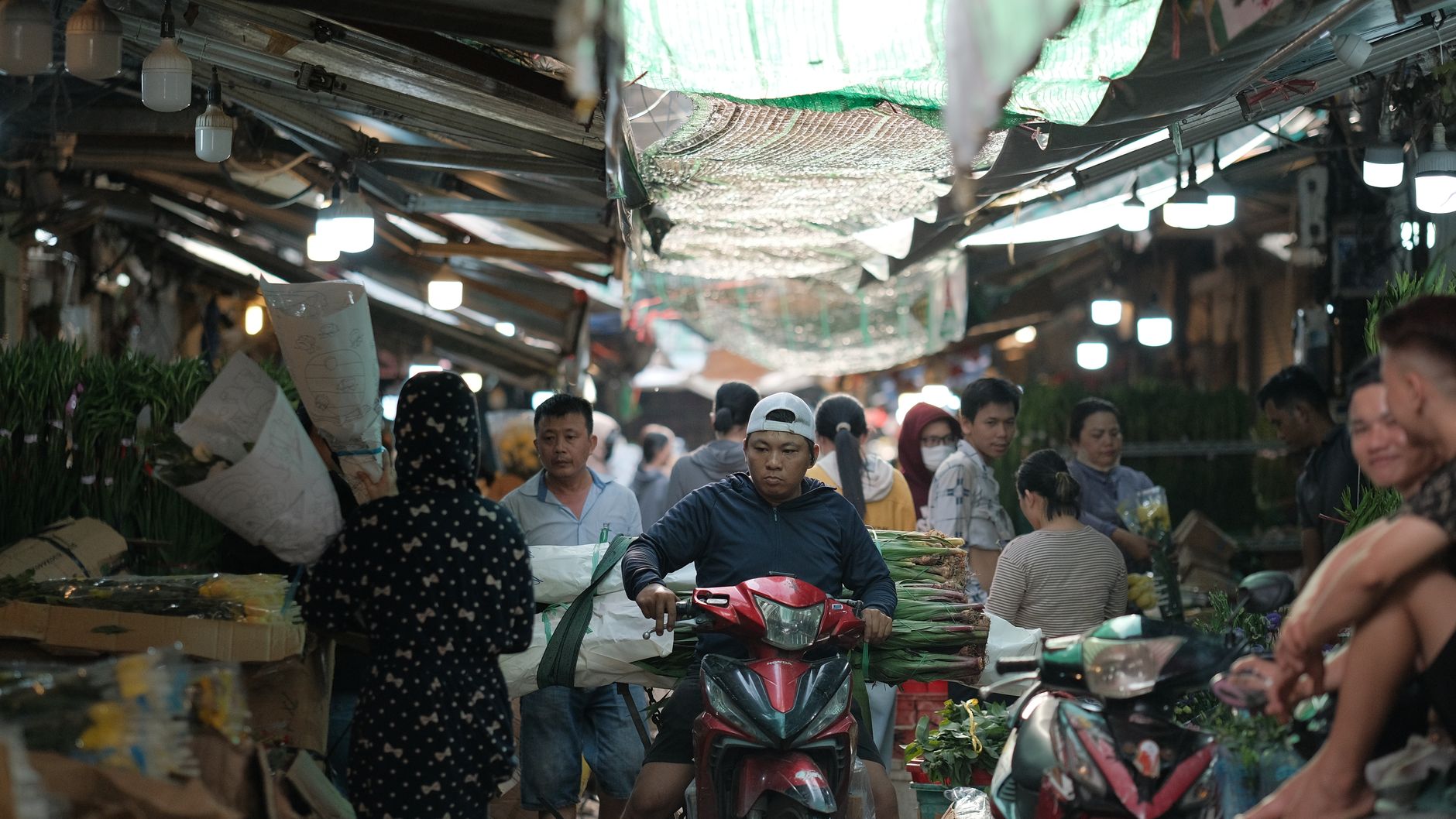
Locals buy based on season, occasion, and symbolism. Winter (November–February) sees high demand for peonies, chrysanthemums, and carnations; summer favors sunflowers, celosia, and locally grown lotus. Red and pink blooms are gifts; white and yellow flowers go to temples or funerals. Tet is the biggest buying season—chrysanthemums (gold for wealth), peach blossoms (northern tradition, still popular), and kumquat branches fill homes and shops for two weeks. Orchids, always luxury, mark weddings and corporate gifts. Street vendors and wet markets stock what's fresh that day; expats and travelers often don't know which flowers are in season, so we guide you during our market tours and culture sessions to understand the rhythm and see why a florist recommends one bloom over another.

Why does Ho Chi Minh City's heat kill flowers so fast?
Temperatures above 32°C (90°F) and humidity above 80% (typical June–September) accelerate wilting. Stems lose water faster than roots can replace it; flowers close early or drop petals. Imported cold-chain roses last 3–4 days; hardy local chrysanthemums last 7–10 days if kept cool. We teach re-cutting (slicing 2 cm off stems at 45°, removing lower leaves) and placing arrangements in shade near air conditioning. Daily water changes—flushing the vase and adding fresh water—remove bacterial buildup that clogs stems. Never use hot water; room temperature or cooler slows respiration. Floral food packets (which we include in workshop take-homes) lower pH and feed blooms, but the biggest factor is vase placement: a sunny windowsill kills flowers in 2 days; a shaded corner extends life to 5–7. During our seasonal workshops, we show tricks for monsoon and high-heat displays so your arrangement—or a gift you give—survives the environment.
Ask for workshop dates on WhatsApp
What's the difference between hand-tied bouquets and arranged gifts?
Hand-tied bouquets (what street vendors and upmarket florists sell) are stems spiraled in one hand, roots exposed, wrapped in paper or cellophane—they're portable, casual, and ready-to-carry. Arranged gifts sit in a vase, foam, or box; they're styled for display and last longer in water because stems stay submerged.
| Type | Who buys it | Lifespan | Best for |
|---|---|---|---|
| Hand-tied bouquet | Office workers, quick gifts, date nights | 4–5 days (if re-cut daily) | Personal, spontaneous, portable |
| Vased arrangement | Home décor, Tet, corporate lobbies | 7–10 days | Lasting impression, formal settings |
| Flower box | Luxury gifts, events, social media | 5–7 days | Surprise reveals, gift impact |
Hand-tied is what locals do: fast, affordable, expressive. Arranged or boxed is what travelers and expats often request—it feels finished. We teach both in our bouquet and hand-tie workshops; beginners struggle most with the spiral—they bunch stems parallel instead of rotating each stem slightly, which weakens the structure. The spiral distributes weight evenly and lets water reach every stem.
How do Tet flower traditions shape what you should order?
Tet (Lunar New Year, late January or early February) is when 80% of annual flower spending happens locally. Red and gold blooms symbolize luck and prosperity; peach blossoms (from the north) and kumquat branches (from the south) are regional icons. Chrysanthemums, especially dyed gold, fill homes and temples. Many expats, couples, and families want to join this tradition but don't know what to choose. Red carnations or roses work if peach isn't available. Gold spray-painted chrysanthemums are common (some prefer natural color). Orchids in red or pink are upscale Tet gifts. Our seasonal workshops during November–January teach you to create Tet arrangements—conditioning blooms for the heat, balancing traditional red with modern pastels, and wrapping in lucky red or gold paper. Ordering for Tet is urgent because stock runs low; ask us for a quote on WhatsApp early. We can tell you what's fresh that week and help you choose blooms that match your space and budget.
What should you check before buying flowers or booking a workshop?
Before ordering a bouquet or arrangement:
- Occasion & budget: Casual gift vs. formal? Ask us for a quote on WhatsApp; we'll tell you what's available and sustainable pricing.
- Recipient's space: Small apartment or large home? Dark corner or sunny shelf? Heat and humidity vary by floor; we ask these details to recommend longevity.
- Allergies or preferences: Some dislike fragrant lilies; others avoid white (funeral connotation). Tell us upfront.
- Delivery timing: Same-day delivery in Hanoi and Ho Chi Minh City is available; availability is confirmed on WhatsApp. Don't assume next-day for large orders.
Before booking a workshop:
- Group size: Solo, couple, or team? We run private and couple sessions, team building workshops, and parties (hen, birthday)—each needs different timing and flower volume.
- Skill level: Beginners worry about "ruining" flowers. We use affordable, hardy local blooms so mistakes teach, not frustrate.
- Heat readiness: Workshops run year-round; July–August are hottest. We provide cool water, frequent breaks, and we take arrangements indoors immediately after (not left in sun).
- Language & culture: We teach in English; many expats are curious about why locals choose certain colors. We explain symbolism, not just technique.
- Output: Do you want to take home a finished bouquet or a small arrangement to practice? We adjust materials so every person leaves with something they made and love.
Ask for workshop dates on WhatsApp
Where do you learn real Ho Chi Minh City flower skills?
Wet markets are free observation; you see vendors and locals in action, but no hands-on teaching. Instagram floral accounts show aesthetics, not heat survival. We offer hands-on workshops where you learn to condition stems (slice at 45°, remove thorns, strip lower leaves under water to prevent air pockets), spiral-hand-tie (the core local technique), and color-balance for the climate. Tourists and travelers often book half-day sessions; couples book private dates combining culture and creativity; families and kids book family workshops with softer stems and lower tables. Longer floral design courses run 4–8 weeks for those wanting professional depth. All sessions use real imported and local flowers that you take home—not plastic, not old stock. We teach you to spot fresh blooms (firm stems, no brown edges, petals tight not drooping) so you buy smart afterward.
How do children and groups learn differently from solo learners?
Children (ages 5–12) struggle with hand strength and patience; we use softer stems (celosia, leather leaf), shorter arrangements (8–10 inches), and lower work tables. Kids often succeed with "flower box and basket classes" where layering is more forgiving than spiral hand-tie. Groups (6–15 people) need management: we pre-cut stems, organize color by table, and stagger instruction so no one waits. Hen and birthday parties are festive; we keep arrangements simple and fun, with color themes and photo moments. Team building workshops focus on collaboration—pairs or trios work on one arrangement, teaching communication and shared outcome.
️ See how a class runs

What's one technique you can try at home right now?
The re-cut and water refresh (saves wilting bouquets):
- Strip all leaves below the water line (bacteria on leaves rots stems).
- Slice 2 cm off the base of each stem at 45° with a sharp knife (increases surface area).
- Place in fresh, cool water immediately (don't let stems dry).
- Do this every 2–3 days; flowers last twice as long.
This one habit—taught in every class—is why locals' bouquets survive Ho Chi Minh City's heat when expats' wilt in two days. You need nothing fancy: a clean knife, cool water, five minutes. Try it on your next market bouquet and compare it to one you don't refresh. The difference is dramatic.
How do we customize workshops for rainy season?
June–October monsoons mean less ambient heat but more humidity and mold risk. We move workshops indoors (our studio spaces in Hanoi and Ho Chi Minh City), use dehumidifiers, and shorten arranging time so flowers don't sit wet. We teach anti-mold practices: remove fallen petals daily, ensure vase water drains fully (no stagnant water), and space stems so air circulates. Rainy-season blooms are heartier (mums, anthurium); imported roses are riskier. We swap materials and charge the same; we reply as soon as we can on WhatsApp if you're booking during this season.
How does Vietnamese flower culture differ from Western traditions?
Western arrangements often use focal flowers (one big bloom centered) and lots of filler (baby's breath). Vietnamese style favors line, asymmetry, and natural form—stems show, negative space breathes, and blooms are balanced by height and direction, not density. Symbolism differs: white flowers are avoided (funerals); red is luck and joy. Lotus (a national symbol) appears in spiritual and wedding settings. Hand-tie is the standard—vases are for display afterward, not arrangement mechanics. Our classes teach you to see and work Vietnamese style so your arrangements feel local, not imported. Expats often arrive expecting Western floristry; they leave understanding why locals choose sparse beauty over lush.
Can you learn floral design professionally in Ho Chi Minh City?
Yes. Our floral design course runs longer formats (ask us for a quote on WhatsApp on structure and timing). You learn stem conditioning, color theory, seasonal sourcing, Tet and holiday design, and business basics if you're considering freelance or small-business florist work. We use real flowers—not practice materials—so cost and decision-making are authentic. We link to market tours and teach you to source wholesale. Most students are expats, travelers staying long-term, or locals wanting to refresh skills. No prior experience needed; hands-on rhythm builds confidence fast.
What to expect: a typical workshop minute-by-minute
Minutes 1–10: Greeting, space tour, flower talk. We show you fresh blooms, explain seasonal picking, and answer quick questions about symbolism and heat.
Minutes 11–20: Conditioning demo. You watch (and we narrate) how we strip leaves, slice stems, and remove thorns. You're invited to try one stem.
Minutes 21–35: Your first arrangement. You select blooms, we guide color balance and stem length. Most beginners make mistakes (too thick, too short, petals touching)—we adjust gently, never throw out their work.
Minutes 36–50: Second piece or refinement. Second attempts are always better; you feel the difference. Photos happen here.
Minutes 51–60: Wrapping, care card, goodbyes. Your arrangement goes into a water-filled bag or box; we print care instructions (re-cut, water change timing, placement tips).
Classes vary by format (half-day, full-day, couple, group), but this rhythm holds. We move slower with kids, faster with repeat guests.
Comparing bouquet sources in Ho Chi Minh City
| Source | Pros | Cons | Best for |
|---|---|---|---|
| Wet market vendor | Cheap, fresh, same-day | No consistency, no wrapping, haggling | Quick personal gifts, learners |
| Upmarket florist shop | Polished, imported options, delivery | Higher cost, may not survive heat well, no teaching | Corporate gifts, formal events |
| Workshop (us) | You make it, learn technique, affordable, heat-smart | Takes 1–3 hours, group energy, not instant | Personal growth, couples, events, travelers |
FAQ
Do I need to book a workshop in advance, or can I walk in?
We confirm availability on WhatsApp before you arrive. Walk-ins are welcome if space allows, but booking ensures materials, instructor time, and a smooth session. Reply time is quick on WhatsApp.
What's the cheapest way to get fresh flowers in Ho Chi Minh City?
Wet markets (street-level or covered) are cheapest; expect to negotiate and pick mixed bunches. Same quality, no markup. Our workshops cost more because you learn technique and take home a finished piece—you're paying for the experience and skill, not just blooms.
How long do flowers last if I take them home from a workshop?
5–7 days indoors (cool, shaded, with daily water changes and re-cutting). In direct sun or without care, 2–3 days. Heat kills faster than cold. We print care cards so you maximize lifespan.
Can I buy a bouquet from you for same-day delivery without taking a workshop?
Yes. Same-day delivery in Hanoi and Ho Chi Minh City is available; ask us for a quote on WhatsApp. We confirm timing and your address, and we tell you what's fresh that day.
Are there workshops for couples who want to make a bouquet together?
Yes. Private and couple sessions are designed for two people; you work on one arrangement or each make your own. It's romantic, collaborative, and takes about 90 minutes. Ask us for a quote on WhatsApp.
What if I'm allergic to pollen or fragrant flowers?
Tell us before booking. We use low-pollen blooms (roses, carnations) and avoid lilies and heavy-scent flowers. Workshops and bouquets can be tailored; just ask on WhatsApp.
Do you deliver outside Ho Chi Minh City?
We deliver in Hanoi and Ho Chi Minh City only. If you're in another location, we can suggest nearby options or help you learn to source and arrange yourself during a visit.
Is there a best time of year to learn flower arranging in Ho Chi Minh City?
November–February (Tet season and cooler weather) is peak; flowers last longest, and cultural meaning is richest. June–September are hot and humid, but we teach you heat-survival techniques. Any season works; we adjust materials and pacing. Ask for workshop dates on WhatsApp
Ask for dates
Tell us the city, the date and how many people. We reply on WhatsApp in English with workshop options and a quote.
FAQ
Do I need to book a workshop in advance, or can I walk in?
We confirm availability on WhatsApp before you arrive. Walk-ins are welcome if space allows, but booking ensures materials, instructor time, and a smooth session. Reply time is quick on WhatsApp.
What's the cheapest way to get fresh flowers in Ho Chi Minh City?
Wet markets (street-level or covered) are cheapest; expect to negotiate and pick mixed bunches. Same quality, no markup. Our workshops cost more because you learn technique and take home a finished piece—you're paying for the experience and skill, not just blooms.
How long do flowers last if I take them home from a workshop?
5–7 days indoors (cool, shaded, with daily water changes and re-cutting). In direct sun or without care, 2–3 days. Heat kills faster than cold. We print care cards so you maximize lifespan.
Can I buy a bouquet from you for same-day delivery without taking a workshop?
Yes. Same-day delivery in Hanoi and Ho Chi Minh City is available; ask us for a quote on WhatsApp. We confirm timing and your address, and we tell you what's fresh that day.
Are there workshops for couples who want to make a bouquet together?
Yes. [Private and couple sessions](/private-and-couples) are designed for two people; you work on one arrangement or each make your own. It's romantic, collaborative, and takes about 90 minutes. Ask us for a quote on WhatsApp.
What if I'm allergic to pollen or fragrant flowers?
Tell us before booking. We use low-pollen blooms (roses, carnations) and avoid lilies and heavy-scent flowers. Workshops and bouquets can be tailored; just ask on WhatsApp.
Do you deliver outside Ho Chi Minh City?
We deliver in Hanoi and Ho Chi Minh City only. If you're in another location, we can suggest nearby options or help you learn to source and arrange yourself during a visit.
Is there a best time of year to learn flower arranging in Ho Chi Minh City?
November–February (Tet season and cooler weather) is peak; flowers last longest, and cultural meaning is richest. June–September are hot and humid, but we teach you heat-survival techniques. Any season works; we adjust materials and pacing. [🌸 Ask for workshop dates on WhatsApp](https://wa.me/84969293894)
More like this
Vietnamese flower culture
Vietnamese Flower Culture: What to Wear & Why It Matters
Vietnamese flower traditions shape dress codes at celebrations and sacred spaces. We show you what's appropriate and how florals guide your wardrobe choices.
Vietnamese flower culture
Vietnamese Flower Culture: A Rainy Day Workshop in Hanoi & HCMC
Vietnamese flower culture thrives year-round, even when monsoon rains drench Hanoi and Ho Chi Minh City. A rainy day flower workshop lets you dive into this tradition indoors—conditioning stems, mastering spiral hand-ties, and learning why lotus and chrysanthemum hold such meaning in Vietnamese life
Vietnamese flower culture
Vietnamese Flower Culture in Hanoi: What to Buy & Experience
Vietnamese flower culture in Hanoi blends ancestral symbolism with living practice. Visitors can explore markets, learn arranging techniques, and take home their own seasonal designs.