
Home › Blog › Workshop guides
Hanoi Flower Market Guide: Where to Learn, Shop & Arrange
By the Vietnam Flower Workshop team · 2026-11-06
Hanoi's flower markets cluster in the Old Quarter and suburban hubs like Nhat Tan, where wholesale vendors sell everything from imported roses to local lotus. Most open early (4–6 am) but tourist-friendly hours are 8 am–2 pm. You can walk, buy stems, and learn conditioning on the spot—but serious learners come to us: Vietnam Flower Workshop by Hoa Lang Thang teaches market navigation, stem selection, and hand-tying in hands-on sessions where you source flowers, arrange them, and take your work home. Beginners often overpay or choose wilted stems; we show you freshness cues, color balance, and heat survival strategies specific to Hanoi's humidity. Sessions run in English for travelers and locals, with real imported and local flowers you arrange yourself. Ask for workshop dates on WhatsApp
Where are Hanoi's main flower markets and when do they open?
Hanoi's largest markets are in the Old Quarter (Hang Dau and surrounding alleys), Nhat Tan on the outskirts (bigger, cheaper, wholesale-focused), and smaller vendor clusters near Hoan Kiem Lake. Most open 4–6 am for trade; 9 am–1 pm is best for tourists who want crowds smaller than dawn rush but full stock. Nhat Tan is 20–30 minutes from central Hanoi by taxi; Old Quarter is walkable. We teach our tourist workshops with market tours included—you visit with guidance, learn what florists look for, then arrange back at our studio. This saves the typical beginner's mistake: buying beautiful but already-wilting imports or not knowing local seasonal peaks.
Key question: Are you after volume (wholesale) or quality samples for learning?

What flowers are actually in season in Hanoi, and why does it matter?
Hanoi's heat and monsoon cycles shape availability and price. Year-round: sunflowers, carnations, green chrysanthemums, and lilies (imported). Spring (Feb–April): tulips, hyacinths, local peonies, and roses peak in quality. Summer (May–Aug): heat stress hits; imports struggle; local dahlia and celosia thrive. Autumn (Sept–Nov): roses and chrysanthemums return strong. Winter (Dec–Jan): Christmas imports, amaryllis, and premium roses flood in. Prices drop in peak season and spike in off-season—so a beginner's our current quote Valentine bouquet costs our current quote in June. Humidity also damages certain flowers: delicate sweet peas wilt fast; succulents and tropical anthurium hold better. Our seasonal workshops teach which flowers to buy when, how to condition each type for Hanoi's 80%+ humidity, and wrapping that keeps them cool. A spiral hand-tie with proper stem hydration can add 5–7 extra days of life in our climate—but only if you choose wisely at the market first.
Decision: Will your flowers be displayed in a cool room or humid kitchen? That changes which stems to buy.
How do you pick fresh flowers vs. wilted ones—the beginner's mistake?
Beginners grab pretty faces without checking stems and leaf color. Here's what florists check in 10 seconds:
- Stem firmness: Bend gently; fresh stems snap slightly or bend slowly. Soft, bendy stems = already water-stressed or aged.
- Leaf color: Bright, turgid green leaves mean hydration. Brown, papery, or yellowing edges = dehydration or disease.
- Petal/sepal edges: Crisp edges = fresh. Curled, brown, or bruised = days old or damaged.
- Smell: Rot or vinegar smell = bacterial decline. No smell is fine.
- Closed buds (if relevant): Tight, plump, symmetrical = good. Loose, drying, or lopsided = weak genetics or stress.
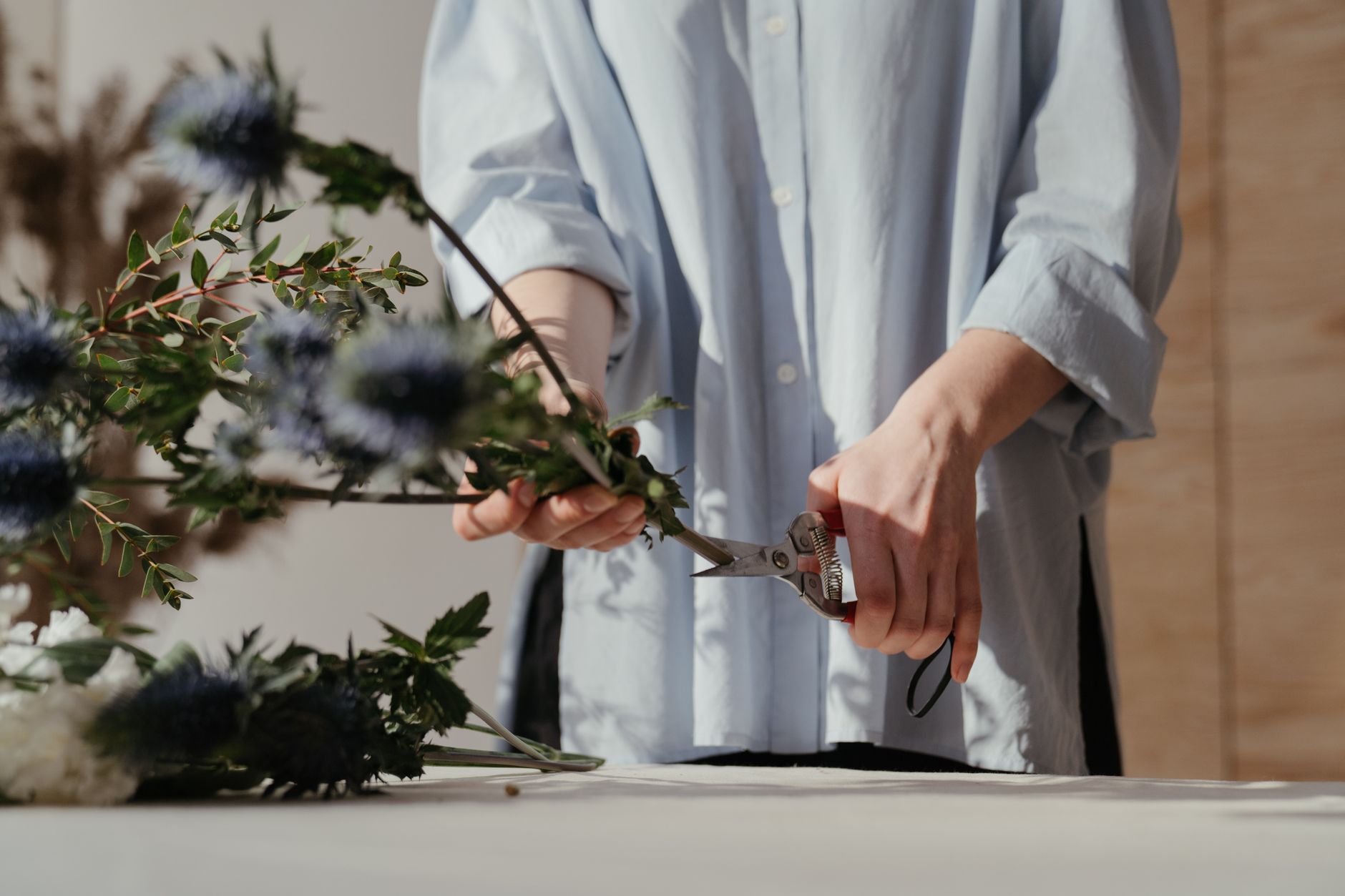
Skip anything with slimy stems or foul odor—that spreads bacteria to your vase fast. Our flower arranging class walks you through this selection ritual at the market itself; we condition stems together, show you how to strip leaves below water line, cut at 45°, and why Hanoi's heat demands constant hydration throughout your work. Most beginners arrange too slowly—they chat, forget stems are drying mid-session. We teach you to work in stages: prep all stems first, then arrange. This is non-negotiable in a tropical climate.
What's the difference between learning at a market and a workshop—and which should you choose?
Market visit alone:
- Pro: See real supply, meet vendors, buy cheap.
- Con: No guidance on freshness, color theory, or technique; overwhelming for first-timers; language barrier; no tools or wrapping.
Our structured workshops:
- Pro: Florist mentorship, correct tools (sharp knives, floral tape, proper conditioning), hands-on spiral hand-tie and color balance lessons, humidity and heat survival tips, you arrange real bouquets and take them home.
- Con: Higher cost than raw stems.
Comparison Table (based on typical Hanoi pricing and workshop structure):
| Experience | Time spent | Cost basis | What you learn | Output |
|---|---|---|---|---|
| Market alone | 1–2 hours | Stem cost only | Where to buy, prices | Loose stems, no skill |
| Market + DIY arranging | 3 hours | Stems + your trial-and-error | Guesswork on conditioning, color | Hit-or-miss bouquet |
| Our workshop (includes market tour) | 2–3 hours hands-on | Ask for quote on WhatsApp | Freshness cues, spiral hand-tie, color theory, heat-resistant techniques, wrapping | Professional-looking bouquet to take home, skills for next time |
| Floral design course (multi-week) | 8–12 hours total | Ask for quote on WhatsApp | All of above + seasonal design, commercial sizing, advanced mechanics | Portfolio, confidence for gifts or side income |
Verdict: If you're buying one bouquet for yourself, the market works. If you want skill and confidence—or a gift-worthy result—a workshop teaches you to replicate this yourself.
️ See how a class runs

How do you keep flowers alive in Hanoi's heat and humidity after you buy them?
This is where most visitors' bouquets die by day two. Hanoi's heat (30–35°C in summer) and humidity (70–85% year-round) accelerate bacterial growth and water loss. Here's the survival hierarchy:
- Conditioning BEFORE arranging (non-negotiable):
- Strip all leaves below the water line—submerged leaves rot, feeding bacteria.
- Cut stems at 45° with a sharp knife (not scissors—they crush).
- Use floral preservative in cool water if available; plain water works but needs changing every 1–2 days.
- Arrangement placement:
- No direct sunlight (accelerates wilting).
- No aircon draft (dries faster than it hydrates).
- Cool room (kitchen away from stove; bedroom better than living room if you have aircon).
- Daily check:
- Recut stems every 2–3 days.
- Top up water daily (evaporates fast).
- Remove any wilting petals or yellowing leaves immediately—they rot and infect others.
- Wrapping for transport:
- We wrap with floral tissue and moss, which holds moisture.
- Loose bouquets in plastic dry out on the 15-minute taxi ride.
- Never leave flowers in a hot car.
Our bouquet-making workshop teaches spiral hand-tie—a technique where stems spiral upward in a cone, creating a dense base that holds water contact longer than scattered arrangements. Combined with proper wrapping and conditioning, bouquets last 5–7 days even in peak summer. Take-home flower box arrangements last even longer because the floral foam stays wet. At a market, you get raw stems; with us, you learn the whole journey from stem to vase.
Ask for workshop dates on WhatsApp
What should you check before visiting a market or booking a workshop?
Before the market:
- Wear comfortable shoes and bring cash (not all vendors take cards).
- Go early (before 10 am) for best selection; by afternoon, stock is picked over or damaged.
- Bring a bag or ask vendor for wrapping—don't carry stems naked in heat.
- Note vendor location (markets shift stalls seasonally); ask a local or your hotel staff for the most reliable current cluster.
- Expect no English; a translator app or phrasebook helps.
Before a workshop:
- Confirm dates and times on WhatsApp—we reply as soon as we can on WhatsApp.
- Let us know if you have flower allergies or specific color preferences.
- Wear clothes you don't mind getting wet or stained.
- Bring a small bag or box to carry your finished arrangement home (we often provide, but check).
- If booking a group (hen and birthday parties, team building), confirm participant count; we adapt space and materials accordingly.
- Mind the time difference if booking from abroad.
Best for travelers: Our tourist workshop handles the logistics—transport to the market, English-speaking instruction, all tools provided, florals included. You arrange, learn, and leave with a bouquet. No hunting, no language barrier, no tool rental.
Best for couples or solo learners: Private and couple sessions let you work at your pace and customize flowers to your taste or occasion.
Best for kids and families: Kids and family workshops teach simplified arranging, color mixing, and creativity—perfect rainy-day activity. We adapt techniques and use sturdy, safe flowers.
What flowers should you avoid or be cautious with in Hanoi's market?
Avoid or use with care:
- Sweet peas: Beautiful scent, crisp petals, but wilt in 2–3 days in heat. If you love them, buy last and arrange first.
- Limonium (statice): Dries out but lasts; OK in Hanoi, not fragrant.
- Delphiniums, stocks: Tall, impressive, but sensitive to heat stress and bacterial wilt. Need pristine conditioning.
- Tulips (imported): Peak in spring only; summer imports are weak. Check stem firmness carefully.
- Roses with woody, thick stems: Often recut poorly at the market. Ask vendor to cut fresh in front of you.
- Greens that smell ammonia-like: Dead or decaying. Skip them.
- Anything with a visible leak or mold on the stem: Walking disease.
Safe bets for Hanoi heat: Sunflowers, celosia, dahlias, chrysanthemums, anthurium, ginger, local peonies (in season), carnations, solidago. These tolerate humidity and heat better and last 6–10 days with proper care. Our Vietnamese flower culture & market tour teaches you which blooms are actually local, which are imported, and what to expect seasonally—so you stop buying out-of-season roses at double price.
FAQ
Can I take a workshop on a rainy day?
Yes—rain is common in Hanoi, especially May–September. We run sessions indoors with full conditioning and arranging facilities. If you're learning about the market itself, we reschedule the market walk for another day or teach market knowledge in-studio with photos and vendor contacts.
Do I need to speak Vietnamese to visit the flower market?
No, but basic phrases help. Market vendors know numbers and common flower names (rose = hoa hồng, sunflower = hoa向日葵). A translation app or our tourist workshop avoids all language friction.
What's the cheapest way to buy flowers in Hanoi—bulk or small batches?
Bulk (20+ stems per type) is cheaper per stem at wholesale markets like Nhat Tan. Small batches (5–10 stems) cost more but suit apartment arranging. Retailers in Old Quarter charge premiums for convenience. We teach both sourcing paths in workshops; ask which fits your needs.
How much does a flower market visit cost?
Stems cost 20,000–a quoted price per stem depending on type, season, and quantity. A small bouquet (10–15 stems) runs 200,000–a quoted price. Arrange it yourself at home with no skill cost; or join a workshop for guidance and tools. Ask us for a quote on WhatsApp for class pricing.
Are there flower markets outside Hanoi's center?
Yes—Nhat Tan (northwestern suburbs), Tay Ho district, and seasonal roadside stands. We deliver in Hanoi and Ho Chi Minh City only and teach market navigation as part of private sessions and group workshops.
What's the best time of year to visit Hanoi's flower markets?
October–April: cool, low humidity, premium blooms, peak prices. May–September: heat and rain, fewer imports, more local flowers, lower prices, but bouquets fade faster. For learning skill, any season works; we condition and wrap for your climate. For bulk shopping, spring and autumn are best.
Can I book a workshop for my family visiting Hanoi for one week?
Yes. Kids and family workshops and private sessions suit multi-generational groups. We reply as soon as we can on WhatsApp to lock in dates and customize for ages and interests.
Do your workshops include the flowers, or do I bring my own from the market?
Both. Tourist workshops include real imported and local flowers; you arrange and take home. Some private bookings let you bring market finds and we teach conditioning and arranging on your stems. Discuss preference when you ask for a quote on WhatsApp. ===
Ask for dates
Tell us the city, the date and how many people. We reply on WhatsApp in English with workshop options and a quote.
FAQ
Can I take a workshop on a rainy day?
Yes—rain is common in Hanoi, especially May–September. We run sessions indoors with full conditioning and arranging facilities. If you're learning about the market itself, we reschedule the market walk for another day or teach market knowledge in-studio with photos and vendor contacts.
Do I need to speak Vietnamese to visit the flower market?
No, but basic phrases help. Market vendors know numbers and common flower names (rose = hoa hồng, sunflower = hoa向日葵). A translation app or our [tourist workshop](/tourist-workshop) avoids all language friction.
What's the cheapest way to buy flowers in Hanoi—bulk or small batches?
Bulk (20+ stems per type) is cheaper per stem at wholesale markets like Nhat Tan. Small batches (5–10 stems) cost more but suit apartment arranging. Retailers in Old Quarter charge premiums for convenience. We teach both sourcing paths in workshops; ask which fits your needs.
How much does a flower market visit cost?
Stems cost 20,000–100,000 VND per stem depending on type, season, and quantity. A small bouquet (10–15 stems) runs 200,000–500,000 VND. Arrange it yourself at home with no skill cost; or join a workshop for guidance and tools. Ask us for a quote on WhatsApp for class pricing.
Are there flower markets outside Hanoi's center?
Yes—Nhat Tan (northwestern suburbs), Tay Ho district, and seasonal roadside stands. We deliver in Hanoi and Ho Chi Minh City only and teach market navigation as part of [private sessions](/private-and-couples) and [group workshops](/team-building).
What's the best time of year to visit Hanoi's flower markets?
October–April: cool, low humidity, premium blooms, peak prices. May–September: heat and rain, fewer imports, more local flowers, lower prices, but bouquets fade faster. For learning skill, any season works; we condition and wrap for your climate. For bulk shopping, spring and autumn are best.
Can I book a workshop for my family visiting Hanoi for one week?
Yes. [Kids and family workshops](/kids-and-family) and [private sessions](/private-and-couples) suit multi-generational groups. We reply as soon as we can on WhatsApp to lock in dates and customize for ages and interests.
Do your workshops include the flowers, or do I bring my own from the market?
Both. [Tourist workshops](/tourist-workshop) include real imported and local flowers; you arrange and take home. Some [private bookings](/private-and-couples) let you bring market finds and we teach conditioning and arranging on *your* stems. Discuss preference when you ask for a quote on WhatsApp. ===
More like this
Workshop guides
Things to Do in Saigon Flower Workshop: Hands-On Classes for Travelers
A flower workshop in Ho Chi Minh City lets you create and take home your own arrangement in a single session, combining relaxation with a tangible craft memory of Vietnam.
Workshop guides
Things to Do in Hanoi Old Quarter: Flower Workshop & Classes
A flower workshop in Hanoi's Old Quarter teaches you to design and wrap fresh bouquets and arrangements using imported and local blooms. You'll work with a florist, condition stems, balance color, and leave with a professional piece the same day.
Workshop guides
Things to do in Hoan Kiem flower workshop: hands-on classes & designs
At Vietnam Flower Workshop by Hoa Lang Thang in Hanoi, you'll arrange real imported and local blooms, take your designs home, and learn techniques that survive Vietnam's heat. We run beginner-friendly sessions daily for travelers, couples, teams, and families.