
Home › Blog › Flower arranging class
Flower Arranging Class for Beginners: Learn in Hanoi or Ho Chi Minh City
By the Vietnam Flower Workshop team · 2026-11-06
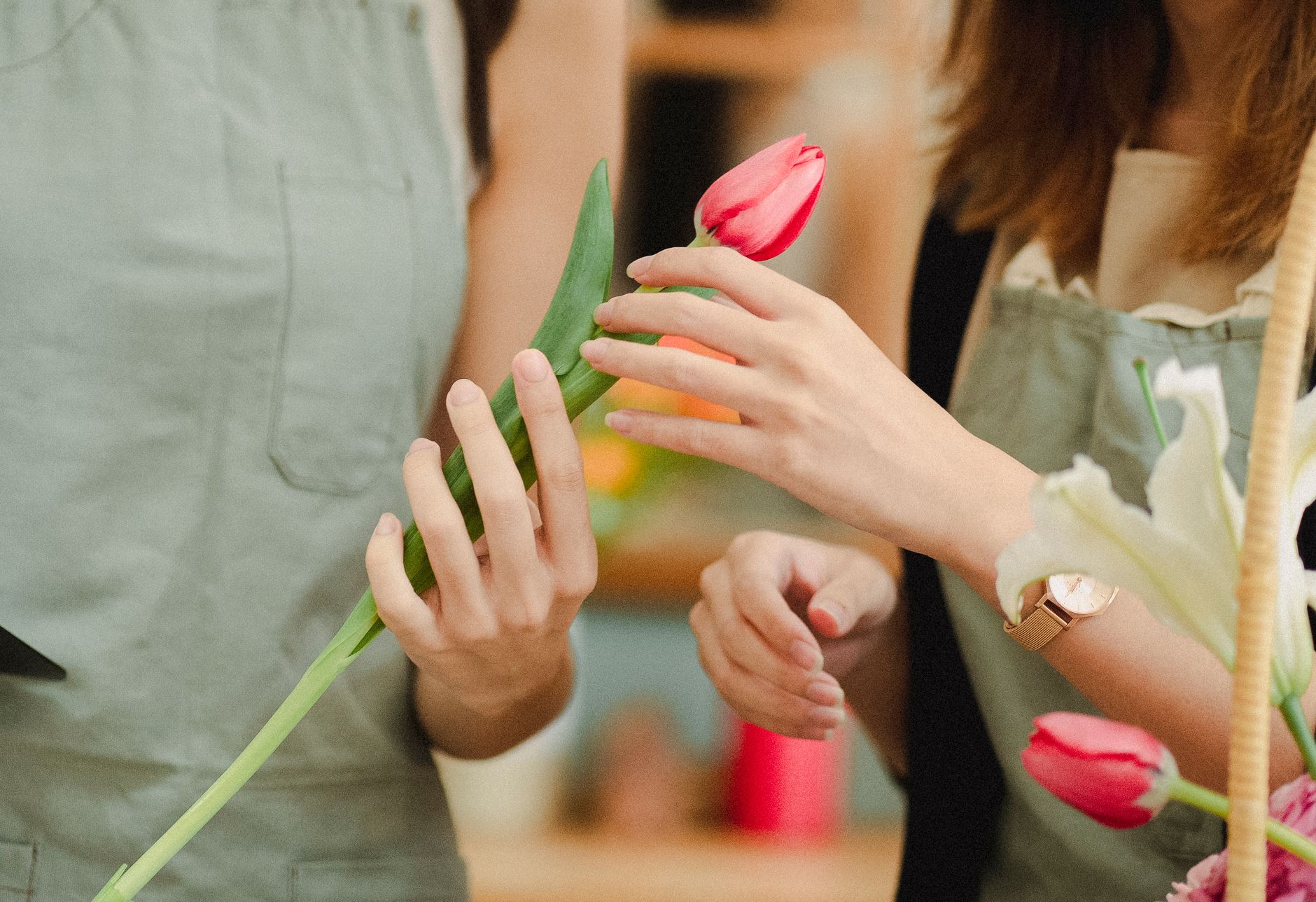
At Vietnam Flower Workshop by Hoa Lang Thang, our beginner classes run hands-on in Hanoi and Ho Chi Minh City, with real imported and local flowers you take home. A session teaches stem conditioning (trimming, stripping leaves), the spiral hand-tie technique (rotating stems under tension for a professional look), and color balance (pairing warm and cool tones so arrangements don't clash). We use English instruction for travelers and expats. Beginners typically struggle most with hand tension—holding the spiral too loose makes stems slip; too tight bruises them. We show you how to feel the difference in real time. All materials and flowers are included; there's no hidden cost. You leave with your own arrangement wrapped and ready. Sessions suit individuals, couples, families, and groups. Availability is confirmed on WhatsApp; same-day delivery arrangements are also offered in both cities. Ask for workshop dates on WhatsApp
What happens in your first 90 minutes?
We start with a 10-minute walk through our workspace, showing you the flower buckets, tool station, and where your finished piece will be photographed and wrapped. The next 15 minutes cover conditioning: why we strip lower leaves (they rot in water), how to cut stems at a 45-degree angle with sharp shears, and why some flowers (like roses and orchids) need deeper water than others. You'll practice on 3–4 stems before touching your design flowers. Then we move to color theory for 10 minutes—not abstract rules, but why a purple orchid and a yellow chrysanthemum sit next to each other without looking jarring. Most beginners expect flowers to "just work" together; we show you that saturation and value matter more than matching a picture. The remaining 50+ minutes is your hands-on spiral. You hold the bucket in your non-dominant hand, rotate stems with your dominant hand, and build an outward dome. It feels awkward at first—your wrist tires, your thumb wants to do all the work—but by the end, muscle memory kicks in. We wrap everything in paper and tie it with ribbon. Beginners leave saying their hands hurt (good—you worked) and surprised they created something they'd buy in a shop.

Why do beginners struggle with hand-tie tension?
The single biggest challenge is holding the spiral point firm while rotating new stems around it without crushing them. New hands grip too hard because they fear the whole thing will collapse; in reality, stems are tougher than they look, and bruising happens only from over-squeezing. The fix is counterintuitive: hold lighter than you think, and let the spiral's geometry do the work. When you rotate a new stem into a dome at a 45-degree angle, it wedges naturally; tension comes from the circle, not your fingers. We have you practice this by building a spiral with just leaves and filler first, then adding focal flowers. By the time you hold roses or orchids, your muscle memory knows the pressure point. What trips people up most is switching hands mid-spiral—your left hand wants to take over from your right—so we drill one-hand control for the first 15 minutes of hands-on work. After a session, you'll notice florists on TV doing this the same way you've learned; it's not magic, it's physics.
How do flowers survive Hanoi and Ho Chi Minh City heat?
Our design flowers arrive daily in cool boxes and live in cold water until your class. After you leave, we recommend keeping your finished arrangement in a cool spot, away from direct sun and air conditioning vents (both dry stems fast). In Hanoi's cooler months (October–March), arrangements last 7–10 days. In Ho Chi Minh City's year-round heat, expect 4–6 days if you follow aftercare: trim a half-inch off stems every two days, refresh water daily, and remove any leaf that touches water. We give you a printed care card. Tropical flowers like orchids and celosia handle heat better than imported roses, so we stock more local varieties in summer. If you're joining us during monsoon season, humidity actually helps—flowers drink faster but don't desiccate. What kills arrangements fastest is stagnant water and bacteria buildup, which is why we stress the daily trim. We've tested this in both cities for multiple seasons; the difference between a three-day and ten-day arrangement is almost always the water routine, not the flower type.
What's different about kids and group classes versus one-on-one?
Kids (ages 6+) get a simplified spiral: instead of 20 stems, they use 8–10, and we pre-strip all leaves to cut prep time. Their focus is color mixing and muscle discovery, not technical perfection. A child's arrangement won't look like a florist's, but they own it, and that's the point. Group classes (4–8 people) run the same structure as one-on-one but with more demo time upfront; we show the technique on a demo spiral, then everyone replicates it in their own rhythm. Pairs and couples get one facilitator and can ask real-time questions without feeling rushed. Birthday and hen parties (10–15 people) need two instructors and run 2–3 hours with a 15-minute break. We adapt the flower palette for celebrations—brighter colors, easier stems—and can tie in a simple cake setup if you book that separately. Rainy days (common in both cities June–September) don't change the class; we're indoors with climate control. The only shift is that afternoon humidity means flowers drink faster, so we use shorter-stem designs and add floral preservative to the water. Family sessions often include a grandparent and a teen; we find the teenager usually masters tension first, while the older person excels at composition—different skills click for different ages.
Should you take a longer course instead of a one-off class?
| Format | Who it suits | What you'll learn | Takeaway |
|---|---|---|---|
| Single class (90 min) | Travelers, first-timers, couples | Spiral technique, color balance, one design style | 1 finished arrangement |
| Multi-week course | Local floral hobbyists, gift-givers | 4+ design types, advanced conditioning, seasonal shifts | 4–6 arrangements, muscle memory |
| Team building session | Corporate groups, offices | Collaboration, quick wins, takeaway bouquets | Group fun + design skills |
A single class teaches you enough to feel confident holding a spiral and understanding why floristry is a craft, not just throwing flowers in a vase. If you live in Hanoi or Ho Chi Minh City and want to gift handmade arrangements to friends, or you're exploring a new hobby, a floral design course over 4–6 weeks makes sense—you'll try hand-tied bouquets, flower boxes, and seasonal wreaths. If you're a traveler with one free afternoon, the 90-minute session is perfect. Corporate team building workshop groups often book a class as a morale activity; it works because everyone leaves with proof they made something, not just sat in a meeting. The cost basis differs by session type; ask us for a quote on WhatsApp for whichever suits your timeline.
️ See how a class runs
One technique you can practice at home right now
Before booking a class, try this with flowers from a local market: grab 5–7 stems of any flower (roses, carnations, even chrysanthemums), strip all leaves below where your hand will grip, and cut each stem at a 45-degree angle with scissors or a knife (never a blunt tool). Fill a jar with room-temperature water and add a pinch of sugar or a drop of dish soap (both help water uptake). Now hold the jar in your left hand and rotate one stem slowly while sliding a second stem around it at a slight angle—not vertical, not flat, but 45 degrees. Keep rotating the jar, not your hand. By the third or fourth stem, you'll feel how the angle wedges them in place. This is the spiral principle. Your actual class will use much larger buckets, more stems, and real focal flowers, so the feeling will be different—but you'll recognize the geometry. Most beginners who try this at home arrive at their session saying, "Oh, now I see why it works." That's exactly the mindset we want.
What to check before you book
- Flower allergies? Tell us on WhatsApp; we'll note your arrangement and suggest hypoallergenic varieties.
- Mobility or hand strength concerns? We can adapt the spiral height or suggest a pre-built bucket design instead; just mention it when confirming dates.
- Bringing children under 6? Single sessions aren't ideal (they need constant attention), but our kids and family workshop has a junior structure.
- Group of more than 8? We'll confirm space and instructor availability on WhatsApp.
- Want to visit as a traveler? We run tourist-focused workshops with English instruction and flexible dates; book via WhatsApp.
Ask for workshop dates on WhatsApp
Why join us instead of watching YouTube?
Videos show the hand position, but they can't correct your pressure in real time or tell you why your color balance feels off. In a live class, we catch the moment your spiral wobbles and guide your thumb—something no screen can do. You also take home a real arrangement made with quality flowers, not crushed stems from a big-box supplier. And you're in a room with an instructor who has made thousands of arrangements and knows exactly which struggle is a beginner trap versus which is a sign you're learning. If you want community and accountability (not just a skill video), a class beats DIY every time.
Ready to start?
Visit our main class page to see what a session includes, or check out our private and couples sessions if you're looking for a quieter experience. For seasonal designs—Christmas wreaths, Tet arrangements, or lotus-inspired pieces—browse our seasonal workshops. Each session is hands-on, photographed, wrapped, and ready to take home the same day.
Ask for workshop dates on WhatsApp

FAQ
Do I need any experience to join a beginner class?
No. We teach from zero. If you've never held a stem or heard the word "conditioning," you're exactly who our class is designed for. We start with basics and move at a pace that lets everyone finish with a real arrangement.
What's the difference between a class and a bouquet-making workshop?
A beginner class teaches fundamentals (tension, color, technique) using a spiral hand-tie in a bucket. Our bouquet making workshop focuses specifically on wrapped hand-tied bouquets with paper, ribbon, and gift styling—more detail-oriented, often booked for gifting skills.
Can I book a private session instead of a group class?
Yes. Private and couples sessions run one-on-one or two-person, same structure, more customization. Ask us for availability and pricing on WhatsApp.
What flowers will I work with?
A mix of imported (roses, orchids, ranunculus) and local varieties (celosia, chrysanthemums, tropical greens). Availability changes seasonally; we confirm the flower list when you book.
Where do I keep my finished arrangement?
Take it home and place it in a cool spot away from direct sun and vents. Trim stems every two days and change water daily. In Hanoi's mild months, arrangements last 7–10 days; in Ho Chi Minh City's heat, 4–6 days.
How do I book, and what's the cost?
Message us on WhatsApp with your preferred dates and number of people. We confirm availability and send a quote. We operate in Hanoi and Ho Chi Minh City only.
Can I bring my children?
Children 6+ can join a standard class with an adult. For younger kids or larger family groups, ask about our kids and family workshop, designed for that age range.
Ask for dates
Tell us the city, the date and how many people. We reply on WhatsApp in English with workshop options and a quote.
FAQ
Do I need any experience to join a beginner class?
No. We teach from zero. If you've never held a stem or heard the word "conditioning," you're exactly who our class is designed for. We start with basics and move at a pace that lets everyone finish with a real arrangement.
What's the difference between a class and a bouquet-making workshop?
A beginner class teaches fundamentals (tension, color, technique) using a spiral hand-tie in a bucket. Our [bouquet making workshop](/bouquet-workshop) focuses specifically on wrapped hand-tied bouquets with paper, ribbon, and gift styling—more detail-oriented, often booked for gifting skills.
Can I book a private session instead of a group class?
Yes. [Private and couples sessions](/private-and-couples) run one-on-one or two-person, same structure, more customization. Ask us for availability and pricing on WhatsApp.
What flowers will I work with?
A mix of imported (roses, orchids, ranunculus) and local varieties (celosia, chrysanthemums, tropical greens). Availability changes seasonally; we confirm the flower list when you book.
Where do I keep my finished arrangement?
Take it home and place it in a cool spot away from direct sun and vents. Trim stems every two days and change water daily. In Hanoi's mild months, arrangements last 7–10 days; in Ho Chi Minh City's heat, 4–6 days.
How do I book, and what's the cost?
Message us on WhatsApp with your preferred dates and number of people. We confirm availability and send a quote. We operate in Hanoi and Ho Chi Minh City only.
Can I bring my children?
Children 6+ can join a standard class with an adult. For younger kids or larger family groups, ask about our [kids and family workshop](/kids-and-family), designed for that age range.
More like this
Flower arranging class
Flower Arranging Class in Hanoi Old Quarter: Hands-On Workshop Guide
We run hands-on flower arranging workshops in Hanoi Old Quarter where you condition stems, master spiral technique, and leave with a finished bouquet the same day.
Flower arranging class
Flower Arranging Class Ho Chi Minh City for Beginners
Our beginner flower arranging classes in Ho Chi Minh City teach spiral hand-ties, color balance, and stem conditioning in a single hands-on session. You arrange with real imported and local flowers and take your finished piece home the same day.
Flower arranging class
Flower Arranging Class Hanoi English: Hands-On Workshop Guide
We run hands-on flower arranging classes in English at Vietnam Flower Workshop by Hoa Lang Thang in Hanoi, where you condition stems, learn spiral hand-ties, and take home a finished arrangement on the same day.