
Home › Blog › Workshops for travelers
Things to Do With Flowers in Vietnam Near Hanoi: Hands-On Workshops
By the Vietnam Flower Workshop team · 2026-11-06
Near Hanoi, the most hands-on flower activity is a structured workshop where you condition stems, learn spiral hand-tie technique, and assemble a bouquet or arrangement in 2–3 hours using real imported and local flowers you take home. Vietnam Flower Workshop by Hoa Lang Thang operates in Hanoi (and a second location in Ho Chi Minh City) and teaches travelers, expats, couples, families, and groups in English. A typical session covers stem prep, color balance, wrapping, and design principles beginners struggle with most: stem length, water absorption, and asymmetry. Sessions run daily; cost varies by season and group size—ask us for a quote on WhatsApp. Avoid booking through travel agents who mark up fees; book direct. The heat around Hanoi (28–35°C most of the year) is real, but we condition flowers in ice water and teach guests how blooms survive the journey home in a box. Rainy season means tighter wrapping and faster turnaround. Ask for workshop dates on WhatsApp
What makes a flower workshop better than a market tour alone?
A market tour shows you where flowers come from; a hands-on workshop teaches you to make something. At Vietnamese flower culture & market tour, you learn history and sourcing. In a workshop, you learn techniques: how to strip leaves below the waterline so stems absorb water, why spiral hand-ties last longer, and how to balance color so arrangements don't look flat. After 90 minutes, you walk out with a bouquet you built, not just photos of someone else's work. That muscle memory sticks—you'll arrange flowers at home for years after.
Which Hanoi flower workshop fits a solo traveler?
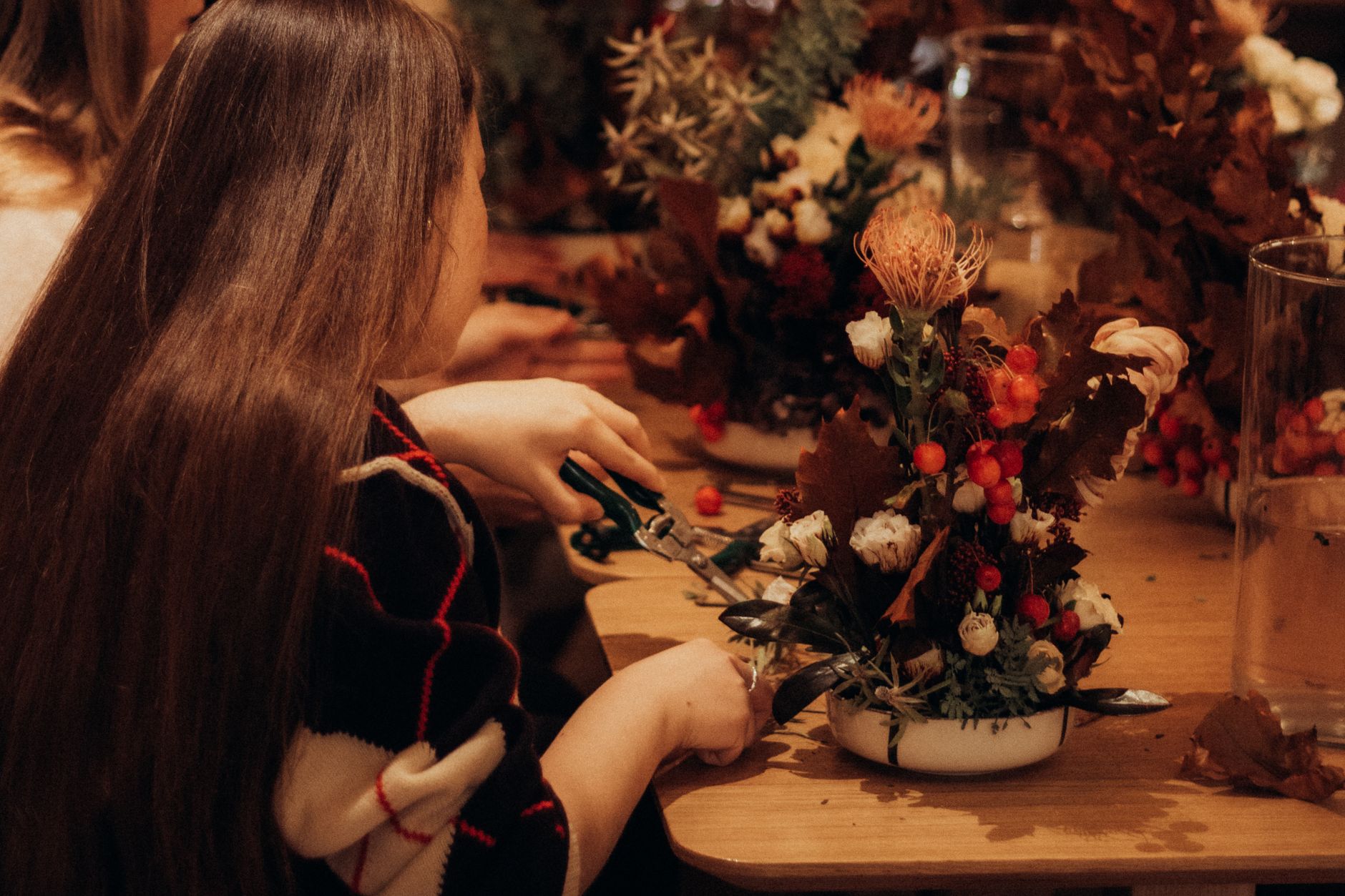
Solo travelers want flexibility, no pressure, and a souvenir they made themselves. Our flower arranging class runs small groups (3–8 people) in English most days, so you're not alone but not in a tour bus either. You arrive, learn the basics, make your piece in 90 minutes, and leave with it. The class covers stem conditioning, color theory basics, and asymmetrical design—skills that turn grocery-store flowers into hotel-room décor. Many solo travelers book after a cooking class or museum visit; we're a 15-minute motorbike ride from central Hanoi's tourist zones (a jewelry quarter, lacquerware shops, or traditional medicine market nearby). No reservation? Message us on WhatsApp and we'll fit you in same-day if space allows.
️ See how a class runs
How do couples make a date out of a flower workshop?
Private and couple sessions give you a full room, a florist's undivided attention, and time to chat while arranging side-by-side. We guide each of you through the same steps—stem conditioning, color selection, hand-tie technique—but you both control your own design. Couples often choose this over a restaurant date because you're doing something together, not just sitting across from each other. Romantic + practical. Most couples take 2–3 hours and go slower, asking questions. We adjust for any skill gap: one person might have done ikebana before, the other has never touched a stem. The flowers you create are identical in technique but unique in feel. Afterward, you carry them through Hanoi as matching pieces—a keepsake photo op.
Can kids and families join a flower workshop?
Yes, and it's messier and louder than adult classes—in the best way. Kids and family workshop sessions teach children aged 6+ the same conditioning and spiral technique, scaled for smaller hands and shorter attention spans. A typical family session runs 90 minutes: 20 minutes of demo and prep, 50 minutes of hands-on arranging (with florist guidance every 5–10 minutes), 20 minutes of wrapping and photos. Kids struggle most with: stem length consistency (they cut too short or too long), patience with the spiral (it takes 3–5 tries), and grip strength to tie off the hand-tie knot. We provide pre-cut stems in two lengths and adjust wrapping tightness to avoid crushing blooms. Families love this because kids take home something alive they made—they water it, feel responsibility, and remember the experience for weeks. Rainy days work fine; we move you indoors and the humidity actually helps flowers absorb water faster.
How do groups and team-building events use a flower workshop?
A team building workshop turns a room of strangers into collaborators in 2 hours. Groups of 8–20 people work in pairs or small teams on a shared design brief: "Create a bouquet under these three color rules" or "Each pair makes one layer; we stack them into one installation." The beauty is that everyone learns the same technique simultaneously, but the outcomes are different—no competition, all unique. We've run sessions for:
- Corporate teams visiting Hanoi for conferences (ask for a quote on WhatsApp; we can arrange transport from a hotel in the downtown area, not a named property).
- Hen and birthday parties (see hen & birthday parties for custom options: flower crowns, oversized bouquets, designs in a group's favorite colors).
- Volunteer groups and study-abroad cohorts wanting a cultural activity that's hands-on, not just observational.
Group sessions are cheaper per person than solo classes—ask us to quote a group rate. Rainy days are ideal for groups; everyone stays focused indoors, and we have more time to teach without heat stress.
Seasonal workshops: which flowers are worth planning around?
Hanoi's climate shifts what's available and what lasts. Our seasonal workshops highlight what's in peak season and best value based on the calendar:
| Season | Peak Flowers | Best For | What You'll Learn |
|---|---|---|---|
| Tet (late Jan–early Feb) | Gold chrysanthemums, peach blossoms, apricot branches | Lucky arrangements, gift sets | Branch work, symbolic color |
| Spring (Mar–May) | Roses, tulips, ranunculus (imported) | Romance, pastel palettes | Water management in warmth (28–32°C) |
| Summer (Jun–Aug) | Sunflowers, celosia, local dahlias | Bold, bright designs | Heat survival techniques, stem sealing |
| Autumn (Sep–Nov) | Chrysanthemums, celosia, protea | Textured, earthy tones | Drying and longevity |
Why it matters: Peach blossoms and apricot branches (hoa đào, hoa mai) are cultural icons at Tet; if you're in Hanoi January–early February, a Tet workshop is unmissable. Spring and autumn are mild (20–28°C), so flowers last longest; if you're visiting then, a class is easier and more forgiving. Summer workshops teach heat-survival: we ice-condition stems, wrap tighter, and use floral foam that holds more water. Book a seasonal workshop 1–2 weeks ahead; peak Tet slots fill fast.

What to check before you book a flower workshop near Hanoi
- Language. We teach in English; confirm that before booking if you don't speak Vietnamese.
- Group size. Solo travelers should ask if you're joining a small group or getting a private session (different prices). Groups of 8+ get a lower per-person rate; ask for a custom quote.
- Flowers provided or DIY? We provide all flowers, stems, and tools. You don't buy them separately. Imported blooms (roses, tulips, ranunculus) may have limited stock in summer; local blooms (chrysanthemums, celosia) are always available.
- What you take home. Your finished piece comes in a water-filled carry box. It lasts 5–7 days in a hotel room if you water it daily. Don't squeeze it into a backpack.
- Rainy season logistics. June–September, we work indoors and wrap arrangements extra-tight because humidity is 80%+. Classes still run; just arrive dry.
- Cancellation and rescheduling. Message us on WhatsApp at least 24 hours ahead if you need to move your date.
How a workshop minute-by-minute runs: the real schedule
0–10 min: Arrival & demo. You arrive, meet the florist-teacher, see finished sample pieces. We show you the flowers on offer that day (usually 6–10 types). You choose your color palette.
10–30 min: Stem conditioning. We strip lower leaves, cut stems at a 45° angle under running water, and condition in ice water for 15 minutes. You do this yourself under guidance. This is the step most beginners skip at home—it's why homemade bouquets wilt in 2 days.
30–75 min: Hand-tie spiral & assembly. You hold stems in one hand and build a spiral by rotating the bunch and adding stems at a 45° angle. Sounds simple; it takes 20–30 minutes to feel right. We walk beside you, adjust your grip, and celebrate when it clicks. You add greenery and secondary blooms. Color balance happens here: no two reds touching, one focal flower per focal line.
75–90 min: Wrapping & photography. We wrap your hand-tie in kraft paper or cellophane (you choose), tie a bow, and trim. You take photos. We place it in a water-filled box with a care card.
Book a flower arranging class | ️ Ask for workshop dates on WhatsApp
Practical technique you can try at home: the spiral hand-tie
After a Hanoi workshop, keep this going:
- Start with greenery. Hold 3–5 stems of foliage (eucalyptus, leather leaf, or mint) in your non-dominant hand at a loose 45° angle.
- Add focal flowers one at a time. Pick a rose or ranunculus. Insert it at a slight angle, not straight up. Rotate the whole bunch in your hand, not the flower. Add the next stem at a similar 45° angle on the opposite side. Spiral builds symmetry.
- Fill gaps with secondary blooms. Smaller flowers, wildflowers, or spray roses go between focal flowers. Rotate and add each one.
- Tighten your hand. After 20–30 stems, squeeze your grip gently. Blooms should nestle and support each other, not fall through.
- Wrap and cut. Bind the stem bundle 2 inches below the blooms with floral tape or string. Cut all stems to the same length (about 10 inches for a vase).
- Condition immediately. Place in room-temperature water with flower food (or a pinch of sugar and a drop of bleach). Change water every 2–3 days.
Why it works: A spiral hand-tie distributes water to every stem equally. Bundles tied tight at the neck last 7–10 days indoors. Grocery-store arrangements that wilt fast are usually bunched haphazardly with no conditioning—the opposite of this.
Other flower activities near Hanoi: how they compare
| Activity | Time | What You Get | Best For | When to Book |
|---|---|---|---|---|
| Hands-on arranging class | 2–3 hours | A bouquet you made | Learning, souvenir, date night | Same-day or 1 week ahead |
| Market flower tour | 1–2 hours | Photos, history, local knowledge | Photography, cultural interest | 2–3 days ahead |
| Seasonal workshop (Tet, Christmas) | 2–3 hours | Festive design (wreath, lucky arrangement) | Holiday prep, cultural immersion | 2–4 weeks ahead |
| Couple's private session | 3 hours | Two unique pieces, florist attention | Romantic date, engagement prep | 1 week ahead |
| Corporate team-building | 2 hours | Group output, icebreaker | Office groups, study-abroad cohorts | 2–3 weeks ahead |
The hands-on class is the sweet spot: lowest barrier to entry, fastest booking, takes home a keepsake, teaches skills you use years later.
Why heat and humidity matter: how Hanoi flowers survive
Hanoi summers hit 35°C and 80% humidity. Flowers wilt fast. Here's what we do—and what you should at home:
- Pre-condition in ice water. Stems drink cold water faster; it hardens the vascular tissue. Warm water speeds wilting.
- Strip all leaves below the waterline. Leaves rot in water, block stems, and rot spreads to blooms.
- Keep arrangements away from direct sunlight and air conditioning vents. Both cause rapid dehydration.
- Change water every 2–3 days in summer. Bacteria multiply in warm water.
- Mist spray roses and ranunculus daily. Their petals are delicate and dry out from humidity swings.
In our workshops, we condition stems in ice, teach you the stripping technique, and wrap finished pieces in a water-filled box for transport. You'll carry a bouquet through Hanoi heat and it'll arrive at your hotel fresh. At home, follow the care card we send.
Ask for workshop dates on WhatsApp
When to book a longer floral design course vs. a one-off class
If you're staying 1–2 weeks in Hanoi and love flowers, consider a floral design course instead of one class. A course runs 3–5 half-days and covers:
- Stem anatomy and water absorption (why some flowers drink faster).
- Color theory applied to real blooms (not abstract).
- Seasonal availability and pricing logic.
- Advanced techniques: layered hand-ties, installation work, wreath construction.
- Business basics if you're considering freelance flower work.
Courses suit travelers who want deep skill-building, not just a one-off keepsake. Expats and long-term volunteers often enroll. After a course, you can arrange flowers confidently for years—weddings, events, gifts. Ask about custom course timing if you're staying longer than 2 weeks.

FAQ
Can I book a workshop if I've never held a flower before?
Yes. Beginners are our core audience. We teach conditioning, spiral technique, and color balance from zero. By the end of 2–3 hours, you'll have a finished bouquet. Arrive with an open mind; leave with a skill and a keepsake.
What if I arrive and the flowers I wanted aren't available?
We always stock 6–10 types of blooms daily (imported roses, tulips, ranunculus; local chrysanthemums, celosia, dahlias). If a specific bloom is out of stock, we'll suggest a similar alternative in the same color range. Ask on WhatsApp the day before if you have a strict color requirement.
How long does my bouquet last after the workshop?
5–7 days indoors if you follow our care card: water daily, change water every 2–3 days, keep away from direct sun and AC vents. Summer heat reduces longevity; spring and autumn bouquets last closer to 10 days.
Is there parking or transport from central Hanoi?
Our Hanoi location is accessible by motorbike or taxi. We're a short ride from downtown tourist zones (jewelry quarter, lacquerware shops, markets). If you book a group or private session, message us on WhatsApp and we can advise on transport logistics.
Can I customize a workshop for a hen party or birthday?
Yes. Hen & birthday parties are a specialty. We can teach a group of 8–15 people and adjust the design brief (e.g., "make a bouquet in the bride's colors" or "each person creates a wreath"). Pricing is per-person; ask for a quote on WhatsApp with your group size and date.
What's the difference between an arranging class and a bouquet-making workshop?
A bouquet workshop focuses exclusively on hand-tied bouquets and wrapping. An arranging class includes bouquets but also covers vase arrangements, asymmetry, and design principles. Both are 2–3 hours; choose the bouquet workshop if you want to take home a tied, wrapped gift-ready piece.
Do you teach ikebana or other specific styles?
We teach Western hand-tie and vase techniques. Ikebana is a separate discipline; we don't offer it. If you have ikebana experience and want to bring it into a session, message us and we can discuss a custom class.
What if I'm visiting during Tet? Is a Tet-specific workshop worth it?
Absolutely. Seasonal workshops in January–early February teach you peach blossom and apricot branch arrangements—iconic Tet décor. Branches are harder to work with but beautiful. Book 3–4 weeks ahead; Tet slots fill fast.
Ask for dates
Tell us the city, the date and how many people. We reply on WhatsApp in English with workshop options and a quote.
FAQ
Can I book a workshop if I've never held a flower before?
Yes. Beginners are our core audience. We teach conditioning, spiral technique, and color balance from zero. By the end of 2–3 hours, you'll have a finished bouquet. Arrive with an open mind; leave with a skill and a keepsake.
What if I arrive and the flowers I wanted aren't available?
We always stock 6–10 types of blooms daily (imported roses, tulips, ranunculus; local chrysanthemums, celosia, dahlias). If a specific bloom is out of stock, we'll suggest a similar alternative in the same color range. Ask on WhatsApp the day before if you have a strict color requirement.
How long does my bouquet last after the workshop?
5–7 days indoors if you follow our care card: water daily, change water every 2–3 days, keep away from direct sun and AC vents. Summer heat reduces longevity; spring and autumn bouquets last closer to 10 days.
Is there parking or transport from central Hanoi?
Our Hanoi location is accessible by motorbike or taxi. We're a short ride from downtown tourist zones (jewelry quarter, lacquerware shops, markets). If you book a group or private session, message us on WhatsApp and we can advise on transport logistics.
Can I customize a workshop for a hen party or birthday?
Yes. [Hen & birthday parties](/parties) are a specialty. We can teach a group of 8–15 people and adjust the design brief (e.g., "make a bouquet in the bride's colors" or "each person creates a wreath"). Pricing is per-person; ask for a quote on WhatsApp with your group size and date.
What's the difference between an arranging class and a bouquet-making workshop?
A [bouquet workshop](/bouquet-workshop) focuses exclusively on hand-tied bouquets and wrapping. An [arranging class](/flower-arranging-class) includes bouquets but also covers vase arrangements, asymmetry, and design principles. Both are 2–3 hours; choose the bouquet workshop if you want to take home a tied, wrapped gift-ready piece.
Do you teach ikebana or other specific styles?
We teach Western hand-tie and vase techniques. Ikebana is a separate discipline; we don't offer it. If you have ikebana experience and want to bring it into a session, message us and we can discuss a custom class.
What if I'm visiting during Tet? Is a Tet-specific workshop worth it?
Absolutely. [Seasonal workshops](/seasonal) in January–early February teach you peach blossom and apricot branch arrangements—iconic Tet décor. Branches are harder to work with but beautiful. Book 3–4 weeks ahead; Tet slots fill fast.
More like this
Workshops for travelers
Flower Workshop for Tourists: Tools & Techniques in Hanoi & HCMC
We teach tourists real floral techniques—spiral hand-ties, color balance, stem conditioning—using imported and local flowers you take home same day.
Workshops for travelers
Flower Workshop for Tourists in Saigon: What to Expect
A flower workshop for tourists in Ho Chi Minh City puts you in front of real blooms, teaches core techniques in one session, and sends you home with an arrangement you made yourself—no experience needed.
Workshops for travelers
Flower Workshop for Tourists in Hoan Kiem: What to Expect
Hoan Kiem flower workshops teach tourists real arranging techniques in English, with imported and local blooms. You design, wrap, and leave with your creation the same day.