
Home › Blog › Workshops for travelers
Things to Do with Flowers in Vietnam: How Long Each Activity Takes
By the Vietnam Flower Workshop team · 2026-11-06
In Vietnam, flower activities range from 90-minute beginner arranging classes to full-day cultural market tours and multi-week floral design courses. At Vietnam Flower Workshop by Hoa Lang Thang in Hanoi and Ho Chi Minh City, a typical hands-on session includes stem conditioning, spiral hand-tie technique instruction, color balance practice, and wrapping—you leave with your finished piece. Workshops run 90 minutes for basics; couple sessions, hen parties, and team building scale from 2–4 hours depending on group size and complexity. Private seasonal designs (Tet wreaths, Christmas arrangements) often need consultation time before the hands-on portion. A full floral design course spans multiple weeks. Prices vary by session type; ask us for a quote on WhatsApp. Heat and humidity mean fresh flowers last shorter indoors—we condition blooms heavily and advise placing arrangements in cool spots away from direct sun. Ask for workshop dates on WhatsApp | ️ See how a class runs
How Long Does a Beginner Flower Workshop Actually Take?
Most first-time arrangers expect 60 minutes; reality is closer to 90 minutes from walk-in to carrying your bouquet out the door. We start with a 10-minute demo on stem conditioning—cutting at a 45-degree angle, removing lower leaves, and hydration. The spiral hand-tie technique, where stems spiral outward in a cone shape for balance, takes 20–30 minutes to execute; beginners typically struggle with pacing the spiral angle and keeping tension even. Wrapping and finishing add another 15–20 minutes. Throughout, we pause for you to adjust, ask questions, and correct common mistakes—bunching stems too tight or placing focal flowers off-center. By minute 90, you walk out with a finished arrangement in water, ready to place at home. This timing holds for both Hanoi and Ho Chi Minh City locations. Expect shorter sessions only if you skip conditioning or choose a pre-wrapped box style.

How Do You Keep Flowers Fresh in Vietnam's Heat?
Vietnam's tropical climate—temperatures above 30°C and high humidity—compresses flower life dramatically; a bouquet that lasts two weeks in a cool climate may fade in five days here. We condition stems aggressively: cutting at least 2 cm off the base, removing all foliage below the water line, and using flower food in every arrangement. Participants learn to place arrangements in the coolest room (often air-conditioned), away from direct sunlight, heat vents, and ripening fruit (which releases ethylene gas). Daily water changes and re-cutting the stems every second day extend life another few days. Certain flowers—roses, spray roses, and orchids—tolerate heat better than peonies or daffodils, which wilt fast. During our seasonal workshops, we explain which blooms suit rainy season conditions (fewer stems, more foliage for structure) versus dry season designs (lusher, water-heavy arrangements).
What's Different About Private and Couple Sessions?
Private and couple sessions run 2–4 hours depending on what you want to create and your prior experience. If you've never held a stem before, we spend more time on fundamentals. If you're a repeat crafter, we jump into advanced color balancing or constructing multiple pieces. Couples often choose to make matching arrangements or trade roles—one person arranges while the other wraps. Heat and humidity matter here: an afternoon session in Ho Chi Minh City means we work fast because water evaporates quickly. We prep extra water and mist arrangements frequently. Many couples skip workshops entirely and instead book a flower box and basket class, which takes 90 minutes and produces a finished gift immediately—ideal if you're on a tight travel schedule.
How Do Group Events—Hen Parties and Team Building—Run?
Hen parties and birthday celebrations typically run 2.5–3 hours for 8–12 people, though timings stretch if your group is larger or includes children. The first 15 minutes covers introductions and a demo; the next 60–90 minutes is hands-on arranging, with us circulating to fix stem angles and color placement. The final 30 minutes is photography, celebration, and packing. For team building workshops, we often add a competitive element—teams build arrangements against the clock—which extends sessions slightly but keeps energy high. Rainy days complicate group flow: if we're working indoors in a studio setup rather than an open space, ventilation gets tight with that many people. We adapt by opening doors, spacing stations wider, and preparing stems in advance so drying time isn't wasted. Groups struggle most with patience—everyone finishes at different speeds, and faster arrangers get bored waiting for slower teammates. We manage this by setting "design challenges" (add texture without using green, balance asymmetry) so fast finishers keep learning.
What About Kids and Families—How Young Can They Start?
Kids and family workshops suit ages 5 and up, though 8+ grasp spiral technique better. A kids session runs 60–75 minutes because attention span and fine motor control are real limits. We use shorter, softer stems (no thorns), pre-cut foliage, and bright, forgiving flowers like gerberas and chrysanthemums. Color blocking (one color per child) replaces the complex color balance adults learn. A parent often co-arranges or supervises, so family sessions feel less like class and more like guided playtime. Heat is a bigger factor: kids tire faster in 35°C studios, so we keep sessions shorter and offer water frequently. The real challenge isn't the flowers—it's keeping stems upright in water while a six-year-old fumbles with wrapping. We hand them pre-cut paper and let them decorate the vase instead. Families always leave happy because the child gets to take home something they made, even if Mom secretly adjusted the spiral later.
How Long Does It Take to Explore Vietnam's Flower Culture?
Our Vietnamese flower culture and market tour pairs a 2–3 hour guided walk through a local flower market with a 90-minute arranging workshop back at the studio—a full morning or afternoon outing. You'll see how wholesalers condition bulk flowers, meet traders who import seasonal blooms, and learn which flowers appear at temples during Tet or Christmas. Markets run early (5–7 AM is peak), so morning tours capture the busiest energy. The market walk itself is informal, not rushed; we stop at vendor stalls, taste tea, ask questions on your behalf, and explain Vietnamese floral traditions. Rainy days change market dynamics: fewer customers, slower pace, but better chances to chat with vendors. You then return to the studio, take a full workshop class, and leave with an arrangement reflecting what you saw in the market. This day-long experience costs more than a standalone class; ask us for a quote on WhatsApp. It's ideal for travelers with 1–2 weeks in country who want cultural depth beyond typical tourist activities.
Decision Framework: Choosing Your Flower Activity
| Activity | Who It's For | Time Commitment | Why Pick This |
|---|---|---|---|
| Beginner arranging class | First-timers, solo travelers | 90 minutes | Learn core skills, take home finished piece |
| Couple session | Partners, anniversaries | 2–4 hours | Intimate experience, custom complexity |
| Hen party or birthday | Groups, celebrations | 2.5–3 hours | Shared memory, personalized arrangements |
| Team building workshop | Corporate groups, 8+ people | 2.5–3.5 hours | Competitive fun, group bonding |
| Kids and family | Families with children 5+ | 60–75 minutes | Child takes home their creation |
| Market tour + class | Culture-curious travelers | 4–5 hours (half-day) | See flower supply, learn tradition, make something |
| Seasonal workshops | Holiday planning | 90–120 minutes | Learn Tet wreaths, Christmas garland, lotus styling |
| Floral design course | Serious hobbyists | Multiple weeks | Master advanced techniques, build portfolio |
️ See how a class runs
One Technique You Can Try at Home: The Spiral Hand-Tie
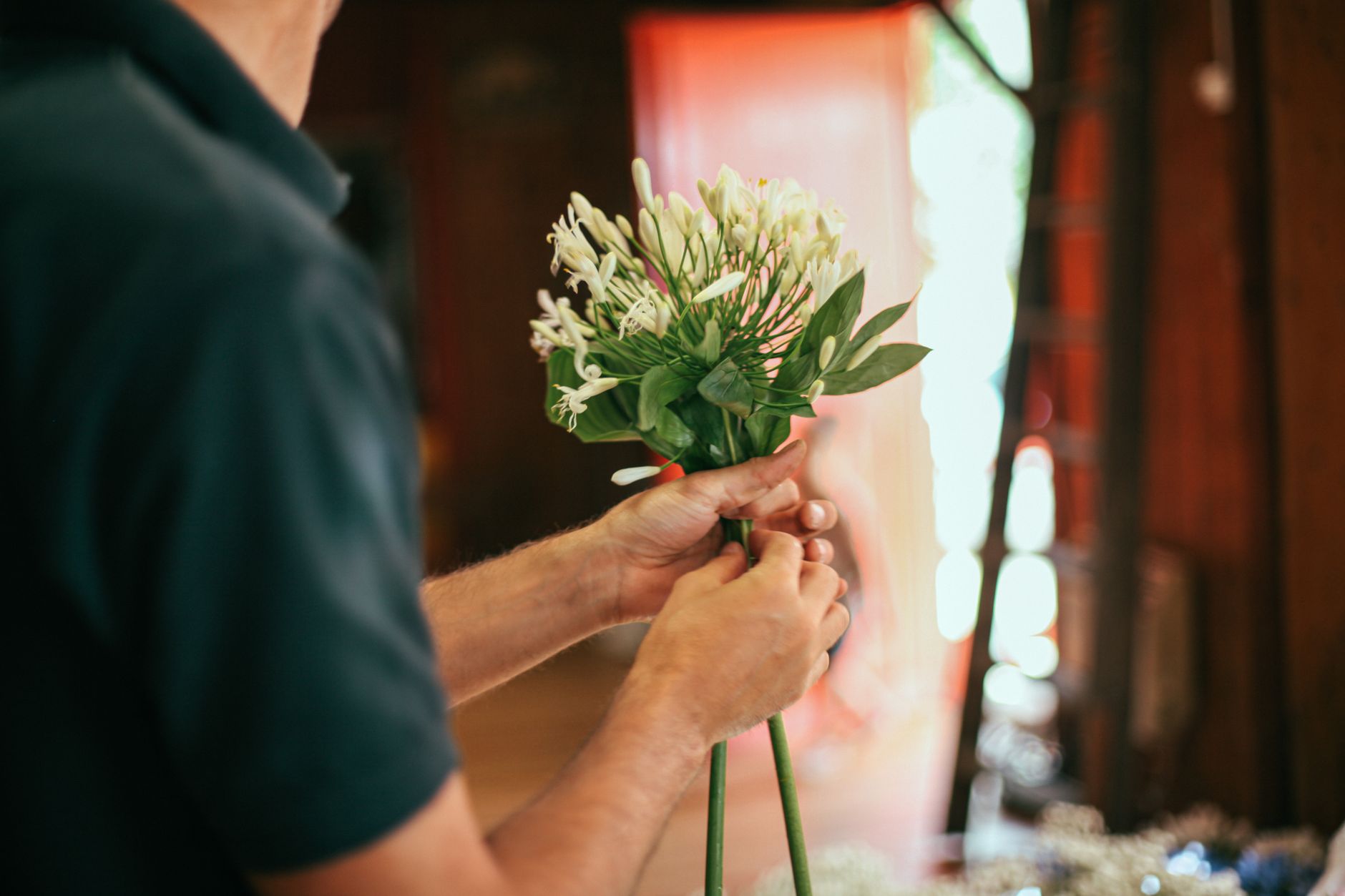
The spiral hand-tie is the foundation of every hand-held bouquet. Start with one focal flower (a large rose or peony). Hold it upright in your left hand. Take a secondary stem and lay it diagonally across the focal stem at a 45-degree angle. Rotate your bouquet slightly counterclockwise and add the next stem at the same angle, overlapping the previous one. Keep rotating and spiraling; stems should fan outward in a cone, not bunch straight up. The spiral creates a dome shape where all stems cross at a single point in the hand—this distributes water evenly and looks professional. Common mistakes: rotating too fast (creates gaps), angling stems too shallow (bouquet looks flat), or gripping too tight (bruises stems and restricts water flow). When you wrap, the spiral point is where the binding starts. Practice at home with grocery-store flowers in a glass of water; you'll see the spiral tighten and the arrangement hold structure naturally.
What to Check Before You Attend a Workshop
- Arrival time & location: We operate in Hanoi and Ho Chi Minh City only. Ask us on WhatsApp for your exact venue address and nearest public landmark before your workshop. Mind the time difference if booking from abroad.
- Heat and humidity: Sessions in afternoon heat work faster (water evaporates, stems dry). Morning bookings are more comfortable. We adjust water and misting based on weather.
- What flowers are in season: Certain blooms (cherry blossom, lotus) are available only during specific months. Confirm flower types on WhatsApp when booking.
- Rainy season: June–September sees occasional downpours. We run indoors, but ventilation may be tighter on busy group days. Ask if you're sensitive to humidity.
- Group size: Confirm your headcount so we prep enough stems and materials.
- Photography: Bring a camera; many of our photos come from participant arrangements, and sharing on social media means we can tag you.
Ask for workshop dates on WhatsApp | ️ See how a class runs
Why Time Estimates Matter in Vietnam's Climate
A flower arrangement's lifespan varies wildly between Hanoi, Ho Chi Minh City, and cooler regions. We quote timings based on what you'll experience after leaving our studio—in your hotel room, shared accommodation, or local home. Heat and humidity compress everything. A hand-tied bouquet lasts 5–7 days in a cool, shaded corner with daily water changes; it wilts in 2–3 days if left in sun or near air conditioning that dries it out. Workshops themselves always run on the schedule listed above, but your arrangement's afterlife depends on your care. This is why we spend class time teaching conditioning, wrapping, and placement—not just arranging.

FAQ
What's the shortest workshop available?
Our beginner flower arranging classes run 90 minutes and include stem conditioning, spiral hand-tie technique, color balance practice, and wrapping—the foundation you need to create a finished bouquet and take it home immediately.
Can I do a workshop if I've never held a flower before?
Absolutely. Every session assumes zero experience. We demo each step, slow down for questions, and build muscle memory through hands-on practice. Beginners typically master basic spiral structure within 90 minutes.
How do rainy days affect class timing?
Rainy seasons (June–September) don't change workshop duration. We adapt by working indoors with extra ventilation and preparing stems in advance so moisture doesn't interrupt learning. Group sessions may need slightly wider spacing, but your personal time stays the same.
What's the difference between a couple session and a standard class?
A couple session runs 2–4 hours (longer than the standard 90-minute class), is private to just you two, and lets you pick your own complexity level—from simple hand-ties to multi-arrangement designs. You work at your pace with one-on-one guidance.
How do you know what flowers to use for a Tet or Christmas workshop?
We confirm seasonal flower availability on WhatsApp when you book. Tet designs favor red, gold, and auspicious blooms like pussy willow and orchids; Christmas uses imported roses, hypericum, and foliage. We prep a seasonal flower list before each workshop.
Can I buy flowers after the workshop to make another arrangement at my hotel?
We don't sell retail flowers separately. For fresh blooms to take beyond the class, contact local flower vendors near your accommodation or ask us on WhatsApp for vendor recommendations in your area.
Does the heat ruin arrangements I make during a workshop?
No, but aftercare is critical. Keep your arrangement in the coolest room available, away from direct sun and heat vents. Change water every other day and re-cut stems. With care, arrangements last 5–7 days in Vietnam's heat; without it, 2–3 days.
What if I'm traveling for only a few days—is a workshop worth my time?
Yes. A 90-minute class is a full skill-building experience and a tangible souvenir you can carry to the airport. If you want deeper cultural context, combine a market tour with a workshop—a half-day outing that fits any itinerary.
Ask for dates
Tell us the city, the date and how many people. We reply on WhatsApp in English with workshop options and a quote.
FAQ
What's the shortest workshop available?
Our beginner flower arranging classes run 90 minutes and include stem conditioning, spiral hand-tie technique, color balance practice, and wrapping—the foundation you need to create a finished bouquet and take it home immediately.
Can I do a workshop if I've never held a flower before?
Absolutely. Every session assumes zero experience. We demo each step, slow down for questions, and build muscle memory through hands-on practice. Beginners typically master basic spiral structure within 90 minutes.
How do rainy days affect class timing?
Rainy seasons (June–September) don't change workshop duration. We adapt by working indoors with extra ventilation and preparing stems in advance so moisture doesn't interrupt learning. Group sessions may need slightly wider spacing, but your personal time stays the same.
What's the difference between a couple session and a standard class?
A couple session runs 2–4 hours (longer than the standard 90-minute class), is private to just you two, and lets you pick your own complexity level—from simple hand-ties to multi-arrangement designs. You work at your pace with one-on-one guidance.
How do you know what flowers to use for a Tet or Christmas workshop?
We confirm seasonal flower availability on WhatsApp when you book. Tet designs favor red, gold, and auspicious blooms like pussy willow and orchids; Christmas uses imported roses, hypericum, and foliage. We prep a seasonal flower list before each workshop.
Can I buy flowers after the workshop to make another arrangement at my hotel?
We don't sell retail flowers separately. For fresh blooms to take beyond the class, contact local flower vendors near your accommodation or ask us on WhatsApp for vendor recommendations in your area.
Does the heat ruin arrangements I make during a workshop?
No, but aftercare is critical. Keep your arrangement in the coolest room available, away from direct sun and heat vents. Change water every other day and re-cut stems. With care, arrangements last 5–7 days in Vietnam's heat; without it, 2–3 days.
What if I'm traveling for only a few days—is a workshop worth my time?
Yes. A 90-minute class is a full skill-building experience and a tangible souvenir you can carry to the airport. If you want deeper cultural context, combine a market tour with a workshop—a half-day outing that fits any itinerary.
More like this
Workshops for travelers
Things to Do With Flowers in Vietnam for Groups: 5 Workshop Options
Group flower workshops in Vietnam range from casual traveler sessions to corporate team building and celebratory parties. We run hands-on classes where groups of any size learn arranging, hand-tied bouquets, and seasonal design—then take home what they make.
Workshops for travelers
Take Flowers Home from Vietnam: Workshop & Travel Guide
Yes, you can take flowers home from Vietnam—but tropical humidity and long flights demand specific techniques. We teach travelers how to condition, wrap, and preserve blooms at our hands-on workshops in Hanoi and Ho Chi Minh City.
Workshops for travelers
Flower Workshop for Tourists: Tools & Techniques in Hanoi & HCMC
We teach tourists real floral techniques—spiral hand-ties, color balance, stem conditioning—using imported and local flowers you take home same day.