
Home › Blog › Flower box and basket
Flower Box Workshop for Beginners: Hands-On Hanoi & HCMC
By the Vietnam Flower Workshop team · 2026-11-06
A flower box workshop for beginners at Vietnam Flower Workshop by Hoa Lang Thang is a 2–3 hour hands-on session where you learn to select, condition, and arrange fresh imported and local flowers directly into a decorative box. We work one-on-one or in small groups in Hanoi and Ho Chi Minh City, guiding you through spiral stem placement, color harmony, and wrapping techniques. You condition (cut and hydrate) stems, build the box from the bottom up with greenery, then layer focal blooms and filler flowers. The piece you create is yours to take home immediately—no shipping. Beginners struggle most with stem length consistency and water distribution; we coach you through both. Ask us for a quote on WhatsApp to confirm dates and availability; we reply as soon as we can. Ask for workshop dates on WhatsApp | ️ See how a class runs
What happens in the first 30 minutes?
We start by walking you through the box itself—its depth, water capacity, and how florist foam sits inside. You'll inspect the flowers delivered that morning: tropical imports (orchids, anthuriums), seasonal local blooms (chrysanthemums, roses), and greenery. We demo conditioning: cutting stems at 45° under running water, removing lower leaves, and placing them in room-temperature water mixed with flower food. This takes 10–15 minutes and is the single most critical step to keep your box fresh through the heat and humidity of Hanoi and Ho Chi Minh City. We explain why each cut matters and show you the exact angle and depth. Beginners often skip this or cut too shallow; we catch it and adjust. By minute 30 you've handled real stems, asked your questions, and you're ready to start your own design.

How do you balance color in a box without it looking chaotic?
We teach a simple three-color rule: pick one dominant color (say, white), one secondary (blush pink), and one accent (deep burgundy or greenery). Start by placing all one color in a rough pattern—say, whites around the perimeter—then layer the secondary in clusters (don't scatter randomly), then dot accent blooms to "finish" the eye. On paper this sounds rigid; in your hands it feels like problem-solving. We hand you blooms and ask where they go; most beginners place an accent bloom dead center, which flattens the box. We nudge it off-center instead. The key is asymmetry: odd numbers (3, 5, 7 roses) look more natural than even rows. By the end you'll instinctively reach for balance instead of symmetry, and the result is giftable and modern.
️ See how a class runs
Why do flowers wilt so fast in the heat here?
Hanoi and Ho Chi Minh City sit between 28–35°C most of the year with 60–80% humidity. Flowers are 90% water; that heat and dry air pull moisture from petals and leaves faster than stems can replace it. Roses wilt in 2–3 days indoors without conditioning; tropical blooms (anthuriums, orchids) last 7–10 days. We teach you this in the workshop because it changes how you design: in cooler climates, a box lasts 5–7 days; here, expect 3–4 days best case, 2 days if placed in direct sun or near an air conditioner (which dries the foam). The fix is to teach your recipient how to refill the box with water daily using a spray bottle on low mist—we write this on a card you leave in the box. That single step extends life by 1–2 days. We use higher-water-holding foams and denser arrangements to compensate. You'll see exactly how we pack the foam and position stems for maximum water access.
What's different about teaching kids versus adults in the same room?
Kids (ages 6–12) focus on color and speed; they want their box to "pop" and finish fast. Adults often overthink proportions and worry about waste. We teach both together by giving kids bigger blooms and fewer stems (8–10 total) while adults use 15–20 and finer detail work. Kids sit on higher stools so they see into the box; we demo spiral technique on a large foam block they can see from a distance. Adults learn to spiral clockwise, slowly reducing stem length as they move inward—a skill that takes 20 minutes to feel natural but pays off when the box has depth and flow. If a child's arrangement looks lopsided, we reframe it as "modern" rather than "wrong"; if an adult's is too dense, we ask them to pull three stems—suddenly there's air and elegance. Mixed groups work best when we stagger timing: kids finish, get a photo, then switch to a shorter task (decorating the box exterior with ribbon or wax seals) while adults refine. Everyone leaves happy.
How do you adapt on a humid, rainy day?
Humidity jumps to 90%+ on heavy rain days in Hanoi and Ho Chi Minh City, which paradoxically stresses flowers: they stop transpiring (releasing water vapor) and petals feel clammy and heavy. We shift the class in two ways. First, we use open-sided boxes or lower-profile designs instead of tall, closed arrangements—airflow helps. Second, we pick flowers known to handle moisture: tropical orchids and anthuriums, which naturally grow in humid rainforests, stay firm; roses and carnations get soft edges. We also increase the misting frequency in the workshop itself—a humid room keeps the flowers' own humidity in balance. We tell you: if your recipient opens the box on a rainy day, leave it out of the plastic wrap for a few hours to breathe, then store in a cool, dry spot. This one piece of advice prevents the "my flowers smell musty" complaint. On very heavy rain days we sometimes shift class outdoors under our covered area—the indirect light and air circulation actually help.
Beginner Flower Box: Quick Comparison
| Box Type | Best For | Stem Count | Key Challenge | Why Pick This |
|---|---|---|---|---|
| Compact cube (20×20 cm) | First-timers, desk gifts | 12–15 stems | Fitting depth without crowding | Quick win, looks full and balanced |
| Tall rectangle (30×20 cm) | Larger rooms, impact gifts | 18–25 stems | Preventing top-heavy tipping | More impressive, uses variety better |
| Low oval (35×15 cm) | Table centerpieces | 15–20 stems | Managing uneven water saturation | Unusual shape, shows off greenery design |
| Seasonal (Tet, Christmas) | Holiday gifts, events | 10–20 stems | Matching cultural colors (red-gold, red-green) | Thematic, memorable, personal touch |
What should you check before booking your first session?
Ask yourself these four things:
- Do I want to keep the box I make, or is it a gift I'll give away the same day? If you're gifting same-day, let us know—we'll brief you on how to hand it over and what care tips to share.
- Can I handle spending 2–3 hours in a humid workshop? We have fans and keep the space cool, but it's never air-conditioned to full comfort. Wear breathable clothes.
- Am I a perfume-sensitive person? Fresh flowers have strong scents, especially tuberose and lilies. If you're sensitive, tell us—we can swap them for scentless blooms.
- Do I want to learn one technique deeply, or get a taste of many? Our flower box session is narrow and deep—you master box building, not bouquets or wreaths. If you want breadth, consider our flower arranging class instead, which covers multiple formats.
Then message us on WhatsApp with: your preferred dates (mind the time difference if you're booking from abroad), group size (solo, couple, small group), and any flower preferences or allergies. We reply as soon as we can and confirm availability.
Ask for workshop dates on WhatsApp
Why start with a box instead of a bouquet?
A box teaches constraint, which is a gift when learning. A hand-tied bouquet is open-ended—stems spiral outward in all directions and you chase proportions forever. A box has walls; foam holds stems in place so you can focus on color and height, not fighting gravity. We find beginners finish their first box feeling accomplished and confident. A bouquet would frustrate them because the learning curve is steeper and the structure less forgiving. After mastering a box, joining a bouquet-making workshop feels like the natural next step because you already know stem conditioning and color balance.
Is this class good for team-building or special occasions?
Yes. Groups of 4–12 work well in our Hanoi and Ho Chi Minh City workshops. Hen parties (bridesmaids creating a gift box together), birthday small groups, and corporate team-building sessions all book flower box classes regularly. Each person makes their own box, but the energy is shared—you laugh, troubleshoot together, and leave with a keepsake and photos. For private and couple sessions, we run one-on-one or just two of you, which is slower and more intimate; some couples treat it as a date where they make one box together. For parties, we often pre-cut some stems and simplify foam prep so you have more time for the fun parts and less time waiting. Ask us what we can customize when you message us on WhatsApp.
Where does this fit in our course offerings?
Our flower workshop for travelers includes a flower box class as one option, usually 2–3 hours mixed with a market tour of local flower vendors in Hanoi or Ho Chi Minh City. If you're visiting and want more depth than a one-off class, our floral design course runs over multiple days and covers boxes, bouquets, seasonals, and business basics. For a pure cultural angle, our Vietnamese flower culture and market tour walks you through how flowers fit into Tet, weddings, and daily life before or after a hands-on session. All are available in Hanoi and Ho Chi Minh City only. Check the main workshop page for flower box and basket classes to see what else is bundled.
️ See how a class runs | Ask for workshop dates on WhatsApp
Key takeaways for your first flower box
- Conditioning is everything. Spend the first 15 minutes cutting stems, removing leaves, and hydrating in flower-food water. Skip this and your box wilts in 2 days, not 4.
- Asymmetry beats symmetry. Odd numbers of blooms in off-center clusters look modern and giftable; dead-center rows look flat.
- Color rule of three. Pick one dominant, one secondary, one accent color and stick to it. Chaos is just too many colors competing.
- Heat and humidity here are real. Design dense, keep misting instructions simple, and expect a 3–4 day lifespan instead of a week. Your recipient needs to know that.
- Start with a box, move to bouquets. A box teaches you constraint and confidence before you tackle the open-ended spiral hand-tie.

FAQ
Do I need any flower experience to join a flower box workshop for beginners?
No. We teach from scratch: how to hold scissors, where to cut, why conditioning matters. We assume zero knowledge and walk through every step. By the end you'll have a finished, giftable box you made yourself.
How long does a flower box last in Hanoi or Ho Chi Minh City?
With daily mist refills on the foam, 3–4 days typical. Without refilling, 2 days. We write care instructions on a card inside the box so your recipient knows what to do. Tropical blooms (orchids) last longer; roses fade faster.
Can I book a private session, or is it only group classes?
We offer both. Group sessions are fun and social; private or couple sessions are quieter and let us focus on your technique. Message us on WhatsApp with your preference and we'll find a time that works.
What if I'm visiting Hanoi or Ho Chi Minh City for just a few days—can I still book?
Yes. Our flower workshops for travelers are scheduled throughout the week in both cities. Let us know your dates and we'll confirm availability as soon as we can on WhatsApp. Mind the time difference if you're booking from abroad.
What happens if I mess up a stem or put a flower in the wrong place?
We pause and adjust it together. Florists do this every day; there's no such thing as ruined. If a stem is cut wrong, we swap it for a fresh one. If a bloom is in the wrong spot, we move it. The whole point is learning, not perfection.
Can I take my finished flower box on a plane or in a car to another city?
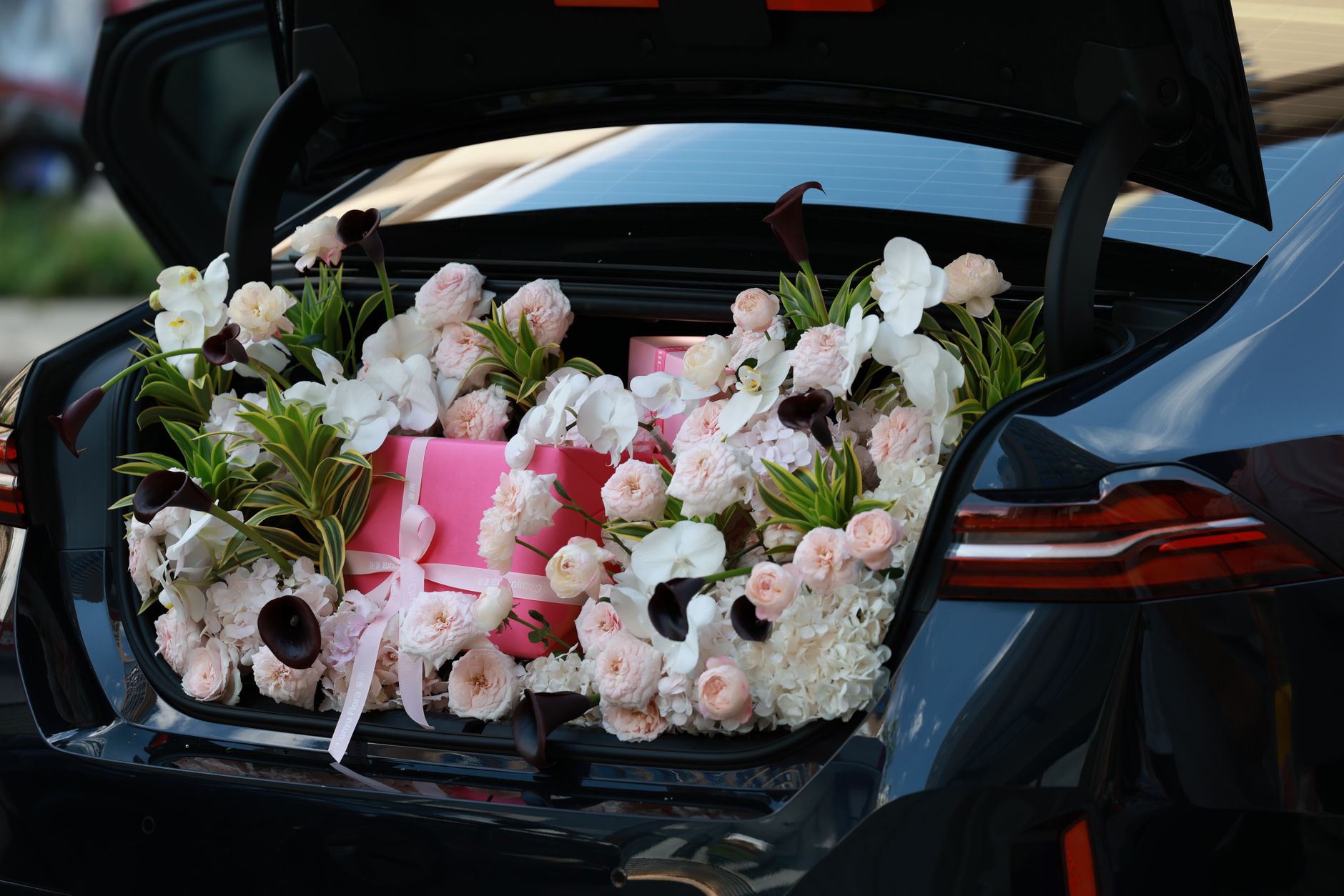
Yes, but it's fragile. We'll wrap it carefully. If you're traveling same-day, keep it upright, avoid placing it in a hot trunk, and avoid crushing it against other items. We deliver same-day in Hanoi and Ho Chi Minh City; for travel outside our service areas, the box travels at your own risk.
What's the difference between a flower box class and your general flower arranging class?
The flower box class focuses on one format—boxes—so you go deep on technique and leave with one finished piece. The flower arranging class covers multiple formats (bouquets, vases, hand-tied) in a broader overview. Pick a box class if you want mastery of one skill; pick the general class if you want taste of many.
Ask for dates
Tell us the city, the date and how many people. We reply on WhatsApp in English with workshop options and a quote.
FAQ
Do I need any flower experience to join a flower box workshop for beginners?
No. We teach from scratch: how to hold scissors, where to cut, why conditioning matters. We assume zero knowledge and walk through every step. By the end you'll have a finished, giftable box you made yourself.
How long does a flower box last in Hanoi or Ho Chi Minh City?
With daily mist refills on the foam, 3–4 days typical. Without refilling, 2 days. We write care instructions on a card inside the box so your recipient knows what to do. Tropical blooms (orchids) last longer; roses fade faster.
Can I book a private session, or is it only group classes?
We offer both. Group sessions are fun and social; private or couple sessions are quieter and let us focus on your technique. Message us on WhatsApp with your preference and we'll find a time that works.
What if I'm visiting Hanoi or Ho Chi Minh City for just a few days—can I still book?
Yes. Our flower workshops for travelers are scheduled throughout the week in both cities. Let us know your dates and we'll confirm availability as soon as we can on WhatsApp. Mind the time difference if you're booking from abroad.
What happens if I mess up a stem or put a flower in the wrong place?
We pause and adjust it together. Florists do this every day; there's no such thing as ruined. If a stem is cut wrong, we swap it for a fresh one. If a bloom is in the wrong spot, we move it. The whole point is learning, not perfection.
Can I take my finished flower box on a plane or in a car to another city?
Yes, but it's fragile. We'll wrap it carefully. If you're traveling same-day, keep it upright, avoid placing it in a hot trunk, and avoid crushing it against other items. We deliver same-day in Hanoi and Ho Chi Minh City; for travel outside our service areas, the box travels at your own risk.
What's the difference between a flower box class and your general flower arranging class?
The flower box class focuses on one format—boxes—so you go deep on technique and leave with one finished piece. The [flower arranging class](/flower-arranging-class) covers multiple formats (bouquets, vases, hand-tied) in a broader overview. Pick a box class if you want mastery of one skill; pick the general class if you want taste of many.
More like this
Flower box and basket
Flower Box Workshop: What to Expect When You Book
In a flower box workshop at Hoa Lang Thang, you'll learn stem conditioning, color balance, and layering live flowers in a foam base—then walk out with your finished arrangement.
Flower box and basket
Flower Box Workshop in English – Learn & Take Home in Hanoi & HCMC
A flower box workshop in English teaches you spiral wrapping, color balance, and stem conditioning—then you leave with your own designed arrangement. We run sessions in Hanoi and Ho Chi Minh City using imported and local blooms.
Flower box and basket
Flower Box Workshop Vietnam: Learn to Arrange Like a Pro
A flower box workshop in Vietnam teaches you to condition stems, balance color, and arrange imported and local flowers under tropical heat—then you take your finished piece home the same day.