
Home › Blog › Flower arranging class
Flower Arranging Workshop Saigon English: Hands-On Classes for Travelers
By the Vietnam Flower Workshop team · 2026-11-06
At Vietnam Flower Workshop by Hoa Lang Thang in Ho Chi Minh City, we teach flower arranging in English to travelers, expats, and couples who want to learn spiral hand-tying, stem conditioning, and color balance. A typical workshop runs 2–3 hours: we begin with fresh stem prep (cutting at 45° angles, leaf stripping below the waterline), then move into hand-tied bouquet structure using imported and seasonal Vietnamese flowers. You leave with a finished arrangement to take home. Saigon's heat (27–34°C year-round) means we condition stems in cool water, work indoors with air conditioning, and use fast-absorbing floral foam. No prior experience needed. We teach small groups, private couples, or families. Ask us for a quote on WhatsApp for specific dates—workshops run most days depending on group size and season. ️ See how a class runs
What makes an English-taught workshop in Saigon different from general craft classes?
Flower arranging requires live material and real-time feedback on technique—not video tutorials. We work hands-on with imported Ecuadorian roses, local jasmine, and seasonal blooms that arrive daily, so every student handles flowers that feel and cut like the ones sold in Saigon markets. Unlike pre-recorded courses, an English-speaking instructor watches your spiral grip, corrects your stem angle in the moment, and adjusts difficulty as you work. Beginners often grip too tightly or strip leaves too high on the stem; we catch that in person. A live workshop also means you leave with a real bouquet, not a photo—that's the difference between learning and creating.
Ask for workshop dates on WhatsApp

Which workshop format suits solo travelers vs. couples or groups?
Workshop format comparison
| Format | Who it's for | Duration | Setup | Best for |
|---|---|---|---|---|
| Tourist group session | Solo travelers, backpackers, small tour groups | 2–2.5 hours | Shared stems, one instructor per 6–8 | Meeting other travelers, casual interest |
| Private & couple sessions | Partners, anniversary, proposal prep, honeymooners | 2–3 hours | Dedicated florist, custom flower choice | Intimacy, bespoke arrangements, proposal florals |
| Team building workshop | Company groups, expat communities, clubs | 3–4 hours | Stations, competition format, team boxes | Corporate bonding, networking, group memory |
| Kids & family workshop | Families with children 6+, multi-generational groups | 1.5–2 hours | Simplified stems, safe scissors, larger blocks | Kids learn plant biology, family activity, low pressure |
Solo travelers often join the tourist format because the energy is social and no commitment required. Couples book private sessions to choose wedding colors or recreate a meaningful flower type. Teams enjoy competition—dividing into groups to design the fastest or most creative box arrangement. Families with young children attend our adapted session with softer stems (carnations, daisies) and child-safe tools. All formats include a take-home arrangement.
How do we keep flowers fresh in Saigon's heat and humidity?
Saigon's heat (often 30–34°C with 70–90% humidity) accelerates wilting and bacterial growth in cut stems. We combat this in five ways. First, we condition every stem on arrival: cut at 45° angles under running water to maximize xylem exposure, strip all leaves below the waterline (bacteria grows there and clogs stems), and soak in cool water with floral food for 2–4 hours before class. Second, our workshop is fully air-conditioned—working in 22–24°C indoors slows transpiration (water loss through leaves) dramatically. Third, we use fresh floral foam daily; reused foam blocks trap bacteria. Fourth, we add floral preservative to every student's take-home vase water—it feeds flowers and acidifies water to prevent bacterial blooms. Fifth, we wrap finished bouquets in kraft paper and cellophane to reduce dehydration. Despite humidity, a properly conditioned bouquet lasts 7–10 days in Saigon if kept indoors away from direct sun and topped up daily. We tell every student this on day one.
What techniques do beginners struggle with, and how do we teach them?
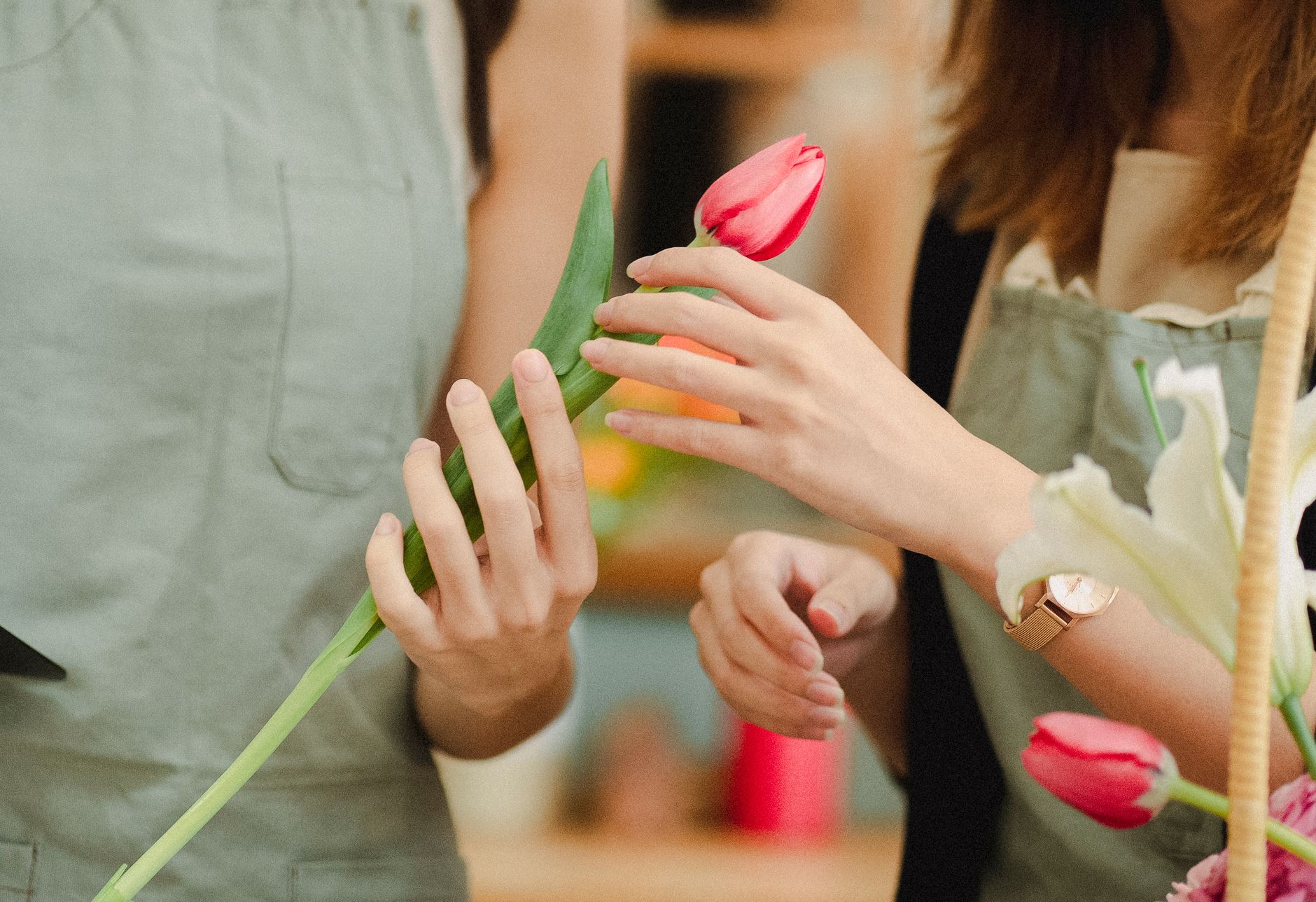
Most beginners make three mistakes. The "too tight" grip: new arrangers squeeze stems so hard in the spiral that they crush vascular tissue and water can't flow. We teach a relaxed three-finger cradle instead—thumb and forefinger guide, middle finger supports from below. Students practice on practice foam (no water) first. The "all one height" syndrome: beginners center every stem at the same level, creating a dome instead of a dynamic, sculptural shape. We show that half the stems should be shorter (foreground), half taller (backdrop), with odd numbers only (3, 5, 7 stems per color cluster)—asymmetry feels intentional. The "leaf clutter" error: leaving foliage high on stems makes the spiral chunky and hides structure. We demonstrate that stems should be bare for 4–6 inches below the spiral point. We drill this three times: "Everything below the hand is stripped. Everything above stays." By the end of a 2-hour session, students feel the difference between a tight, hidden spiral and an open, visible one.
How do we adapt workshops for kids, rainy days, and large mixed-ability groups?
For children (ages 6+): we swap delicate roses for hardy carnations and dahlias; they're forgiving and cut like carrots. We use child-sized scissors (safer edges) and softer floral foam. Sessions run 1.5 hours instead of 2.5—young focus spans shift. We frame arranging as a "flower puzzle" (colors, heights, shapes) and let them take the finished creation home immediately to show parents. Kids rarely worry about perfection; they enjoy the sensory experience (water, texture, smell).
On rainy days: our workshop is indoors, so rain doesn't cancel sessions. However, very heavy rain (tropical downpours) can delay flower delivery from local suppliers. On those mornings, we message group participants to confirm we're proceeding—and we always have backup stock in cold storage. Humidity on rainy days is high (85%+), so we lower our AC to 20°C and keep stems in water right up until class starts.
For mixed-ability groups: we ask participants beforehand about experience. Absolute beginners start with hand-tie basics and small clusters (3–5 stems). Experienced arrangers (who've done floral courses or home gardening) jump straight to large spirals, texture layering, or structural branches. Both groups work in the same room, so the energy builds—novices see advanced work and feel inspired; advanced makers see beginner questions they'd forgotten and reinforce their own foundations. One instructor + one assistant means we can rotate attention.
What should you check before booking a Saigon English workshop?
Before you commit, confirm these:
- Instructor language: ask specifically if the instructor speaks conversational English or if there's a translator. We teach entirely in English; no translation lag.
- Flower type & season: ask what blooms will be in stock on your date. Tet (January–February) workshops feature lotus and red/gold arrangements; Christmas workshops include holly-inspired wreaths. Off-season might mean fewer imported options. See our seasonal workshops page for what's available when.
- Take-home format: clarify if you leave with a loose bouquet (we wrap it) or a vase-ready arrangement. For travelers on a flight, a wrapped bouquet is easier to pack.
- Group size: small groups (≤6 people) mean more hands-on correction; larger groups (8+) are more social but less individual feedback. Choose based on your learning style.
- Accessibility: let us know if you have mobility issues or hand weakness. We can adapt the height of work tables or use lighter stems.
- Photo policy: tell us if you want photos taken of you arranging. We don't publish anything without permission.
️ See how a class runs
Why choose a workshop over online tutorials or buying a pre-made bouquet?
Online tutorials can't correct your spiral angle in real time, show you how flowers feel when properly conditioned, or let you touch imported Ecuadorian roses before purchase. Pre-made bouquets are beautiful to receive but don't teach you the skill—you miss the satisfaction of building something with your hands. A live workshop in English gives you three things tutorials and store purchases don't: immediate feedback (the instructor sees your stem angle and adjusts it), muscle memory (you feel the spiral spiral, the weight, the resistance), and a finished artifact you made yourself. Many students who take our flower arranging class say the biggest surprise is how meditative the work is—not rushed, not Instagram-ready, just you and flowers for 2–3 hours. That's hard to replicate online or in a shop.
Who should book a private vs. group session—and when?
Book a private and couples session if you're celebrating an anniversary, planning a proposal, or want to design florals for a specific event (wedding rehearsal, small dinner). Private sessions let you choose exact colors and flower types—and one florist works just with you. Couples sessions often include champagne and are designed as a date activity. Book a group or team session if you're part of a company retreat, tour group, or friend cluster visiting Saigon. Group workshops are livelier, cheaper per person, and create shared memories. They also suit family reunions or hen parties. If you're unsure, ask us—we can recommend based on your group size and vibe.
Ask for workshop dates on WhatsApp
Can I learn flower arranging and also visit Saigon's flower markets?
Yes. Many students pair a workshop with a Vietnamese flower culture & market tour to see where our blooms come from—early-morning wholesale markets, small family growers, and traditional Tet flower zones. A tour runs 2–3 hours and includes market history, haggling tips, and flower quality grading. Some travelers do the market tour first (to understand supply), then attend a workshop to apply that knowledge. Others reverse it. Both orders work—there's no prerequisite. We can help link these on the same day or on consecutive days depending on your schedule.
What's included in the price, and when should I ask for a quote?
We don't publish single workshop prices here because costs vary by group size, flower selection (imported vs. local), season (Tet and Christmas are busier), and session type. A solo traveler's drop-in is usually lower per head than a private couple's session with premium roses. A team-building workshop for 15 people is less per person than a private and couples session. Ask us for a quote on WhatsApp—include your date, group size, and any flower preferences. We'll send you a full breakdown, including what flowers are in stock that week and any seasonal premiums.
Ask for workshop dates on WhatsApp

FAQ
Do I need any flower arranging experience to join?
No. We teach from absolute beginner to intermediate level in the same sessions. The instructor adapts complexity—beginners learn spiral basics, experienced arrangers explore texture and asymmetry. Everyone leaves with a finished bouquet.
How long do the flowers last after I take them home?
7–10 days in Saigon if kept indoors, away from direct sun, with daily water top-ups. We send every student home with floral food and care instructions. Heat and humidity reduce vase life compared to cooler climates, but proper conditioning extends longevity significantly.
What if I'm flying out the next day—can I still take my bouquet?
Yes. We wrap the finished arrangement in kraft paper and cellophane to minimize dehydration during travel. Lay it flat or hold it upright in your luggage. Mist lightly before packing. Many travelers have successfully transported bouquets on flights; we include packing tips in class.
Do you offer longer floral design courses, or only single workshops?
We offer both. Single workshops are 2–3 hours and teach one technique (hand-ties, boxes, seasonal wreaths). A floral design course is a multi-session program (ask us for duration and topics)—ideal for people planning to arrange flowers professionally or want deep skill-building. Courses run less frequently and require advance booking.
Can kids attend, or is it only adults?
Kids 6+ are welcome in our kids & family workshop. Sessions are shorter (1.5 hours), stems are easier to cut, and we focus on fun and color learning instead of perfection. Family workshops mix generations and often book around school holidays. Ask us for family-friendly dates.
What if the workshop is cancelled due to weather or low booking?
Tropical rain in Saigon rarely cancels workshops (we're indoors). Very occasional supply delays might mean we shift to backup flowers, but the session runs. If a workshop is under-booked, we'll reschedule you to another date with priority notice and the same price. Cancellations are rare, but we communicate promptly on WhatsApp if they occur.
Ask for dates
Tell us the city, the date and how many people. We reply on WhatsApp in English with workshop options and a quote.
FAQ
Do I need any flower arranging experience to join?
No. We teach from absolute beginner to intermediate level in the same sessions. The instructor adapts complexity—beginners learn spiral basics, experienced arrangers explore texture and asymmetry. Everyone leaves with a finished bouquet.
How long do the flowers last after I take them home?
7–10 days in Saigon if kept indoors, away from direct sun, with daily water top-ups. We send every student home with floral food and care instructions. Heat and humidity reduce vase life compared to cooler climates, but proper conditioning extends longevity significantly.
What if I'm flying out the next day—can I still take my bouquet?
Yes. We wrap the finished arrangement in kraft paper and cellophane to minimize dehydration during travel. Lay it flat or hold it upright in your luggage. Mist lightly before packing. Many travelers have successfully transported bouquets on flights; we include packing tips in class.
Do you offer longer floral design courses, or only single workshops?
We offer both. Single workshops are 2–3 hours and teach one technique (hand-ties, boxes, seasonal wreaths). A [floral design course](/floral-design-course) is a multi-session program (ask us for duration and topics)—ideal for people planning to arrange flowers professionally or want deep skill-building. Courses run less frequently and require advance booking.
Can kids attend, or is it only adults?
Kids 6+ are welcome in our [kids & family workshop](/kids-and-family). Sessions are shorter (1.5 hours), stems are easier to cut, and we focus on fun and color learning instead of perfection. Family workshops mix generations and often book around school holidays. Ask us for family-friendly dates.
What if the workshop is cancelled due to weather or low booking?
Tropical rain in Saigon rarely cancels workshops (we're indoors). Very occasional supply delays might mean we shift to backup flowers, but the session runs. If a workshop is under-booked, we'll reschedule you to another date with priority notice and the same price. Cancellations are rare, but we communicate promptly on WhatsApp if they occur.
More like this
Flower arranging class
Flower Arranging Workshop Tay Ho for Beginners: Step-by-Step Guide
Vietnam Flower Workshop by Hoa Lang Thang runs hands-on flower arranging sessions in Tay Ho, Hanoi's lakeside district, where beginners learn stem conditioning, spiral wrapping, and color theory in 2–3 hours with real flowers to take home.
Flower arranging class
Flower Arranging Workshop Tay Ho in English: Book Now
We run hands-on flower arranging workshops in English across Hoa Lang Thang's Hanoi and Ho Chi Minh City studios. Tay Ho participants learn conditioning, spiral techniques, and color balance in 2–3 hour sessions with real flowers to take home.
Flower arranging class
Flower Arranging Workshop Saigon for Beginners
A flower arranging workshop in Saigon teaches beginners the core skills—stem prep, spiral technique, wrapping—in a single 2–3 hour session with guidance from working florists.