
Home › Blog › Bouquet workshop
Bridal Bouquet Workshop Tools & Techniques in Hanoi
By the Vietnam Flower Workshop team · 2026-11-06
A bridal bouquet workshop covers three core skills: stem conditioning (hydration, leaf removal, diagonal cuts), spiral hand-tie construction (rotating stems in a dominant hand while feeding blooms with the other), and finishing wraps and ties. At Vietnam Flower Workshop by Hoa Lang Thang in Hanoi and Ho Chi Minh City, a typical session runs 2–3 hours with real imported and local blooms you take home. Beginners struggle most with hand tension—too tight crushes stems, too loose collapses the spiral—and with judging depth so flowers sit at one focal height. We condition stems 30 minutes before you arrive; tropical heat means blooms wilt quickly without deep water absorption. Ask us for a quote on WhatsApp to book a private session, couple's class, or small group; availability is confirmed there. We reply as soon as we can on WhatsApp. What to avoid: skipping the diagonal cut (reduces water uptake), bunching all heavy stems first (creates a weak core), and exposing finished bouquets to direct sun or air-conditioning drafts during transport. Ask for workshop dates on WhatsApp
Why does hand tension make or break a bridal bouquet?
Spiral hand-tie strength depends entirely on grip pressure during construction. Your dominant hand holds the growing stem bundle while the other feeds new blooms in at a 45° angle; if you squeeze too hard, you crush vessel tissues and water flow stops within hours. If your grip is loose, the spiral unravels and flowers topple out of alignment before the first wrap goes on. We teach the "flex test"—after tying, gently tug the bundle sideways; it should resist with a soft spring, not snap stiff or collapse. Most beginners discover this through mistakes: a bouquet that holds perfectly in the workshop suddenly droops by 6 p.m. at the venue because the stem bundle was crushed mid-spiral. The fix is repetition with feedback; during a session, we stop you mid-construction and ask you to feel the tension, then adjust in real time. This tactile learning beats any video because your hands recalibrate as you build.

What prep work happens before guests arrive?
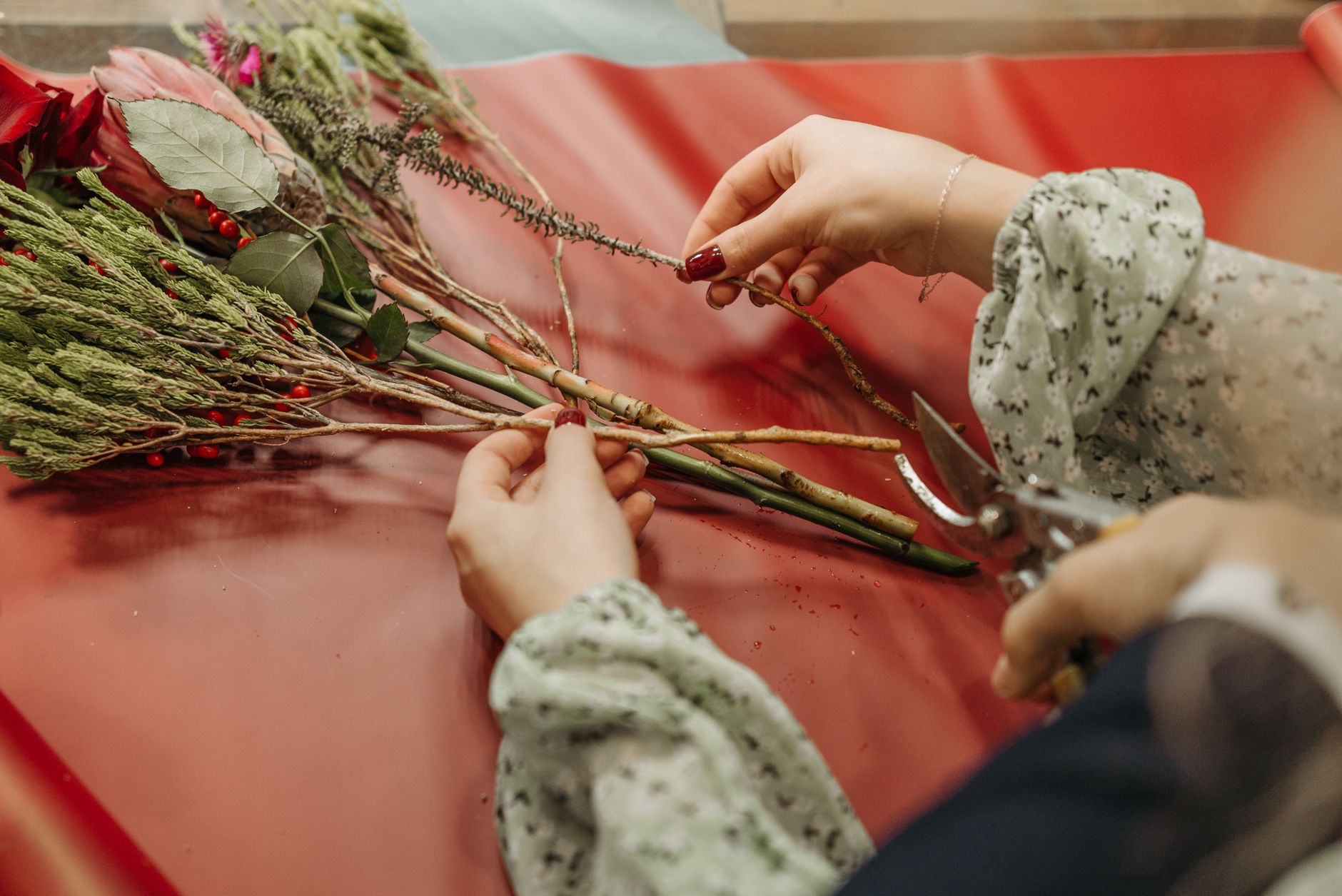
All conditioning occurs behind the scenes in our Hanoi and Ho Chi Minh City studios before you walk in. We remove lower foliage (bacteria live on leaves and clog stems), recut stems at 45° with sharp floral knives (blunt cuts don't hydrate), and soak everything in deep, cool water for 30+ minutes. Tropical heat in Vietnam means blooms dehydrate fast; conditioning is non-negotiable. Roses, lisianthus, and spray chrysanthemums arrive in buckets; we check for bruises, loose petals, and wilting before you use them. Local orchids and seasonal lotus, if included, get extra attention—orchid stems are woody and need crushed stem ends, while lotus stems are hollow and prone to air locks. By the time you arrive, every stem is turgid and ready to hold water for days after your workshop. This pre-prep saves you 30 minutes and prevents the heartbreak of wilting blooms mid-class. You focus on technique, not triage.
How do you adapt technique for Vietnam's humidity and heat?
Standard bridal bouquet methods assume cool, dry air; Vietnam's 80–95% humidity and 28–32°C temperatures break those rules. We use shorter vase life expectations—blooms last 5–7 days instead of 10–14—and adjust water chemistry. We add floral preservative (sugar for energy, biocide to slow bacteria) to every bucket. Wrapping technique shifts too: instead of tissue paper alone, we use breathable floral wrap that prevents moisture trapping yet shields blooms from direct sun. We teach you to finish with a water vial tucked into the binding point (a small tube filled with water keeps stem ends hydrated during transport). In a group session, we show the difference live: one bouquet wrapped tightly with plastic wilts in 4 hours; one with vial and breathable wrap stays fresh for 8+ hours even in a hot car. Beginners are shocked by this. We also brief you on venue setup—avoid placing finished bouquets near air-con vents or windowsills; direct cold or sun causes petal drop within hours. This is why private and couple sessions include a 10-minute "post-workshop care" chat about storage and transport.
What's the difference between beginner and advanced spiral techniques?
Spiral Skill Progression
| Level | Hand Hold | Stem Feed Angle | Density | Time in Workshop |
|---|---|---|---|---|
| Beginner | Loose grip, palm up | Haphazard, 30–90° | Sparse, gaps visible | 2.5–3 hours |
| Intermediate | Firm grip, palm angled 45° | Consistent 45–60° | Medium, balanced | 2–2.5 hours |
| Advanced | Precise grip, micro-adjustments | Exact 45°, no deviation | Dense, no gaps, professional | 1.5–2 hours |
A beginner spirals 5–7 stems and stops; the bouquet looks skinny because gaps remain between blooms. We fix this by adding texture fillers (eucalyptus, ruscus, green chrysanthemum) to hide the holes while you learn hand control. Intermediate students build 12–15 stems and recognize when depth is wrong (a flower sticks out too far forward or sits too deep). Advanced participants finish 18–25 stems, rotate smoothly, and judge focal height by eye alone. The difference is feel, not rules. A flower arranging class covers beginner spirals with live correction; a floral design course (longer, multi-session) teaches you to diagnose your own tension and adjust mid-spiral without stopping. Speed isn't the goal—precision is. A sloppy 30-stem bouquet collapses; a clean 12-stem spiral lasts a week.
How do kids and groups tackle bridal bouquet skills safely?
Kids (ages 8+) can learn spiral basics with supervision; we use shorter, pre-conditioned stems and avoid thorny roses. We pair each child with an adult during a kids and family workshop so hands are guided, not rushed. A group session scales: for a hen or birthday party, we prep more stems, shorten the learning arc (focus on spiral only, not wrapping), and build smaller posies (6–8 stems) that feel like real bouquets but finish in 60 minutes. Team-building groups at our studio often do 2–3 person relay spirals—one person feeds stems, one rotates, one judges height—which teaches collaboration and prevents hand fatigue. The risk is rushing: a hurried spiral buckles under its own weight. We always pause and ask, "Can you wiggle it gently without it collapsing?" If no, we rewind and rebuild. That's the honest feedback: not every attempt succeeds, and that's how learning happens. For travelers and expats with one-day workshops, we focus on the single spiral technique so you leave with one skill you can teach at home, not five half-learned tricks.
What tools do professionals use, and why?
You only need three essentials: a sharp floral knife (Japanese or German steel, ≥8 cm blade), a bouquet holder or binding point (floral foam cage or twine), and scissors for finishing. Most beginners bring household scissors, which crush stems instead of cutting them; this single mistake kills blooms within 24 hours. We provide professional knives and scissors during workshops; you practice the correct grip (knife at 45° to the stem, one smooth stroke downward, no sawing). Wrapping materials are secondary: floral wrap, raffia, ribbon, kraft paper, and twine. The wrap's job is aesthetic and protective—it holds moisture in and sun/air-con drafts out. A tight wrap without breathability traps humidity and causes rot; a loose wrap exposes stem ends and they dry out. We show you the "feel test"—squeeze the wrap gently; you should feel the stem bundle resist, not compress like a sponge. Hand-tied bouquets don't need a holder if stems are bound tightly at a single point; vase arrangements need floral foam (pre-soaked, packed firmly, no air gaps). For transportable bouquets, a vial of water tucked into the binding wrap is non-negotiable in tropical heat. None of these tools are expensive; ask us for a quote on WhatsApp if you want to stock your own kit at home.
What to check before you book a workshop
- Your experience level: Are you a total beginner or have you arranged flowers before? Tell us; we slot you into the right class size and depth.
- Time commitment: Beginner bouquets take 2.5–3 hours hands-on; don't expect to finish and run. Budget 15 minutes extra for wrapping and photos.
- Takeaway care: You leave with fresh blooms in a bouquet. Plan to get them into water within 2 hours. No sealable container? Ask us for advice on WhatsApp before arrival.
- Heat and humidity impact: Blooms condition beautifully in our studio, but Vietnam's climate is harsh. Finished bouquets last 5–7 days with proper care (cool storage, daily water changes). Manage expectations; this isn't a 14-day bouquet like you'd get in temperate countries.
- Group dynamics: If you're in a group, noise and shared space may distract. Private or couple sessions are quieter and allow one-on-one correction.
️ See how a class runs

FAQ
Can I learn to spiral at home after one workshop?
Yes, if you buy pre-conditioned stems from a local flower market and practice 3–4 times per week for 2 weeks. Most people need live correction twice before muscle memory sets in; a single workshop is the start, not mastery.
Do you use imported roses only, or local flowers too?
We use both. Imported roses (Ecuador, Kenya, Netherlands origins) are thorn-heavy and suit formal bouquets; local roses and Vietnamese orchids, carnations, and chrysanthemums are softer and work for romantic, garden styles. We brief you on varieties during the workshop.
What happens if I crush a stem mid-spiral?
Stop, and we rewind the spiral or swap that stem for another. Crushed stems can't recover; trying to force one into the bouquet means it wilts first. No shame—every florist does this. It's why conditioning and repetition matter.
How much do bouquets cost to make at home after the workshop?
Ask us for a quote on WhatsApp on the specific stems you want. Costs depend on season and import availability. Local blooms are cheaper than imported; seasonal (lotus, peonies) vary by month. We can advise once you know what you're building.
Do you offer same-day delivery if I order a bridal bouquet for an event?
We deliver in Hanoi and Ho Chi Mihn City only on the day of your order. Availability is confirmed on WhatsApp; respond with event date and specifics, and we reply as soon as we can with options.
Can couples do a workshop together, or do I need a group booking?
Couples can book a private session for two. Same techniques, one bouquet each, and shared learning. Quieter than a group, more personal feedback.
What's the actual skill difference between a 2-hour and a half-day workshop?
A 2-hour class covers one bouquet, spiral only, no wrapping. A half-day or longer floral design course adds wrapping, finishing, design theory, and a second bouquet. More time = deeper habit and confidence.
Ask for dates
Tell us the city, the date and how many people. We reply on WhatsApp in English with workshop options and a quote.
FAQ
Can I learn to spiral at home after one workshop?
Yes, if you buy pre-conditioned stems from a local flower market and practice 3–4 times per week for 2 weeks. Most people need live correction twice before muscle memory sets in; a single workshop is the start, not mastery.
Do you use imported roses only, or local flowers too?
We use both. Imported roses (Ecuador, Kenya, Netherlands origins) are thorn-heavy and suit formal bouquets; local roses and Vietnamese orchids, carnations, and chrysanthemums are softer and work for romantic, garden styles. We brief you on varieties during the workshop.
What happens if I crush a stem mid-spiral?
Stop, and we rewind the spiral or swap that stem for another. Crushed stems can't recover; trying to force one into the bouquet means it wilts first. No shame—every florist does this. It's why conditioning and repetition matter.
How much do bouquets cost to make at home after the workshop?
Ask us for a quote on WhatsApp on the specific stems you want. Costs depend on season and import availability. Local blooms are cheaper than imported; seasonal (lotus, peonies) vary by month. We can advise once you know what you're building.
Do you offer same-day delivery if I order a bridal bouquet for an event?
We deliver in Hanoi and Ho Chi Mihn City only on the day of your order. Availability is confirmed on WhatsApp; respond with event date and specifics, and we reply as soon as we can with options.
Can couples do a workshop together, or do I need a group booking?
Couples can book a [private session for two](/private-and-couples). Same techniques, one bouquet each, and shared learning. Quieter than a group, more personal feedback.
What's the actual skill difference between a 2-hour and a half-day workshop?
A 2-hour class covers one bouquet, spiral only, no wrapping. A half-day or longer [floral design course](/floral-design-course) adds wrapping, finishing, design theory, and a second bouquet. More time = deeper habit and confidence.
More like this
Bouquet workshop
Bridal Bouquet Workshop in Tay Ho: Design Your Own Flowers
Our bridal bouquet workshops in Tay Ho let you create and take home your own wedding arrangement using imported and local flowers—no floral design experience needed.
Bouquet workshop
Bridal Bouquet Workshop in Saigon: Hands-On Design for Your Big Day
A bridal bouquet workshop in Ho Chi Minh City lets you design and wrap your own wedding flowers, or craft bridesmaid pieces with guidance from our florists. We teach spiral hand-tie technique, stem conditioning, and color balance using real seasonal blooms.
Bouquet workshop
Bridal Bouquet Workshop in Hoan Kiem: Hand-Tied Design Class
Our bridal bouquet workshop in central Hanoi teaches you spiral hand-tie technique, color balance, and conditioning—so you create a wedding-ready arrangement you take home the same day.