
Home › Blog › Bouquet workshop
Bouquet Making Class: What to Expect at Our Hanoi & HCMC Workshops
By the Vietnam Flower Workshop team · 2026-11-06
At Vietnam Flower Workshop by Hoa Lang Thang in Hanoi and Ho Chi Minh City, a bouquet making class runs as a hands-on, small-group or private session where you learn flower conditioning, spiral hand-tie technique, color theory, and wrapping—all in one session. We supply real imported and seasonal flowers; you prepare stems with sharp cuts and remove lower foliage, then build your bouquet by placing stems at a 45-degree angle, rotating as you add each flower to form the spiral. The session includes instruction on how to balance warm and cool tones, anchor your focal flowers, and finish with a professional wrap. Everyone leaves with their own finished bouquet, ready to display at home or give as a gift. Cost varies by season, flower choice, and group size—ask us for a quote on WhatsApp. Beginners often struggle with hand tension and stem angle; we show you how to avoid crushing blooms and maintain an even, stable structure throughout the build. Ask for workshop dates on WhatsApp
What Happens During the First 15 Minutes?
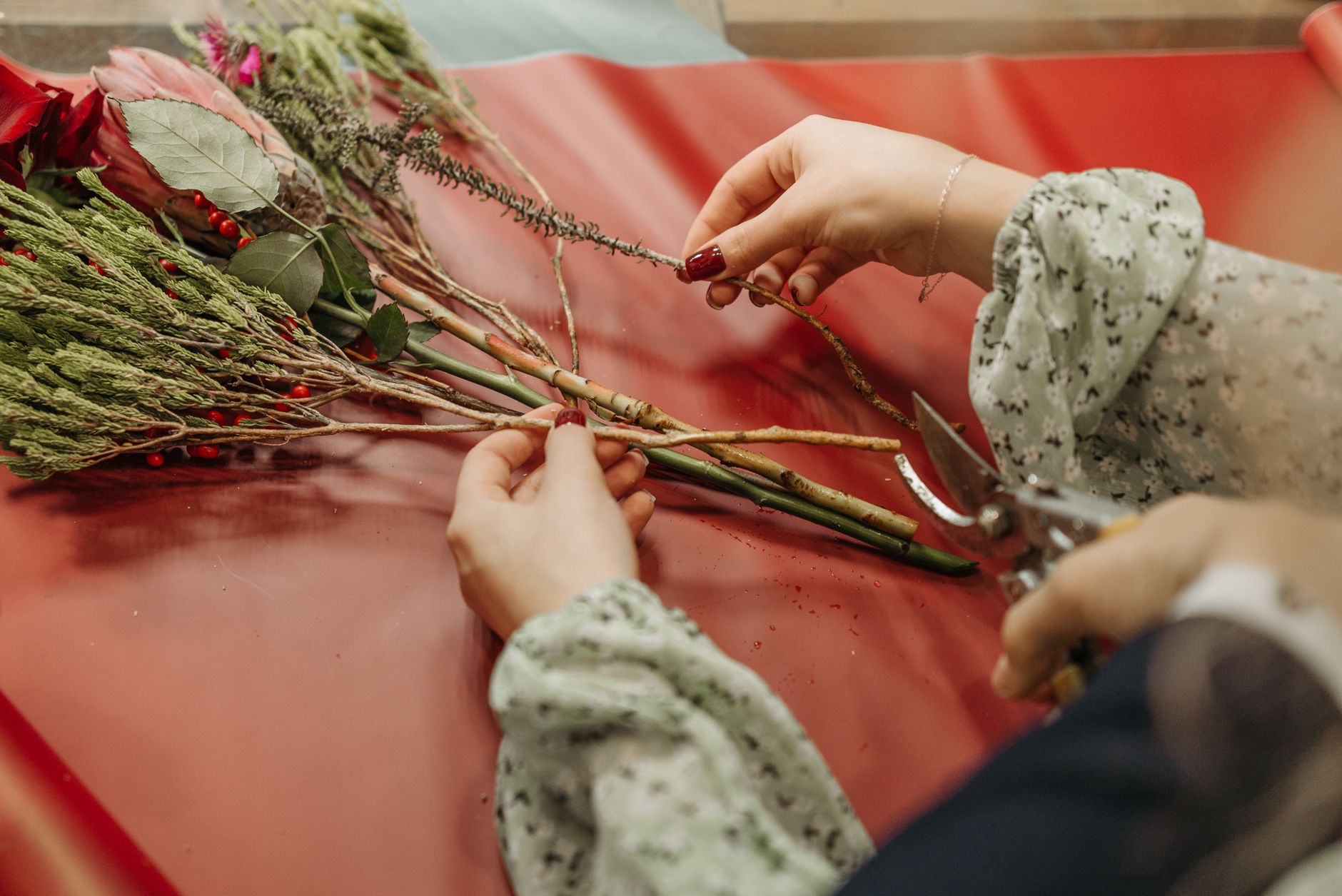
When you arrive, we brief you on the day's flowers: their names, origins, water needs, and which blooms are focal, filler, or greenery. We show you the conditioning station—sharp knives, pruners, buckets of room-temperature water treated to absorb quickly. You'll strip lower leaves and cut each stem at a 45-degree angle under running water to maximize uptake. This step matters: flowers that aren't conditioned wilt faster in Hanoi and Ho Chi Minh City's heat and humidity. We demonstrate on one stem, then you do five or six. Questions? We stop and show you again. No rush. Your bouquet's longevity starts here, not at the wrap station.

How Do You Actually Build the Spiral?
The spiral hand-tie is the core technique every bouquet class teaches. Here's what you'll do: hold one focal flower (rose, peony, or similar) in your left hand at a 45-degree angle; add the next stem slightly off-center, rotating your hand clockwise as you place it. Keep rotating and adding stems in a circular pattern, each one at the same angle. The result is a cone-shaped bouquet where stems cross invisibly inside, creating a natural, domed top. Most beginners hold stems too tight (the blooms bruise) or too loose (it collapses). We give you feedback in real time: feel the weight, let gravity help, trust the angle. After eight to twelve stems, you'll add filler and greenery to soften gaps. The entire build takes 20–30 minutes once you find your rhythm. Wrapping—taping the stems, adding paper or ribbon—takes another 10–15 minutes. If you struggle with balance or stem placement, we pause and re-demo; there's no "right pace" except yours.
What Flowers Are Available, and Do They Differ by Season?
We use imported roses, dahlias, lisianthus, and seasonal blooms (lotus in summer, chrysanthemums in autumn, ranunculus in spring) plus local greenery from Vietnamese markets. Availability shifts: during Tet (lunar new year), we focus on auspicious reds, golds, and pinks; at Christmas, deep reds and whites dominate. Summer heat means we stock more heat-tolerant varieties and skip delicate orchids. For any bouquet class, we confirm what's fresh and in stock when you book—there's no stock list we publish because flowers change weekly based on season, weather, and import schedules.
Ask for workshop dates on WhatsApp
| Design Type | Best For | Why It Works | Availability |
|---|---|---|---|
| Monochromatic rose spiral | First-timers, romantic gifts | Simple color palette, high visual impact | Year-round |
| Mixed seasonal (reds, pinks, whites) | Tet & festive events | Lucky colors, local cultural tradition | Lunar new year + holidays |
| Tropical (anthurium, protea, bird-of-paradise) | Bold, long-lasting gifts | Texture variety, heat-resistant | Summer & autumn |
| Pastel garden (ranunculus, lisianthus, spray roses) | Weddings, soft gifting | Soft tones, many layers | Spring & early summer |
How Do Bouquets Survive the Heat and Humidity?
Hanoi and Ho Chi Minh City summers push 35°C+ and humidity above 80%, shrinking a bouquet's vase life from 7 days to 2–3 if it's not conditioned properly. We teach you three heat-survival tricks during class:
- Cut stems every 2–3 days at a fresh 45-degree angle under running water. Bacteria and air pockets form quickly in warm climates, blocking water uptake.
- Change water daily and add flower food (we provide packets). Room-temperature water works better than ice-cold in tropical heat; cold can shock delicate stems.
- Mist petals lightly in early morning only—never at midday, never directly in sunlight. Evening misting risks fungal spots.
We also recommend placing bouquets away from AC vents and direct sun; a north-facing windowsill or shaded corner extends bloom life by days. If you're giving the bouquet as a gift to someone in a warmer room, wrap it loosely in paper and include a care card with these tips. Many students ask if the flowers "will survive shipping"; locally designed bouquets for same-day delivery in Hanoi and Ho Chi Minh City hold up best, but availability of same-day arrangements is confirmed on WhatsApp when you request it.
️ See how a class runs

What Do Beginners Struggle With Most?
Hand tension. Holding stems too tightly crushes the cells; too loosely and the spiral falls apart. Feedback: "Imagine holding a bird—firm enough it doesn't escape, gentle enough it breathes."
Stem angle confusion. A 45-degree angle isn't flat (0°) or upright (90°). We show you the angle with our own hands, then guide yours into place. Most people default to upright; it takes two or three flowers to retrain the hand.
Color balance. Beginners cluster all warm tones on one side. We ask: "If this bouquet were a clock, where would you place each color?" Visualizing space helps spread tones evenly.
Leaving too much foliage on. Lower leaves trap bacteria in water. We demo the "strip zone"—remove every leaf below the hand-hold point, nothing above. One student watched, nodded, then left half the leaves on; we stripped them together and explained the why (rot, stem softening, odor). Clarity matters.
Overthinking finish. Some people rewrap three times. We say: "It's a gift, not a museum piece. Slight asymmetry is charm." Permission to be done is often relief.
How Do We Adapt Classes for Kids, Couples, and Teams?
Kids & Families
For children (6+), stems are pre-cut to safe lengths, foliage already stripped. Kids work with shorter bouquets (fewer stems, simpler spirals) and lighter-weight flowers like spray roses and dahlias instead of heavy peonies. A parent or guide stands close, showing hand placement and angle. Sessions run shorter (30–40 minutes active time, not 60–90). Kids often surprise us with color sense; they place flowers intuitively rather than overthinking. Learn more about our kids workshops.
Couples & Private Sessions
Couples book private private & couple sessions to learn together, often as a date or engagement activity. We let each person build their own bouquet side-by-side, then teach them to handle feedback gracefully ("Your color balance is beautiful, want to swap one stem to make it more you?"). Private sessions mean custom flower choice, flexible timing, and one instructor per pair—ideal for learning without an audience.
Team Building & Groups
Team building workshops ask groups to collaborate: one person conditions, one spirals, one wraps. Rotating roles spreads skill and laughter. We've seen office teams, family reunions, and friend groups bond over a shared bouquet in under two hours. Larger groups work in pairs or small teams to avoid crowding at the conditioning station.
What Should You Check Before Booking?
- Confirm flower availability on WhatsApp before paying; we tell you exactly what's fresh that week.
- Ask about any allergies (pollen, scents, latex)—we can substitute or provide alternatives.
- Wear clothes you don't mind getting wet; water and flower food splash during conditioning.
- Bring a box or wrap if you're transporting the bouquet home in hot weather—paper and string help it breathe and stay cool.
- Clarify group size and timing; small groups (2–4) learn faster than large classes (12+).
- Understand what's included: flowers, vessels, wrapping, instruction, and the bouquet you take home—everything except transportation and a vase for display after class.
Book your bouquet class on WhatsApp
If you want to explore more than one class style, we also offer flower arranging workshops for broader design skills, and seasonal workshops (Tet wreaths, Christmas pieces, lotus arrangements) tied to Vietnam's calendar. Travelers and expats often start with our tourist-friendly flower workshops to get oriented, then return for deeper floral design courses.
FAQ
How long does a typical bouquet making class take?
Conditioning and learning the spiral takes 30–40 minutes; wrapping and finishing takes 15–20 minutes. Total is 60–90 minutes depending on group size and your pace. We don't rush; if you need more time on a technique, we pause and help.
Do I keep the bouquet I make?
Yes. Everyone leaves with their own finished bouquet. If you're giving it same-day in Hanoi or Ho Chi Minh City, we confirm arrangements on WhatsApp. The bouquet is yours to transport and display.
What if I've never done flower arranging before?
That's what the class is for. We teach conditioning, spiral technique, and color balance from the ground up. Beginners struggle most with hand tension and stem angle—we show you over and over until it clicks. No experience needed.
Can I choose the flowers I use in the class?
You choose from what's available that week. We show you options when you arrive or during booking. Imported roses, dahlias, and seasonal blooms rotate; availability is confirmed on WhatsApp.
How long do the flowers last after I take them home?
In Hanoi and Ho Chi Minh City's heat, expect 2–5 days if you follow aftercare (cut stems every 2–3 days, change water daily, add flower food). Cool, humid conditions extend life; direct sun and AC vents shorten it. We give you a care card with tips.
Is there a discount for group bookings?
Ask us for a quote on WhatsApp when you give us your group size and preferred date. Pricing depends on group size, flower choice, and season.
Can I book a class as a gift for someone?
Yes. Contact us on WhatsApp with the recipient's name and preferred date. We'll confirm availability and send you details to share or a gift description for wrapping.
Do you offer classes for team building or corporate events?
Yes. Team building workshops run for groups; we adapt the format so people work together, rotate roles, and leave with a group bouquet or individual ones. Ask us for details on WhatsApp.
Ask for dates
Tell us the city, the date and how many people. We reply on WhatsApp in English with workshop options and a quote.
FAQ
How long does a typical bouquet making class take?
Conditioning and learning the spiral takes 30–40 minutes; wrapping and finishing takes 15–20 minutes. Total is 60–90 minutes depending on group size and your pace. We don't rush; if you need more time on a technique, we pause and help.
Do I keep the bouquet I make?
Yes. Everyone leaves with their own finished bouquet. If you're giving it same-day in Hanoi or Ho Chi Minh City, we confirm arrangements on WhatsApp. The bouquet is yours to transport and display.
What if I've never done flower arranging before?
That's what the class is for. We teach conditioning, spiral technique, and color balance from the ground up. Beginners struggle most with hand tension and stem angle—we show you over and over until it clicks. No experience needed.
Can I choose the flowers I use in the class?
You choose from what's available that week. We show you options when you arrive or during booking. Imported roses, dahlias, and seasonal blooms rotate; availability is confirmed on WhatsApp.
How long do the flowers last after I take them home?
In Hanoi and Ho Chi Minh City's heat, expect 2–5 days if you follow aftercare (cut stems every 2–3 days, change water daily, add flower food). Cool, humid conditions extend life; direct sun and AC vents shorten it. We give you a care card with tips.
Is there a discount for group bookings?
Ask us for a quote on WhatsApp when you give us your group size and preferred date. Pricing depends on group size, flower choice, and season.
Can I book a class as a gift for someone?
Yes. Contact us on WhatsApp with the recipient's name and preferred date. We'll confirm availability and send you details to share or a gift description for wrapping.
Do you offer classes for team building or corporate events?
Yes. [Team building workshops](/team-building) run for groups; we adapt the format so people work together, rotate roles, and leave with a group bouquet or individual ones. Ask us for details on WhatsApp.
More like this
Bouquet workshop
Bridal Bouquet Workshop: What to Wear & How to Prepare
A bridal bouquet workshop demands clothes that won't stain easily and let your arms move freely. We'll show you exactly what to wear and how to prep for a hands-on session.
Bouquet workshop
Bridal Bouquet Workshop in Ho Chi Minh City
A bridal bouquet workshop teaches you to design and wrap your own wedding flowers using professional spiral hand-tie and color-balance techniques. We run hands-on sessions in Ho Chi Minh City and Hanoi where you take home a real, finished bouquet.
Bouquet workshop
Bridal Bouquet Workshop in Hanoi – Hand-Tie & Design Class
A bridal bouquet workshop teaches you to design and hand-tie a wedding-ready arrangement using real imported and local flowers. You leave with your finished bouquet, ready to carry or giftwrap for your big day.